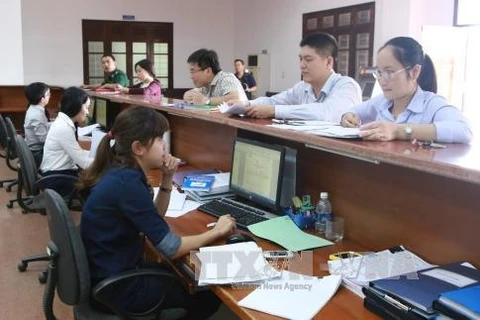
International accounting standards have changed a lot, but Vietnam's are yet to be updated. (Photo: VNA)
Hanoi (VNA) – Not a few transactions under the market economy in Vietnam have not been recognised due to a lack of some accounting standards.
The current system of accounting standards in Vietnam was issued more than a decade ago and lacked 17 standards compared to international practice. An official of the financial sector compared the situation to using a blood test of several years ago to assess the current health conditions.
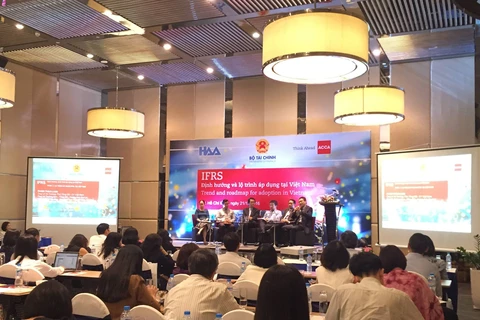
The problem was discussed at the workshop on international experience in and a roadmap on the adoption of International Financial Reporting Standards (IFRS) in Vietnam, held on February 22.
No basis to recognise transactions
According to deputy director of the Finance Ministry’s Department of Accounting and Auditing Regulations Trinh Duc Vinh, Vietnam issued 26 accounting standards (VAS) during 200-2005, which were selected based on international standards.
However, he admitted that the VAS lacks 17 standards compared to international practices, such as standards in agriculture, mineral exploitation, asset loss or appropriate value, which resulted in difficulties in business accounting.
As an example, many assets quickly become outdated due to changes in technology, but the related losses are not accounted for. This leads to overvalued assets.
Besides, Vietnam’s accounting standards and procedures lack specific guidance and requirements on explaining risks of firms, which can affect investors’ decision-making.
Such transactions as payments in shares, recognising and valuing financial tools could not be included in accounting due to the lack of relevant standards.
Vinh said the VAS was issued in the first years of the 21st century when the management level in Vietnam was low, with few transactions under the market economy conducted.
After 14 years, the international standards have undergone a lot of changes but the VAS has not been updated.
“VAS is like a blood test result of years ago but it is used to assess the current health conditions, so it cannot reflect the true condition,” he said.
The official noted the necessity to update or issue a new VAS in accordance with the IFRS.
“We cannot play in a separate playground, we have to join the common one,” Vinh said.
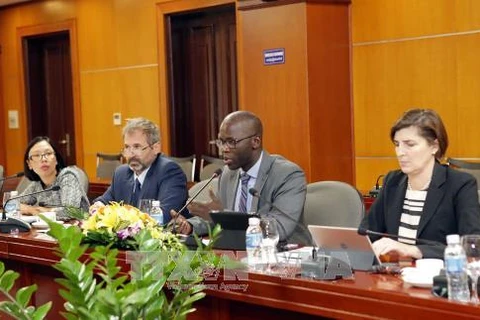
 Deputy Finance Minister Do Hoang Anh Tuan hopes to receive recommendations from international and domestic organisations on the accounting standards to be applied in Vietnam. (Photo: VNA)
IFRS will help promote capital mobilisation
On this issue, deputy chief of representative of the Japan International Development Agency (JICA) in Vietnam Kitamura Shu said 138 countries in the world have adopted the IFRS.
He cited the example of Malaysia, which has applied the IFRS to listed firms since 2012. The application has improved the comparative trust of financial information, thus helping draw more capital from investors from other countries to Malaysian enterprises.
Furthermore, Malaysian enterprises operating on global scale can integrate financial reports of their subsidiaries without the need to supplement or adjust reports of overseas subsidiaries, which improves business administration efficiency.
Deputy Finance Minister Do Hoang Anh Tuan was of the opinion that the application of international standards to financial reporting is necessary for sustainable and inclusive socio-economic development.
He said the Finance Ministry set up a steering board for the compilation of accounting standards and a board to develop a project on the roadmap and plan to apply the IFRS in Vietnam.
The ministry has coordinated with international organisations and the domestic business community to build the project, and the draft has been basically approved by the ministry, Tuan said. He added that the ministry is conducting procedures to put up the draft for feedback from related ministries, sectors, localities, organisations and agencies.
According to the deputy minister, the Government has required the Finance Ministry to complete the project to submit to the Prime Minister for approval in 2019.
He said the ministry hopes to receive recommendations from international and domestic organisations on the accounting standards to be applied in Vietnam.-VNA