Vietnam’s exports to Japan increase rapidly in Q1

The elimination of many tariff lines for goods under the Comprehensive and Progressive Agreement for Trans-Pacific Partnership (CPTPP) has helped Vietnam’s exports to Japan increase sharply in the first quarter of 2019, according to the General Department of Vietnam Customs.
Vietnam’s exports to Japan increase rapidly in Q1 ảnh 1Vietnam’s exports to Japan increased sharply in the first quarter of 2019 thanks to the enforcement of the CPTPP (Photo: VNA)

Hanoi (VNA) – The elimination of manytariff lines for goods under the Comprehensive and Progressive Agreement forTrans-Pacific Partnership (CPTPP) has helped Vietnam’s exports to Japanincrease sharply in the first quarter of 2019, according to theGeneral Department of Vietnam Customs.

Vietnam's export value to Japan in the firstquarter surged 6.7 percent year on year to 4.6 billion USD, helping the countryto become one of three markets gaining an export value in billions of USdollars to Japan, after the US and China.

In March 2019 alone, the export value to Japanreached 1.7 billion USD, a sharp increase of 62.3 percent month on month and asurge of 2.7 percent year on year.

The strong growth in Vietnam’s export value toJapan was attributed to the CPTPP. According to this agreement, Japan for thefirst time has pledged to completely eliminate tariffs for the majority of Vietnam'sagricultural and seafood products exported to this market.

That meant Japan immediately abolished 86 percentof tariff lines, equivalent to 93.6 percent of Vietnam's export value to Japan,and then this figure will increase to 90 percent of tariff lines within fiveyears.

On the other hand, the Vietnam-Japan andASEAN-Japan free trade agreements have created advantages in tariffs for someof Vietnam's seafood products exported to Japan.

About 62.5 percent of Vietnam’s total goodsitems exported to Japan in the first quarter gained strong growth compared tothe same period last year, according to the general department.

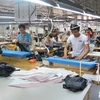
The major export products to Japan includedtextiles (export value of about 900 million USD), means of transport and spareparts (630 million USD), machinery and equipment (450 million USD) and seafoodproducts (306 million USD).

Especially, Vietnam’s fertiliser exports to thismarket had a sudden growth in the first quarter of 2019 to 8,126 tonnes,earning 3.7 million USD. The exports rose up by five times in volume and about11 times in value year on year.

In addition, Vietnam saw strong growth inexports of some goods to Japan in the first quarter, including chemicalproducts (up 70 percent), animal feed and raw materials (up 56.8 percent), oreand minerals (up 52 percent), all kinds of steel (up 49 percent) and plasticmaterials (up 43 percent).

Meanwhile, Japan sharply reduced imports ofcassava and cassava products from Vietnam, with a reduction of 99.6 percent involume and 98.5 percent in value over the same period, despite the averageexport price of cassava surging by 3.3 times to 886 USD per tonne.

In 2018, Vietnam's goods export value to Japanreached more than 18.8 billion USD. Textiles and garments accounted for thelargest proportion with over 20 percent of the total export value. Meanwhile,seafood, furniture and footwear respectively hold 7.4 percent, 6.1 percent and4.5 percent.-VNA
VNA
See more

A refilling station of Petrolimex (Photo: VNA)

Import tariffs on certain fuel products reduced to 0%

Rising tensions in the Middle East, particularly the conflict involving the US, Israel and Iran, have significantly affected the global energy market, especially shipping activity through the Strait of Hormuz – a strategic route for transporting crude oil from the region.

Fishermen raise the national flag before heading out to the sea to affirm Vietnam’s sovereignty over its seas and islands. (Photo: VNA)

Dong Thap promotes IUU awareness from start of fishing season

Gia Thuan commune, located in the eastern part of the province, is a key fishing locality with 563 fishing vessels, including 423 offshore boats and 140 nearshore vessels, producing an average annual catch of over 42,970 tonnes of seafood.

Industrial production surges in the first two months of 2026. (Photo: VNA)

Industrial production posts strong growth in first two months

According to the National Statistics Office (NSO) under the Ministry of Finance, the index of industrial production (IIP) in February was estimated to decrease 18.4% from the previous month but increase 1% year on year. Overall, in the January–February period, the IIP rose 10.4% compared with the same period last year.

A delegation from the Nghe An provincial People’s Committee inspects production and business activities at the VSIP Nghe An Industrial, Urban and Service Park. (Photo:nhandan.vn)

Nghe An steps up reforms to attract FDI

In 2025, the provincial People’s Committee licensed 25 new FDI projects and approved capital adjustments for 20 others, bringing the total newly registered and additional investment to more than 1 billion USD. Many large-scale projects in the Southeast Nghe An Economic Zone have already become operational, contributing to export growth, state budget revenues and job creation.

Nearly 35,500 enterprises are newly registered nationwide, with total registered capital reaching nearly 313.7 trillion VND and more than 167,500 registered workers. (Photo: VNA)

Nearly 35,500 new businesses set up in first two months

The enterprises registered combined capital of about 313.7 trillion VND and more than 167,500 employees. Compared with the same period last year, the number of new businesses surged by 70.7%, while registered capital rose by 36.1% and registered labour increased by 19.1%.

The yarn factory of Unitex Textile and Dyeing Company Limited applies new technology to optimise operations using an automated model. (Photo: VNA)

Resolution 68: International lessons for private sector development

A common feature in many successful economies is a fundamental shift in the perception of private enterprises. In countries such as Singapore, Germany, Republic of Korea (RoK) and China, private firms are viewed not mainly as entities requiring strict control but as development partners and key forces generating growth, jobs and innovation.