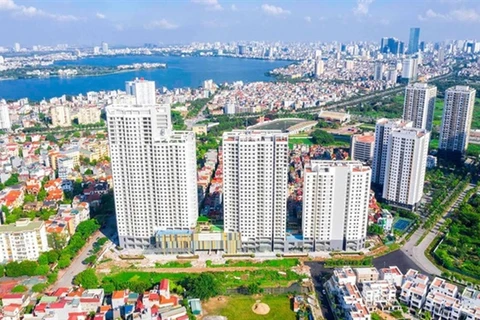
Illustrative image (Source: VNA)
 Hanoi (VNA) - The real estate market has been significantly affected by the COVID-19 pandemic, but not impacted by the Evergrande crisis.
Before the financial crisis of Evergrande - China's giant real estate group, many opinions said that it would affect the Vietnamese real estate market. However, many experts do not think so.
Property market not affected negatively
In an interview granted to the Vietnam News Agency reporters on September 29, Nguyen Van Dinh, Deputy General Secretary of the Vietnam National Real Estate Association, said that Vietnam's real estate market has so far remained stable and been not affected negatively by external factors such as the Evergrande financial crisis.
“If real estate giant Evergrande invests and has projects in Vietnam, or calls on investors in our country to join its project, the market will certainly be involved and affected. However, through my review, I found that the capital flows of this group directly investing in projects in Vietnam through official channels seem to be absent, if any, very little,” Dinh said.
He affirmed that most of Vietnam's real estate businesses affected by the pandemic have a small scale with weak financial resources.
As a result, bonds of large real estate enterprises on the stock market seem to witness no decreases. If any, the influence is not much, Dinh shared.
 Illustrative image (Source: VNA)
 Regarding the hot growth of Vietnam's real estate market for many years leading to an imbalance of supply and demand while most real estate enterprises have small financial strength and have to borrow loans, Dinh said that from 2016-2017, banks carefully calculated policies to minimise risks, and limit credits going to real estate to ensure the monetary security system.
He also noted that currently the Law on Real Estate Business has strong sanctions in handling cases in which investors raise capital when they are not yet eligible to sell houses built in future.
Real estate debts still under control
Dr. Nguyen Tri Hieu, a banking and finance expert, said that Evergrande's risk of bankruptcy is a great lesson for real estate developers in Vietnam in issuing bonds.
According to Hieu, similar to those in China, Vietnamese real estate businesses can also raise capital from people by selling real estate formed in future and customers will pay in accordance with the construction progress. However, if the real estate business goes bankrupt, the impact on the economy will be not small.
Therefore, Hieu proposed the Ministry of Finance and the State Securities Commission strengthen inspection and examination measures for all bonds issued by property developers; and promptly prevent weak real estate enterprises from issuing bonds.
“If Vietnam has several businesses falling into a situation like Evergrande, it could create a very dangerous domino effect on the whole market,” he noted.
Discussing more about the potential risks of bonds, especially those issued privately without collateral or being guaranteed by shares of real estate enterprises, Nguyen Quang Thuan, Chairman of FiinGroup said that the corporate bond market in Vietnam is still quite new and the State Bank of Vietnam has also held back in the past time. The leading large enterprises in the industry will repay their debts in 2024 and 2025, so they cannot be at risk like Chinese real estate and Evergrander.
In addition, according to some experts, currently the profit rate of Vietnamese real estate enterprises is around 50-70 percent, better than China's figure of 30 percent at the highest.
A representative of Nhat Viet Securities Company also said that the total debt out of total assets of real estate businesses is currently at 0.6, less than 1 and under control and also equal to the 5-year average in the 2016-2020 period. Therefore, the debt situation of the real estate industry is still under control./.