Vietnam’s salt industry must adapt: official

The local salt industry must understand the needs of the market, develop standards and guidelines for farmers, and reorganise production, said Le Duc Thinh, Director of the Department of Cooperatives and Rural Development under the Ministry of Agriculture and Rural Development (MARD).
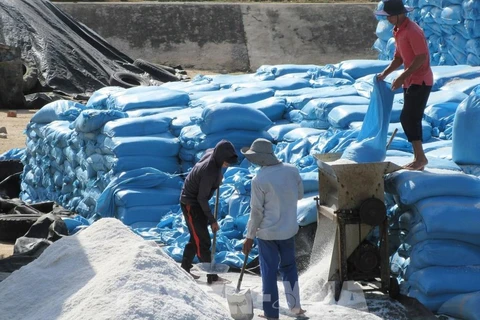
Vietnam’s salt industry must adapt: official ảnh 1Salt farmers at a production area in the Mekong Delta province of Bac Lieu (Photo: VNA)
Hanoi (VNS/VNA) - The local salt industry must understand the needsof the market, develop standards and guidelines for farmers,and reorganise production, said Le Duc Thinh, Directorof the Department of Cooperatives and Rural Development under the Ministry ofAgriculture and Rural Development (MARD).

Vietnam has advantages to help develop its salt production andprocessing industry, including its 3,200km coastline and high heat, Thinhsaid, adding that the country's salt production areas spreadfrom north to south, creating jobs for about 21,000 households.

However, the development of the domestic salt industry has encounteredmany difficulties, including small-scale and scattered production,under-developed infrastructure, modest volume and ineffective applicationof scientific advances, he noted. 

The country is home to 72 salt production and processing units,including production and business households, cooperativesand enterprises. However, most are small scalewith insufficient capital and production capacity.

Bui Son Long, Chairman of the Sea Salt Technology JSC in Hanoi, said at arecent webinar that the salt industry needed to make fundamentalchanges towards producing and processing according to the needsof the market to better meet increasing domestic and exportdemand.

Closer co-operation amonglocalities with salt production areas should be also included, Long said. 

Tran Thanh Nam, Deputy Minister of Agriculture and Rural Development,agreed. He emphasised the importance of finding outthe needs of the market and the tastes of consumers.

"In the past, we had invested in salt industry infrastructurewithout knowing what consumers needed. This is the first lessonwe should learn," Nam said.

"We should provide the market with the saltproducts it needs,” he added. 

It is also necessary to focus on building geographical indications andbrands in the salt industry to raise the income of both salt farmers andproducers.

According to a report by MARD, Vietnam’s salt production area in2021 reached 11,393ha, lower than the 11,926ha,12,494ha and 13,074ha seen in 2020, 2019 and 2018, respectively.

The decreasing area of salt production was attributed to low incomefrom salt production so salt farmers gradually converted inefficientproduction areas to aquaculture or switched to other occupations, resulting inseveral salt production areas being abandoned. 

Last year, the country's salt output hit nearly 915,000 tonnes, farlower than the record of more than 1.33 million tonnes seen in 2020. 

Currently, the price of unprocessed salt ranges from 600- 2,500 VNDper kg while industrially produced salt is sold between 600 and 1,500 VND perkg. 

Vietnam will study and pilot combining salt production and tourism topromote the sustainable development of the industry, according to theGovernment’s recently-approved salt industry development project for 2021-30.

The country will combine salt production with tourism at several villages,including Thuy Hai (Thai Binh province), Bach Long (Nam Dinh), Ho Do, Ky Ha-KyAnh (Ha Tinh), Sa Huynh (Quang Ngai), Hon Khoi (Khanh Hoa) and Can Gio (HCMCity).

The project aims to develop the salt industry towards efficiency andsustainability, based on the advantages of localities with a history ofsalt production to increase productivity, quality and diversify salt products.

Vietnam aims to have 14,500ha of salt farming with an output of 1.5million tonnes per year by 2025. In the next five years, the focus will be onproducing salt to meet domestic demand with healthy natural minerals andmicronutrients with low sodium content.

Total salt farming is targeted to drop to 14,244ha by 2030 but annualoutput is hoped to increase by two million tonnes.

Salt production will be developed on an industrial scale in Khanh Hoa, Ninh Thuanand Binh Thuan provinces to meet the demand of the chemical industry and forraw materials to produce refined salt.

Smaller-scale production will be developed in Thai Binh, Nam Dinh, Thanh Hoa,Nghe An, Ha Tinh, Quang Ngai, Phu Yen, Binh Dinh, Ba Ria-Vung Tau, Ben Tre, TraVinh, Soc Trang, Bac Lieu, Ca Mau provinces and HCM City.

Support will be provided to develop supply chains for the salt industry.

Increasing the appliance of science and technology in salt production andprocessing to minimise the impact of climate change and enhancing promotionsto export more salt are also part of the plan./.
VNA
See more

The proportion of Vietnamese goods remains high at supermarkets. (Photo: VNA)

Vietnamese brands win over domestic consumers to go global

Amid increasingly fierce global competition, the goal is no longer simply to increase domestic consumption of Vietnamese goods, but to develop strong Vietnamese brands capable of winning consumers through quality, innovation and added value, thereby creating a stepping stone for expansion into international markets.

Illustrative image (Photo: VNA)

Automated VAT refunds to be rolled out from December

As of August 11, VAT refunds rose 32% from a year earlier, reaching 64.4% of the full-year estimate. Tax authorities issued 11,627 refund decisions totaling 111.726 trillion VND (4.26 billion USD), up 9% by volume. The payouts improved cash flow for companies and supported production, trade and exports.

ST25 rice is the centrepiece of the Vietnam Goods Week at Selgros. (Photo: VNA)

ST25 rice officially enters Selgros wholesale supermarket chain in Germany

The placement of ST25 rice on Selgros shelves not only creates an additional opportunity for German consumers to access Vietnamese rice products, but also contributes to efforts to increase the added value of Vietnamese agricultural products by shifting the focus from volume to quality, branding and value.

Trains on the elevated section of the Cau Giay – Nhon route in Hanoi provide convenient transportation for local residents. (Photo: VNA)

Multimodal connectivity to drive Vietnam’s transport infrastructure

Under the proposed approach, roads would serve mainly as connectors and for first- and last-mile transport; railways would handle large volumes over long distances; maritime transport would serve import and export cargo; inland waterways would carry large volumes at low cost; and air transport would focus on fast delivery and high-value goods.

Amata Industrial Park in Dong Nai city (Photo: VNA)

Green shift powers investment in southeast Vietnam

The Amata Industrial Park in Dong Nai City, established 32 years ago and covering more than 500ha, is home to over 160 domestic and foreign businesses. Selected in 2020 as one of three national pilot sites for conversion into an eco-industrial park, Amata has raised its compliance with the international eco-industrial park framework from 41% to 86% in 2024, and is working towards becoming Dong Nai's first certified eco-industrial park.

At a port in Ho Chi Minh City (Photo: VNA)

Multi-channel capital mobilisation needed to achieve double-digit growth

The Ministry of Finance estimates development investment for 2026-2030 at a minimum of 38.5 quadrillion VND (1.48 trillion USD), or about 40% of GDP. The state budget is expected to provide only about 20%, or more than 7.7 quadrillion VND, leaving over 80%, or more than 30 quadrillion VND, to be raised from the broader economy. That makes expanding capital mobilisation channels beyond bank credit essential.

An aerial view of the Nhieu Loc – Thi Nghe area in Ho Chi Minh City. The southern metropolis is home to the Vietnam International Financial Centre. (Photo: VNA)

Vietnam International Financial Centre launches membership registration system

Integrated into the official Vietnam International Financial Centre portal at vifc.gov.vn, the online system for registering and recognising members provides a unified online service channel through which investors, organisations and businesses can complete procedures related to membership, from new registration and recognition to information updates and termination of membership.

At a tax office in Hung Yen province (Photo: VNA)

Finance ministry moves to cut business costs, spur growth

Tax policy is among the solutions with the most direct impact on companies. Rather than prioritising near-term revenue collection, fiscal policy is being run to help them preserve cash flow, expand production and build more sustainable revenue sources.

In the Kim Long Motor Hue factory (Photo: VNA)

Hue courts capital to turn industrial zones into growth engine

The economic and industrial zones in Hue city host more than 200 active investment projects worth over 152 trillion VND (5.84 billion USD), with 139 already operational. Since the start of 2026, they have generated about 32 trillion VND, contributed 4.2 trillion VND to the state budget and brought in 730 million USD in exports, while employing more than 46,000 workers.