Vietnam’s seafood exports to ASEAN expected to reach 1 billion USD

Vietnam’s seafood exports to ASEAN expected to reach 1 billion USD soon

With its continuous growth over the past 10 years, ASEAN has become an important market for Vietnamese seafood, and the prospect of 1 billion USD worth of yearly seafood export revenue is reachable.
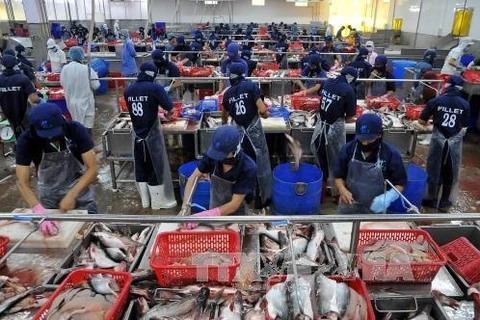
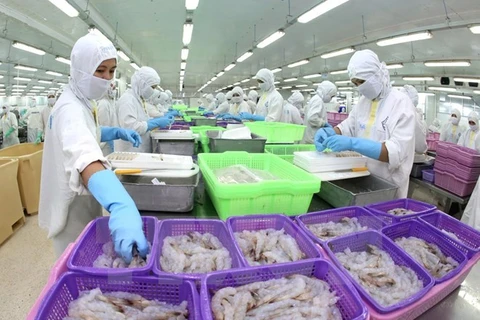
Vietnam’s seafood exports to ASEAN expected to reach 1 billion USD soon ảnh 1Illustrative image (Source: VNA)

Hanoi (VNA) – With its continuous growth over the past 10 years, ASEANhas become an important market for Vietnamese seafood, and the prospect of 1billion USD worth of yearly seafood export revenue is reachable.

Accordingto the Vietnam Association of Seafood Exporters and Producers (VASEP), Vietnam’sseafood export turnover to the Association of Southeast Asian Nations (ASEAN)hit 612 million USD in 2017, up from only 66 million USD in 1998.  

Althoughthe figure remained modest compared with exports to major markets like the US, the EU, Japanand China,ASEAN ranked fifth among the most important markets of Vietnamese seafood.

The10-member group maintained this position in the first six months of this year,with most exports to ASEAN posting positive growth. Of note, ASEAN surpassedthe Republic of Korea (RoK) to become Vietnam’s biggest fried fish paste andsurimi importer with a value of 43 million USD.

AmongASEAN countries, Thailand has been the largest partner of Vietnam’s fishery sector,as reflected through the export revenue of 248 million USD in 2017 and morethan 185 million USD in the first eight months of this year.

Thailandis the only ASEAN country among the top 10 single markets of Vietnameseseafood, together with countries like the US,Japan, China, the RoK, the Netherlandsand the UK.

AfterThailand, the Philippines and Singaporeare Vietnam’ssecond and third largest seafood importers in the group.

Vietnamesefishery products have been shipped to all other ASEAN countries, with top itemsbeing saltwater fish, tra fish, cuttlefish and octopus.

VASEPsaid Vietnam has potential to step up its seafood exports to the group with acombined population of 632 million whose seafood demand is forecast to risefrom 24.5 million tonnes in 2015 to 36.9 million tonnes in 2030 and 41.7million tonnes in 2050.

Seafoodtrading in ASEAN stands at 20 billion USD each year and is expected to expandby 3.7 percent annually in the years to come.

ASEAN groups Brunei, Cambodia, Indonesia, Laos,Malaysia, Myanmar, the Philippines, Singapore, Thailand and Vietnam.-VNA
VNA
See more

Vietnamese Ambassador to Mexico Nguyen Van Hai (fourth from right) and others attend the seventh Veracruz International Energy Congress. (Photo: VNA)

Vietnam, Mexico strengthen energy, port cooperation

A number of Mexican state Veracruz businesses expressed their wish to organise a delegation to Vietnam to gain first-hand insights into the market, seek partners and explore investment and business opportunities, initially focusing on trade, energy, agriculture and tourism.

At the working session (Photo: VNA)

Can Tho, Guangxi seek collaboration in logistics, supply chains

Chinese investors now back 35 projects in Can Tho with registered capital of nearly 1.2 billion USD. In the first seven months of 2026, Can Tho’s exports to China hit 77.5 million USD, while imports stood at 64.7 million USD. Key exports included rice, seafood, farm produce, processed agricultural products and apparel while main imports comprised agricultural chemicals, veterinary medicines, fertilisers, chemicals, fabrics and other materials and inputs.

Vietnamese Minister of Finance Ngo Van Tuan grants an interview to the Vietnam News Agency (VNA). (Photo: VNA)

Vietnam, Russia move to boost financial cooperation

On bilateral economic, trade and investment ties, Tuan said two-way trade hit 3.24 billion USD in the first seven months of 2026, up 12% from a year earlier. Vietnam’s exports to Russia totaled 1.33 billion USD, while imports amounted to 1.91 billion USD.

Cai Mep - Thi Vai Port complex in Ho Chi Minh City (Photo: VNA)

Ho Chi Minh City seeks to make seaports new growth driver

To maximise its seaport advantages, Ho Chi Minh City is developing smart and green ports while promoting clean energy, lower emissions and sustainable supply chains. It aims to establish an integrated ecosystem linking seaports with industrial parks, logistics centres, free trade zones, multimodal transport networks and an international financial centre.

Farmers visit the off-season durian orchard of Cao Chi Dai in Vinh Hanh commune, An Giang province (Photo: VNA)

Vietnam promotes finance for green agriculture

Over the past five years, Vietnam has developed and gradually implemented a green finance system to support low-emission and environmentally friendly production, including agriculture. Based on the State Bank of Vietnam's Directive No. 03/CT-NHNN dated March 24, 2015, banks including BIDV, VCB, HDBank and Agribank have introduced green credit packages for waste treatment, high-tech agriculture, digital transformation, regional linkages and emission reduction across production chains.

An overview of the meeting between representatives from Polish businesses and the Agency for Domestic Market Surveillance and Development. (Photo: Agency for Domestic Market Surveillance and Development)

Polish businesses seek suppliers, partners in Vietnam

MAJAMI, a confectionery manufacturer and trader under Sweet House, is seeking distributors for Polish confectionery products in the Vietnamese market. Meanwhile, GABONA, a distributor and wholesaler of professional cosmetics, hair care and make-up products and beauty accessories, is looking for Vietnamese manufacturers of vegan and natural cosmetics.

Kendra Rinas, Chief of Mission for IOM Vietnam speaks at the event. (Photo: VNA)

Vietnam advances in building, using migrant labour data system: workshop

Data presented in the report reflects effective migration governance in recent years. The average recruitment cost paid by migrant workers dropped by 23.8%, from 164.9 million VND (6,400 USD) in 2021 to 125.7 million VND in 2025. Conversely, average first-month earnings abroad rose by 25.4%, increasing from 22.4 million VND to 28.1 million VND.