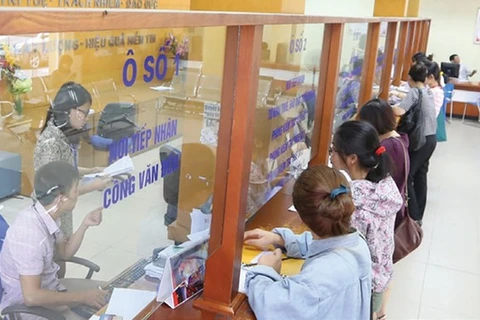
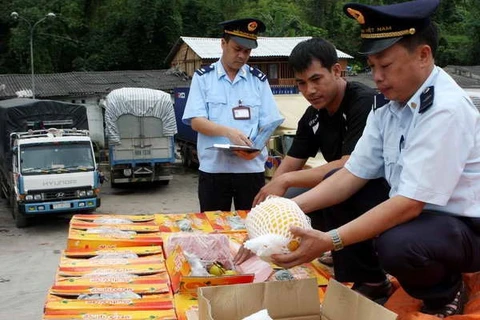
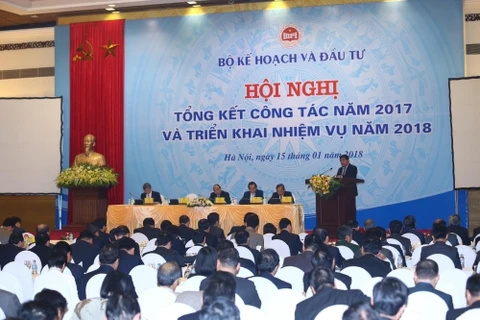
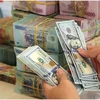
Despite concerns from economic experts about the undetermined scale and scope of Vietnam’s undocumented market transactions, authorities are adamant that the illicit economy is under control and will soon be regulated heavily (Photo: dantri.com.vn)
 Hanoi (VNS/VNA) - Despite concerns from economic experts about the undetermined scale and scope of Vietnam’s undocumented market transactions, authorities are adamant that the illicit economy is under control and will soon be regulated heavily.
In its latest move, the Ministry of Planning and Investment (MPI) is scheduled to finalise and submit to the Prime Minister’s Office a scheme on underground economic sectors on January 30. Under the direction of Deputy Prime Minister Vuong Dinh Hue, the report details the sectors’ structure and statistics, based on the General Statistics Office’s (GSO) findings.
Vo Tri Thanh, former deputy director of the Central Institute for Economic Management (CIEM), said that since 1990, the GSO estimated the size of the underground economy to be more than 10 percent of GDP.
About 10 years ago, reports of evaluations conducted by other agencies and organisations measured the amount of cash outside official circulation. The results showed that the value of this area was about 30 to 35 percent of GDP.
However, economic experts raise questions on the authenticity of the data.
Nguyen Duc Thanh, Director of the Institute for Economic and Policy Research (VEPR), said that a re-calculation of the informal economy was necessary for the Government to grasp specific data and set out a suitable development strategy.
However, he argued that the underground economy should not be included in GDP to increase the size of the economy. If the informal economy was calculated, the total GDP of Vietnam would increase. When GDP increases, it changes many numbers, such as budget overspending, while the ratio of public debt to GDP naturally decreases.
Luu Bich Ho, former Director of the Development Strategy Institute under the MPI, said that statistics of the unregulated sector or underground economy had been around for a long time. The problem was their accuracy and purpose.
Ho said that if fully observed, there were reliable data that could sum up underground economic activities into the overall GDP, increasing the latter’s scale. Therefore, the public-debt ratio could fall from 64 percent to 61 or 62 percent.
The economic expert added that additional statistics, as required by Deputy PM Hue, were needed. But policymakers needed long-term restructured measures for a more accurate national growth model.
‘Indeed, we can gain about five to 30 percent more of the State budget’s tax from these economic transactions. The most important thing now is how the Government can statistically manage such underlying profit,” Ho said at a GSO meeting.
Nguyen Bich Lam, GSO Director General, said it was highly unlikely that the non-observed economy could be as large as 30 percent of Vietnam GDP, rejecting an earlier report by Fulbright University Vietnam, whom he believed to have taken into account household economic activities as well.
Lam said that the underground economy, or black economy, were economic activities not measured by conventional methods and reflected in official data. This whole could be divided into several main sectors of illegal economy - unreported, unrecorded and informal.
According to the GSO, these were purposely hidden activities to avoid tax or evade State management regulation - drug production and trading, prostitution, casinos and unreported data and statistical errors or inaccurate information provided by businesses and agencies.
‘There are difficult elements for the GSO in collecting information for calculations. Particularly underground and illicit economic activities cannot be gleaned in a formal way, and thus cannot be taken into the same categories as formal ones,’ he added.
This meant they were difficult to quantify, and Lam demanded that calculation methodologies be reviewed.
When data from the informal economy was officially accounted for in the country’s economic performance, the GDP scale would be adjusted, which would be followed by the tax rate, public-debt ceiling and government-spending adjustments, Lam said, adding that these changes would not affect the growth rate.
According to the Government Office’s statistics, should the unofficial economy be incorporated, the country’s GDP would instead have so large a multiplier that public sector debt would be significantly greater to finance development needs.
Ho named several factors that could influence Vietnam’s underground economic growth. Loopholes in national laws were the main reason.
For example, regulations stipulate that when the number of staff exceeds 10, business establishments and organizations must register as enterprises and pay the corresponding (i.e. higher) taxes. However, many businesses, though exceeding this number, have been hesitant to become anything larger than extra-small enterprises, thus keeping overall business growth rate stagnant.
Another reason, according to Ho, is that businesses in local, remote wards and communes are protected by local governments, leading to tax evasion by these households - and eventually state budget revenue loss.
Dau Anh Tuan, head of the legal department of the Vietnam Chamber of Commerce and Industry (VCCI), said that according to a study by the International Finance Corporation (IFC) in 2003, Vietnam’s excessive control and concentration had promoted informal activities in the economy.
Tuan said the underground economy would greatly restrict the opportunities and scale of other businesses, making them less competitive at the national level and less able to integrate into international trade.
Economic expert Le Dang Doanh said that all countries had an informal economy, but the rates were different. The best way to manage underground business was to use public e-government.
“The best solution is to create favorable conditions for the Government, but also to be transparent for businesses with good brand names,” Doanh said.-VNA
VNA