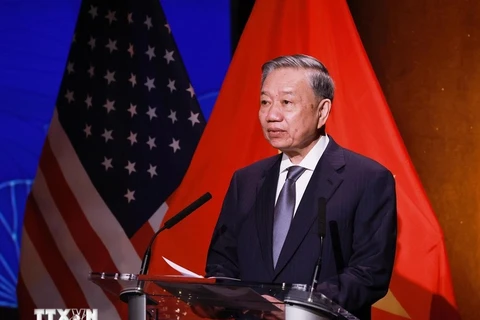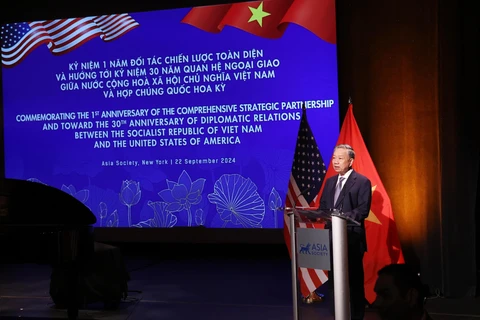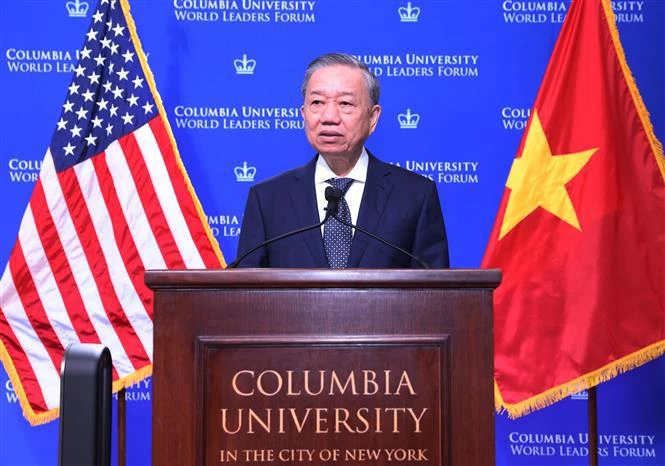
New York (VNA) – General Secretary of the Communist Party of Vietnam Central Committee and State President To Lam on September 23 morning (local time) visited and delivered a policy speech at Columbia University in New York as part of his trip to the US to attend the 79th session of the UN General Assembly (UNGA 79).
In his speech, the leader mentioned several issues on the path towards the era of Vietnam's ascendance, the Vietnam-US relationship, and the vision for building a better future for all humanity amidst significant changes.
Lam said nearly eight decades since its founding and nearly four decades of renewal, Vietnam has achieved monumental success, a testament to the right path chosen under the leadership of the CPV and the efforts and determination of its people. From a war-ravaged country, Vietnam has not only regained its independence but also emerged as a dynamically developing economy, ranking among the top 40 and top 20 economies globally.
Once isolated, Vietnam now boasts diplomatic relations with 194 countries, strategic and comprehensive partnerships with 30 nations, including all major powers and the five permanent members of the United Nations Security Council. It is an active member of ASEAN and more than 70 international and regional organisations, with trade ties with 224 markets across all continents.
He stressed that Vietnam's ambitious goals cannot be achieved without solidarity, valuable support, and effective cooperation from the global community. The country is committed to pushing forward its comprehensive reform, openness, and global integration, aiming to remain a stable, reliable, and attractive destination for foreign investors, businesses, and tourists.
Amid the rapidly changing global landscape, Lam affirmed that under the CPV's leadership, Vietnam will continue to pursue its consistent foreign policy of independence, self-reliance, multilateralism and diversification of external ties. The country aims to be a friend, a reliable partner, and an active and responsible member of the international community.
Vietnam will steadfastly uphold its "four no's" defence policy, strongly support the settlement of disputes and disagreements through peaceful means based on the United Nations Charter and international law. The country opposes unilateral actions, political hegemony, and the use or threat of force in international relations, he noted.

According to him, Vietnam has been recognised by the UN as a leading nation in achieving the Sustainable Development Goals (SDGs). Despite numerous challenges, the country remains committed to reaching net-zero emissions by 2050. Over the past decade, Vietnamese peacekeepers in UN missions have left positive impressions in several African countries, contributing to international peace and security, and supporting local communities in their daily lives.
Vietnam is prepared to make more proactive and constructive contributions to global politics, the world economy, and human civilisation. The country aims to work alongside friends and partners to tackle urgent global challenges such as climate change, food security, health security, and water security. Additionally, Vietnam is committed to promoting the establishment of a fair and equitable international order, grounded in the fundamental principles of the UN Charter and international law, he added.
Referring to the Vietnam – US relations, the leader noted that President Ho Chi Minh sent eight letters and telegrams to President Harry Truman, affirming Vietnam's desire for "full cooperation" with the US. However, due to historical circumstances, it took 50 years for the two countries to normalise their relations.
In nearly 30 years, Vietnam and the US have undergone a remarkable transformation, from former foes to comprehensive partners and now comprehensive strategic partners. Since the normalisation of the relations, many Vietnamese leaders have visited the US, notably the historic visit by late Party General Secretary Nguyen Phu Trong in July 2015, and all US Presidents have visited the Southeast Asian nation.
According to Lam, cooperation between Vietnam and the US across areas, from politics - diplomacy to economy - trade, defence - security, war legacy remediation, education - training, and people-to-people exchange, as well as in addressing regional and global issues such as climate change and terrorism, and in UN peacekeeping, has made significant and substantive progress.
Notably, people-to-people exchange and educational cooperation have become increasingly vibrant, he said, adding that around 30,000 Vietnamese students are studying in the US, including the Columbia University.
Lam affirmed that the most important factor enabling the bilateral relations to reach its current fruitful stage is the tradition of compassion and forgiveness of the Vietnamese people, and the sound leadership of the Communist Party of Vietnam.
The support of many US friends and partners, such as President Bill Clinton and his successors, senators John McCain, John Kerry, and Patrick Leahy, and others, and the strong bipartisan support in the US for the bilateral relations, have also been crucial, helping the bilateral Comprehensive Strategic Partnership grow more stably, sustainably, and practically in the time ahead.
Reflecting on the journey of the Vietnamese people and the success story of the Vietnam-US relations, Lam affirmed that in order to build a better common future for all, it is necessary to emphasise and uphold the spirit of reconciliation, and mutual respect and understanding, with the respect for each other's independence, sovereignty, territorial integrity, and political systems the most important.
The leader highlighted Vietnam’s proactiveness in healing war wounds, noting cooperation in addressing war aftermath served as the foundation for the two countries to reconcile, move toward normalisation, build trust, and deepen their relations.
These will continue to be key cooperation areas in the coming years as war consequences remain severe, especially for Vietnam, he said.
To promote the bilateral relationship, the leader held that the sides need to step up research on each other's history, culture, people, political systems, and socio-economic conditions.
“In the era of science and technology, we can take advantage of new methods, such as digital platforms and tools, to foster broader connections and deeper understanding among nations,” he continued.
Lam also stressed the need to promote the culture of dialogue, taking the Vietnam-US relations as an example. Although the two countries have made significant progress in their relationship, there are still certain differences in perspectives on human rights issues in the fields of economy, politics, and social and religious affairs. However, they have chosen dialogue instead of confrontation, in an open, frank and constructive spirit.
Dialogue should become a common practice, and a useful and important tool for human civilisation, Lam emphasised.
The leader also stressed the highest sense of responsibility towards the international community, saying beyond the bilateral framework, the Vietnam-US cooperation has gradually taken on regional and global significance, particularly in areas such as climate change response, non-proliferation of weapons of mass destruction, counterterrorism, UN peacekeeping, and cybersecurity.
This cooperation has increasingly contributed to peace, stability, cooperation, and development in the Asia-Pacific and the world at large.
In the context of global uncertainty, the Party General Secretary and President said countries should be responsible for their relations and contribute to peace, cooperation, and development worldwide, while raising the sense of responsibility for the future and human civilisation.
People should be put at the centre, he said, highlighting the principle shared by Vietnamese and US leaders in national construction and development that is building a state "of the people, by the people, and for the people".
Regarding solidarity and the future, he stressed that amidst the global evolution, a long-term vision and solidarity are needed more than ever as no nation, no matter how powerful, can solve today's challenges alone.
Lam reiterated Vietnam's spirit of shelving the past and looking toward the future, and expressed his belief that with the approach that promotes international solidarity and looks to the future, as well as the success story of the Vietnam - US relations, the world can turn the impossible into possible, continuing to build a sustainable, progressive civilisation for humanity.
He reaffirmed a strong commitment to realising the nation's aspirations, while calling for support from friends, partners and circles in the US to strengthen the comprehensive strategic partnership.
During a discussion with the school’s professors, lecturers, and students, he addressed various questions regarding national defence, socio-economic issues, and Vietnam’s foreign relations, and global issues. He reiterated Vietnam’s consistent policy of independence, self-reliance and promoting dialogue to achieve peace and stability for Vietnam, the region and the world.
He also outlined socio-economic directions and development priorities, encouraging the application of scientific and technological advancements, creating institutional breakthroughs and enhancing the quality of human resources, so that Vietnam can confidently step into a new era./.