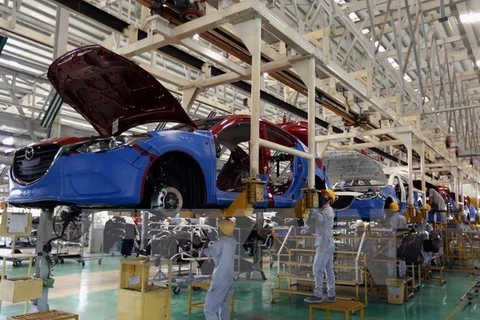
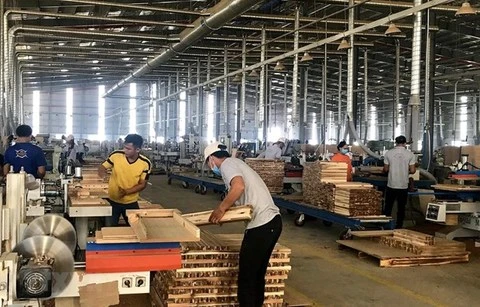
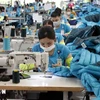
Vietnam’s trade with 11 other major Asian markets could rise from 326 billion USD to 465 billion USD by 2030. (Photo courtesy of UPS)
 "Clearing the Runway for Intra-Asia Trade" sheds light on trade growth drivers, potential headwinds, and multi-stakeholder action required to unlock the 2030 opportunity.
Trade in just 12 key markets (Australia, China, Hong Kong, Indonesia, Japan, Malaysia, the Philippines, Singapore, the Republic of Korea, Taiwan, Thailand, and Vietnam), known as the Asia 12, accounts for 88% of intra-Asia trade today and could more than double in value from 6.4 trillion USD in 2020 to 13.5 trillion USD in 2030.
Vietnam has rapidly grown into an important regional manufacturing hub. The country is expected to leverage this position further in the coming decade and trade value with the rest of the Asia 12 is forecast to rise from 326 billion USD to 465 billion USD by 2030.
“Intra-Asia trade holds incredible potential over the coming decade, built off the immense economic success that key regional economies have accomplished in recent years,” said Michelle Ho, President for UPS Asia Pacific, Middle East and Africa.
According to the study, four segments have driven the surge in trade among the Asia 12: retail, industrial manufacturing and automotive (IM&A), high-tech, and healthcare. In Vietnam, these segments accounted for 82% of trade with the rest of Asia in 2020.
The high-tech segment, a key export industry that constitutes 43% of Vietnam’s intra-Asia trade value, will drive future growth given the rise in digitalisation across the Asia 12. The IM&A segment, meanwhile, accounts for 21% of the country’s trade within Asia today, and this is expected to double by 2030 thanks in part to government support to boost the manufacturing sector.
Additionally, Vietnam’s participation in trade deals such as the Regional Comprehensive Economic Cooperation (RCEP) and Comprehensive and Progressive Agreement for Trans-Pacific Partnership (CPTPP) allows businesses to access a wider range of export markets and consumer goods with reduced trade barriers.
The study also pointed out a number of barriers that, unless addressed, may stagnate trade within the Asia 12. Specifically for Vietnam, lack of progress on logistics infrastructure could constrain its ability to serve centers of demand in rapidly developing economies.
Multi-stakeholder action is required to reduce impediments to regional trade and harness the opportunities to steer intra-Asia trade towards take-off.
Businesses with trade interests in Vietnam and those in the logistics sector must build resilience against potential headwinds while at the same time be ready to capture opportunities presented by the growth in intra-Asia trade. This includes diversifying supply chains, digitalising completely, and integrating micro, small and medium-sized enterprises into regional supply chains.
“Small businesses are vital to the Vietnamese economy, and one of the many things this report highlights is the importance of making sure our SMB customers are getting the support they need so that the full potential of intra-Asia trade can be realised over the next decade,” said Squall Wang, managing director UPS Vietnam.
“At UPS we are doing that by helping businesses digitalise and simplifying the shipping process,” he said.
Export financing
Vietnam's exports contributed to 82% of its GDP, indicating how deeply entrenched exports is within the entire nation. Particularly noteworthy is that 35% of Vietnam’s exports is dependent on SME’s who have working capital as a key roadblock to their growth aspirations.
Sumit Dutta, founder & CEO of ASEAN Business Partners (ABP), said: “Vietnam has huge potential to grow exports in many sectors but lack of credit is hampering SME’s from expanding."
Dutta adds that the Vietnamese Government has taken several steps to encourage export-oriented businesses by providing support in the form of loans, credit guarantees, and other financial services. However, there is scope for alternate options.
ABP is working with several multinational companies to bring in the right export financing platform for the exporters. These solutions can meaningfully meet the requirements of SME’s in growing ASEAN economy, especially in Vietnam, said Dutta who is also former CEO of HSBC Bank in Vietnam.
Le Toan Thang, Deputy Director of National Start-up Support Center (NSSC) under National Agency for Technology Entrepreneurship and Commercialisation Development (NATEC) under the Ministry of Science and Technology (MOST), said that Vietnam innovative start-up enterprises in particular and SMEs in general are in need of trade/export financing through innovative platforms that have been applied globally as well as need of professional consultancy from international experience./.
VNA