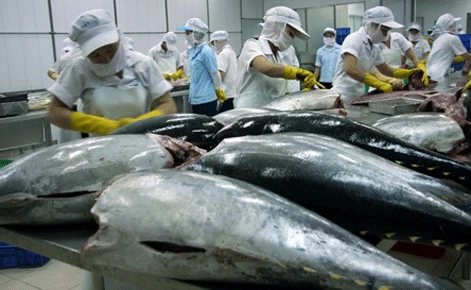
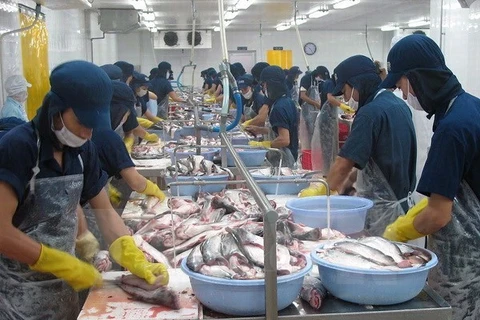
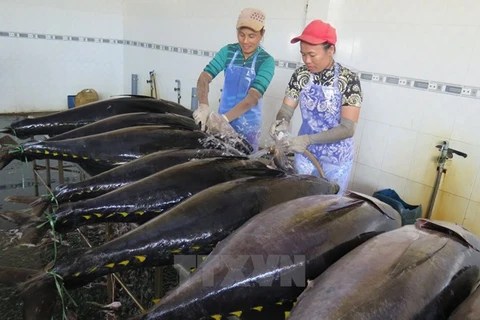
Workers of Hai Nguyen Ltd in Hoai Nhon Town, Binh Dinh Province, process tuna for local consumption (Photo: VNA)
 HCM City (VNA) – Vietnam’s tuna exports increased by 0.9 percent in the first seven month of the year to reach more than 266 million USD, according to the Vietnam Association of Seafood Producers and Exporters (Vasep).
The majority of the exports were fresh and frozen tuna, but compared to the same period last year, exports of these categories fell by 9.6 percent, while exports of processed tuna products went up by nearly 12 percent.
The exports went to 87 markets, with the US being the largest buyer, followed by the EU, ASEAN, and Japan, the association said.
Tuna exports to the US were worth 111.6 million USD, a year-on-year increase of 0.5 percent.
Exports of fresh and frozen tuna accounted for more than 76.8 million USD of total exports to the US, up nearly 11 percent over the same period last year, while exports of processed tuna (code HS 16) decreased by over 16 percent.
Exports to ASEAN member countries increased by 24.9 percent from the same period last year, but exports to the EU and Japan were down by 8.2 percent and 10.6 percent.
In the case of Japan, while fresh and frozen tuna shipments were down by 26.5 percent, exports of processed tuna enjoyed good growth of 10 percent.
The association forecasts that tuna exports to the US, ASEAN countries and China will continue to increase.
L e H a ng, D eputy D irector of VASEP.PRO, said Vietnam’s tuna products, especially processed ones, were subject to high tariffs in many import markets.
An ongoing trial project for tuna fishing, buying, processing, and consumption is expected to help improve quality and competitiveness, she said.
Israeli market
As a developed country in the Middle East region, Israel is a potential market for Vietnamese tuna products, according to the Africa, Southwest Asia Market Department under the Ministry of Industry and Trade.
Tuna exports to the market in the first half of the year were worth 8.6 million USD , a year-on-year increase of over 4 percent.
According to VASEP, Israel is one of eight key export markets of Vietnamese tuna.
With a population with an obesity rate at over 20 percent, the Israel Ministry of Health has recommended that residents consume tuna as a supplement of healthy omega 3-fatty acid.
Currently, exports of frozen tuna fillet (HS0304 code) to the market accounted for approximately 60 percent, and processed tuna (HS16 code) about 30 percent, it said.
According to UN Comtrade statistics, Thailand is the largest tuna exporter to Israel, with an export value of 18.6 million USD last year.
Israel’s tuna imports from China decreased from over 40 million USD in 2013 to 13.9 million USD last year.
Last year, Vietnam earned 15.5 million USD from tuna exports to Israel.
The department said there is still more room for Vietnam to boost tuna exports to the market.
It suggested local firms should focus more on improving their steaming, drying and canning technologies to enhance exports of processed products.-VNA