Vietnam’s wood industry faces difficulties in raw materials

Vietnam’s wood industry faces a quandary as bright export growth prospects are clouded by difficulties in finding necessary raw materials.
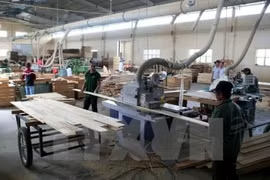
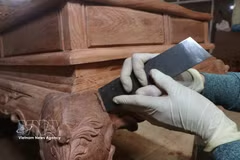
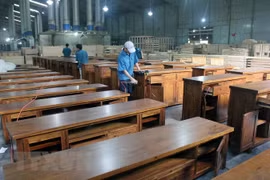
Vietnam’s wood industry faces difficulties in raw materials ảnh 1A worker processes wooden planks at Quang Nam Industry Wood Joint Stock Company’s mill in the central province of Quang Nam (Photo: VNA)

Hanoi (VNA) - Vietnam’s wood industryfaces a quandary as bright export growth prospects are clouded by difficultiesin finding necessary raw materials.

Nguyen Ton Quyen, Vice President and General Secretaryof the Vietnam Timber and Forest Product Association (VIFORES), expected amixed bag of fortunes in the domestic wood sector this year, with a handful ofnew trade agreements set to take effect.

Quyen said that he was certain exports of woodproducts from Vietnam will increase significantly, even for a country that isalready the world’s third largest and ASEAN’s biggest wooden furniture exporter.

He cited the EU-Vietnam Free Trade Agreement (EVFTA)and the Comprehensive and Progressive Agreement for Trans-Pacific Partnership (CPTPP)as major boosts for wood exports, opening up access to a total of 28 marketsacross the world.

But such hope will be in vain without thenecessary policies and guidelines to facilitate processing enterprises in theface of high global standards, changing technology and a shifting laboursource, he added.

Worse still, while exportsare to rise, the Vietnamese wood industry faces a seeminglyinsolvable problem of increasing the quantity of raw materials to meetproducers’ demand for legally obtained timber.

Quyen showed particular concern for an imminentfierce competition to obtain materials, especially from the Chinese market,whose wood processing industry is expected to demand about 60 million cubicmetres of raw timber this year alone. 

He explained that Chinese enterprises will scourneighbouring markets to procure this massive amount ofmaterials, thus putting Vietnam and other Southeast Asian countries undercompetitive pressure.

[2018 to be good year for wood products export]

Meanwhile, neighbouring countries such as Laos,Cambodia or Myanmar will continue to ban the export of logs and sawn timberdirectly from plantations, further reducing supply.

Nguyen Quoc Tri, Director General of the Ministryof Agriculture and Rural Department’s (MARD) Vietnam Administration of Forestry(VAF), was certain that the country’s wood products export turnover willreach 9 billion USD or more in 2018.

Tri said that although Vietnam has closed itsnatural forests for more than a year, the wood processing industry is stilldeveloping well, proving that they can do just fine without consuming naturalwood. But in order for that to happen, the country still needs about 34million cubic metres worth of raw material, he said.

Nonetheless, the VAF has set a target of 201,000 hectaresof new forests and to regenerate 360,000 hectares with an additional 50 milliontrees to be planted, in order to supply up to 18 million cubic metres of rawtimer in 2018. 

He worried that without proper sustainable forestmanagement, improved productivity, quality and distribution, there will not beenough wood to meet domestic demand.

Deputy Minister of Agriculture and Rural DevelopmentHa Cong Tuan suggested extending the life cycle of timber forests as a methodto improving the added value and quality of raw wood materials. 

The deputy minister said on the Government’s onlineportal that he counted on the support of foreign partners for Vietnameseenterprises to raise wood export turnover in 2018.

According to the MARD, the export value of woodand wood products in the first two months of 2018 had reached 1.34 billion USD,up by 26.3 percent over the same period in 2017.-VNA
VNA

See more

Phuong Dinh Anh, Deputy Chief of the Office of the Central Coordination Office for the National Target Programme, speaks at the event.( VNA)

Turning OCOP products into rural tourism experiences

Experts stressed that rural tourism can develop sustainably only when local communities actively participate and benefit from it. Investment in transport, accommodation and attractions must go hand in hand with clean water, waste treatment, hygiene, traditional craft preservation and environmental protection.

Prime Minister Le Minh Hung and his Cambodian counterpart Hun Manet witness the exchange of cooperation agreements between businesses of the two countries (Photo: VNA)

Vietnam, Cambodia look to elevate economic links

Prime Minister Le Minh Hung said that economic, trade and investment cooperation constitutes an important pillar of bilateral ties, which has achieved positive results. However, considerable room remains for further expansion to match the strong political ties and the potential of both countries.

An overview of the meeting (Photo: chinhphu.vn)

Deputy PM calls for tighter price management of essential goods

Deputy PM Thang, who is also head of the committee, urged ministries and agencies to coordinate closely to deliver effective fiscal and macroeconomic policies. The aim is to control inflation, stabilise the macroeconomy, ensure major economic balances, create room to support growth and bolster the economy’s resilience to external shocks.

 Khanh Binh International Land Border Gate in An Giang province.( Photo: VNA)

Vietnam-Cambodia trade gathers pace towards 20 billion USD target

After setting a record of more than 11.3 billion USD in 2025, bilateral trade reached about 8.7 billion USD in the first eight months of 2026, up 8.3% year on year. Vietnam is currently Cambodia’s third-largest trading partner, its second-largest source of imports and second-largest export market.

Vietnamese Ambassador to India Trinh Minh Manh discusses potential areas and strengths for cooperation between Vietnam and India’s Gujarat state. (Photo: VNA)

Vietnam, India’s Gujarat state seek to unlock cooperation potential

Vietnam attaches importance to strengthening cooperation with Indian states boasting strong economic potential, including Gujarat, to further advance the two countries’ Enhanced Comprehensive Strategic Partnership, particularly in the economy, trade and investment, said Ambassador Trinh Minh Manh.

At Nestlé Vietnam factory in Hung Yen province (Photo: VNA)

Vietnam seeks to build stronger ecosystem for FDI

The World Bank has stressed the need to connect global companies with domestic suppliers, improve the business climate and develop supply-chain finance solutions. Those steps will let domestic firms gradually meet requirements on quality, technology, costs and delivery times, and position them to become suppliers to multinational corporations.

Construction of technical infrastructure facilities serving APEC 2027 in Phu Quoc Special Zone, An Giang province. (Illustrative photo: VNA)

Vietnam enters investment grade credit rating category for first time

Vietnam has maintained robust growth, outperforming other Southeast Asian economies. Its ongoing government reforms aimed at streamlining the state apparatus, promoting the private sector, improving the institutional framework and developing capital markets will strengthen the country’s growth potential and economic resilience.

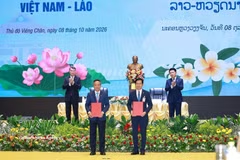
Vietnamese Prime Minister Le Minh Hung and Lao Prime Minister Saleumxay Kommasith witness the presentation of investment certificates and investment cooperation agreements between businesses of the two countries. (Photo: VNA)

Vietnam, Laos strengthen “strategic cohesion” in economic sector

The great friendship, special solidarity, comprehensive cooperation and strategic cohesion between Vietnam and Laos, and between Laos and Vietnam, are an invaluable asset of the Vietnamese and Lao Parties, States and people. It is the responsibility of today's generation to transform this invaluable political asset into new resources for the development of the two countries’ people.

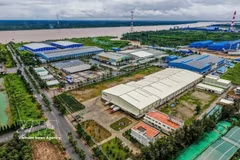
West Food Hau Giang JSC’s factory at the Nam Song Hau Industrial Park – Phase 1, Can Tho city (Photo: VNA)

Southern industrial property market enters new phase of competition

Industrial site selection was previously driven largely by land prices, location and access to markets. However, as supply chains become more complex and manufacturing projects face higher technical requirements, businesses are increasingly assessing sites based on their long-term operational capabilities.

Members of the RoK delegation visit booths showcasing signature agricultural products of Da Lat – Lam Dong. (Photo: VNA)

Lam Dong seeks stronger economic, tourism links with RoK

Lam Dong is particularly interested in sectors in which Korean businesses have strengths, including agriculture, green energy, the circular economy, high-quality tourism, healthcare, education, human resources training and digital transformation, an official said.