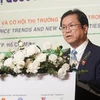
Tong Viet Trung, Vice President of Viettel Group. Photo: VNS
 Viettel has become the biggest telecom company in Vietnam 15 years after it was established and has been one of the country's few successful investors abroad. Viet Nam News speaks with Tong Viet Trung, Vice President of Viettel Group, about the company's business and social responsibility.
* Viettel is one of the most successful Vietnamese companies in terms of investing abroad. Can you tell us about your investments so far?
Fifteen years ago, in Vietnam, Viettel was a very small company with 100 employees, 100,000 USD capital, 2 million USD revenue and approximately 50,000 USD profit. Now the company has become the largest telecommunications and technology company in the country with 10 billion USD revenue, annual profit of over 2 billion USD, over 90,000 employees (75,000 of them in Vietnam, and 15,000 overseas). We deliver services to over 76 million customers in over 10 countries across Asia, Africa and the Americas.
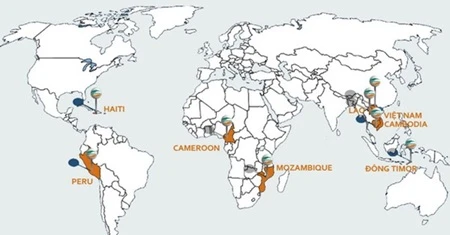
In Asia, we have three countries – Laos, Cambodia and East Timor. In America, we have two - Haiti and Peru. In Africa, there are four countries - Mozambique, Cameroon, Tanzania, and Burundi. The goal is that by 2020 Viettel will become a global corporation and among the 10 largest telecom companies in the world. The goal is also to [enter] 30-35 other countries and serve a population of 600-800 million.
* What does your company attribute the success to?
We do not have a one-size-fits-all formula for our offshore investments, but our strategy varies by the market. Anyway, we do rely on specific underlying determinants.
Viettel maintains a difference when we offer our services in a foreign market. We deploy the full force of our sales teams, whether it is shop-based, door-to-door or net-based sales or a combination of different approaches, and try to widen our customer care system to make sure that all calls are processed in the shortest amount of time, and all incidents are strictly controlled and fixed within a set timeframe. It is our philosophy to put service quality and customers first, and even though it may sound like a cliche since this is what all businesses are looking forward to, what really happens is often a completely different story. And we rely on this difference to guide our service delivery in these markets. We try to finish capital expenditure as soon as possible so that we can start providing services and convert potential into outcomes in real terms. That is how Viettel does it in the countries that we have operations in.
Moreover, in each of the countries that we have been to, we try to translate our investment strategy to real life to become the top provider in terms of both network infrastructure and subscriber base. In our view, any customer, whether from an urban or rural area, will be offered the best service quality and bandwidth. We view telecoms services as a normal commodity rather than a luxury. Telecoms are for everybody. We believe that the development of a nation depends in part on telecoms, which has a massive role to play in changing the way of life for the better in any country. That is why in every country we have been and will be to, Viettel is committed to making meaningful contributions to socio-economic development.
* Can you tell us about your experiences en route to making successful investments abroad?
In every country, we need to explore the local culture, traditions and business practices. We do not have an ‘all in one' recipe. Of course, as a company that has had success in some of the most competitive markets, we have experience.
First, the network infrastructure must be far and wide. In every country the company is in, we aim to have the largest and most sustainable network infrastructure right off the bat. While other firms only invest in major and populous cities, we provide coverage for 80-95 percent of the entire population immediately after launch.
Second, we value local people's pride and offer technology transfer opportunities to the locals. In the countries that we have been doing business for a few years, our [Vietnamese] teams have been downsized to just around 5 percent as we want to promote ownership by locals in running and maintaining day-to-day operations, and only key positions are occupied by Vietnamese staff.
Third, we anchor our business with social responsibility. These programmes often target younger generations, education, health care and the poor.
* What do you think about corporate social responsibility (CSR)? What are the company's CSR plans in the near future?
Viettel instituted and has pursued the "Caring & Innovator – Initiator with a warm heart" slogan since 2004. Built into one another, this double identity has been reflected simultaneously in all our strategies and lines of work. We not only engage in telecom infrastructure development and promoting socio-economic growth in the countries we are in, we are also committed to a philosophy of ‘business inseparable from social responsibility', focusing on three key sectors - education, health care and helping reduce poverty.
We have been and will continue investing in these three areas, not just in Vietnam but in all other countries we have interests in.
* Why does your company's CSR focus on education and health care?
In education, we believe that computerising education will help close the educational gap between the ‘haves' and ‘have-nots' in terms of access to quality education. Everybody should be equal when it comes to access to education. This is a vital impetus for the socio-economic development of any country and it should start with the younger generations.
Over the years we have been working on a large variety of programmes to introduce IT in education. Examples include the "Education networking" programme that introduced broadband internet to all academic institutions in Vietnam in just two years. Our completely free installation and service for all the schools was seen by government leaders as a "historic event for education in Vietnam". The initiative has been expanded to all the countries Viettel has operations in.
* Your company is the premier sponsor of the 2015 Microsoft Office Specialist World Championship (MOSWC). Why did you decide to sponsor the event?
As a telecoms and information technology company operating in 10 countries, we believe IT is among the key drivers of human, business, social and national development.
That is why, in addition to transforming ourselves from a traditional telecom services firm to a technology services provider - thus adapting to meet the increasing needs of users and taking IT to every walk of life - we also provide consistently expanding financial support for the IT sector in the countries we are in, either through free or subsidised installation of telecom infrastructure or financing e-government projects and IT competitions, for example the MS Office specialist competition that Viettel and IIG Vietnam have been following for many years now.
* During your visits to the US, did you perceive an increasing global interest in Vietnam?
As we worked with senior officials of the organisers and hosts - Certiport and Microsoft - we were delighted that Viettel got significant credit from them as well as other participating countries as the premier sponsor of the event. Our efforts over the years have been highly rated, as have our commitments to supporting education and the development of the younger generation, not just in Vietnam but also in the other countries we are doing business in.
I'm very happy to hear that the 2015 MOSWC Vietnam organising board has been awarded the Marketing of the year prize from the World MOSWC organisers for promoting productive partnerships between regulators and businesses. This is the first model of its kind to be introduced in the 80 countries participating in the World finals this year, and has been much welcomed for its efficacy and hopefully will become the norm for other countries.-VNA