Vocational training sector to restructure school network

The vocational training sector plans to continue rearranging its school network to enhance their effectiveness and relevance to labour market demands with the aim of training 2.15 million workers in 2
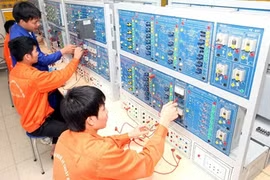
Vocational training sector to restructure school network ảnh 1Students attend a carpentry class in Dong Bac Technology and Agroforestry Vocational Training College in northern Lang Son province. (Photo:VNA)


Hanoi (VNA)
– The vocational training sector plans to continue rearranging its school network to enhance their effectiveness and relevance to labour market demands with the aim of training 2.15 million workers in 2016.

At a press briefing in December 24, the General Department of Vocational Training (GDVT) said the restructuring in 2016 will go along the direction of reducing the number of schools while expanding training scale and improve quality.

At the same time, new training institutions will be established in disadvantaged areas, particularly in the Northwest, the Central Highlands and the Southwest.

The private sector will be welcome to open vocational schools, and the system of public schools will be reshuffled, with more financial autonomy to be given to them.

International cooperation will be boosted in accordance with the plan for international cooperation in education and vocational training to 2020.

In 2015, vocational schools across the country enrolled nearly two million students, meeting 92.1 percent of the yearly target, of whom more than 1.7 million joined short-term courses of less than 3 months.

As of June 30, 2015, there wre 1,467 vocational training institutions across the nation, including 190 colleges, 280 schools and 977 training centres.

GDVT Director General Duong Duc Lan said Vietnam is one of the leading countries in the region in terms of occupational skills, noting that the country came first three times at the ASEAN Skills Competition.

He also called for more active communication work to help enhance the awareness of vocational training among the community.-VNA
VNA

See more

Delegates pose for a photo at the Chile-Vietnam Business Forum in Hanoi on November 16 (Photo: VNA)

Vietnam, Chile seek to expand trade ties

Chilean President José Antonio Kast pointed to potential for cooperation in agriculture and food, and called for stronger technical cooperation, better market access and closer links in innovation, technology, services and sustainable development.

Production of footwear for export at Lefaso Tra Vinh Industrial Investment and Production Joint Stock Company, Tra Cu commune, Vinh Long province (Illustrative image. Source: VNA)

VEFTA implementation requires exporters to restructure supply chains: Experts

Under VEFTA, tariff reductions to zero will be meaningless for Vietnam’s key export sectors, including textiles and garments, footwear, and agricultural and aquatic products, if goods are found to contain banned chemicals, violate rules of origin or lack transparency regarding their carbon footprints.

Deputy Prime Minister Nguyen Van Thang meets with Martin Sommer, head of the IMF’s Article IV consultation mission team to Vietnam, in Hanoi on November 13, 2026. (Photo: VNA)

IMF sees positive growth prospects for Vietnam, urges cautious monetary policy

Martin Sommer, head of the IMF’s Article IV consultation mission team to Vietnam, noted that inflation risks in Vietnam remain under control, but several factors could add to price pressures. He therefore called for cautious monetary policy management and readiness to respond promptly if inflationary pressures increased.

Representatives of the three first-prize-winning startups receive their awards at the event. (Photo: SGGP)

Seven green-tech startups secure 770,000 USD at Net Zero Challenge 2026

In its fourth year, the competition attracted more than 1,100 applications from 80 countries and territories, making it the most competitive edition since its launch in 2023. Nine finalists presented solutions in three categories, namely renewable energy and carbon removal; food systems and sustainable agriculture; and circular economy and waste management.

Vietnamese and Malaysian businesses connect at the event (Photo: VNA)

Vietnam, Malaysia connect businesses to boost bilateral trade cooperation

It centred on a business-to-business (B2B) matchmaking session, bringing Vietnamese and Malaysian companies together to discuss import-export needs, seek partners and explore cooperation. Vietnamese businesses aimed to connect with Malaysian importers, distributors and retailers, while expanding access for their products to Malaysia and other markets.