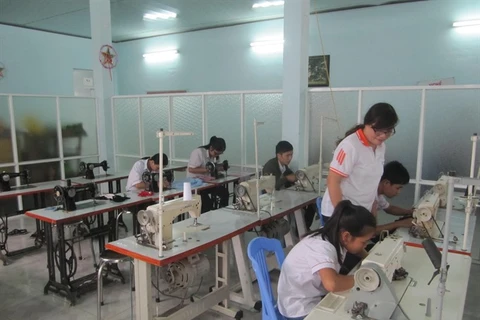
In future the revised project on vocational training for rural labourers will be based on demands from enterprises. (Photo danviet.vn)
 Hanoi (VNA) - In future, the revised project on vocational training for rural labourers will be based on demands from enterprises.
In place of the usual ‘top-down’ mentality where orders and targets are set by higher-ups, in 2018, the Ministry of Agriculture and Rural Development said its training programmes and curricula will be crafted with input from enterprises.
With the needs and criteria of potential employers being taken in, the training is hoped to achieve practical results, ensuring those who received training can be hired by the firms in need.
The change is in line with the Government’s new rural building programme and restructuring in the agriculture sector, said Ma Quang Trung, head of the department of cooperatives and rural development, under the Ministry of Agriculture and Rural Development (MARD).
The ministry said surveys will be sent to businesses and co-operatives, especially those that have already established production and consumption ties with farmers. Training programmes and most of the budget for 2018 will be tailored for these businesses, as well as businesses in important production areas or high-tech production areas.
As many as 104 agriculture vocational training classes – covering topics from production, storage and manufacturing, but focusing on nationally important products and local spearhead products – will be held for workers in cooperatives. Another 16 classes on management skills will also be held for 560 officials in charge of cooperatives affairs in localities.
The steering committee under the agriculture ministry recommended these tasks be undertaken by “all central-level agencies, in direct coordination with businesses’ associations, general companies or businesses who have placed orders for labourers at ministry-level and local-level training centres.”
In 2009, then Prime Minister Nguyen Tan Dung approved the project “Vocational training for rural labourers until 2020”, and six years later, the amended decision No 971 came out with adjustments deemed more practical.
The changes include raising the target number of trained labourers in 2016-20 to six million and making sure that 80 percent of the trained workers are employed or have better wages and productivity, a new requirement to combine “theoretical lessons with field practice”, as well as no longer distinguishing between public or non-public vocational training centres in the programme.
In 2017, the number of people receiving vocational training in the first nine months reached 162,180, or 77 percent of the target (210,430 workers), according to an agricutlure ministry’s report summarising vocational training activities in the first nine months.
The majority of the trained workers are in agriculture, reaching 120,000. Most of the trained workers in the agriculture sector this year – about 43,000 – are members of co-operatives or individual workers in collaboration with agro-businesses.
Some successful co-operation models between the Government-sponsored vocational training programme and businesses include classes held to teach growing and harvesting techniques for rubber trees for new employees of the State-owned Vietnam Rubber Group, training on VietGAP shrimp breeding for employees of Quang Ninh Seaproducts Import-Export Company and training on high-quality rice production for VinaFood 2.
According to the report however, the implementation of the training programme still has a lot of room for improvement.
The effectiveness gap of the programme is one notable weakness. Midland mountainous provinces in the northern region and the Central Highlands, despite receiving equal or more financial support from the Government than other localities, recorded lower numbers of trained workers and a lower employment rate amongst those with training.
Follow-up support for the trained rural workers is also a problem, as without capital, these people would not be able to establish a business to utilise the knowledge they have obtained. This is a serious setback for the training programme, as the goal is to ensure people’s livelihood and help them escape poverty.
A lack of “serious efforts and determination” on the parts of workers during training and a shortage of qualified trainers are other issues that need to be addressed, the agriculture ministry’s report said.-VNA
In place of the usual ‘top-down’ mentality where orders and targets are set by higher-ups, in 2018, the Ministry of Agriculture and Rural Development said its training programmes and curricula will be crafted with input from enterprises.
With the needs and criteria of potential employers being taken in, the training is hoped to achieve practical results, ensuring those who received training can be hired by the firms in need.
The change is in line with the Government’s new rural building programme and restructuring in the agriculture sector, said Ma Quang Trung, head of the department of cooperatives and rural development, under the Ministry of Agriculture and Rural Development (MARD).
The ministry said surveys will be sent to businesses and co-operatives, especially those that have already established production and consumption ties with farmers. Training programmes and most of the budget for 2018 will be tailored for these businesses, as well as businesses in important production areas or high-tech production areas.
As many as 104 agriculture vocational training classes – covering topics from production, storage and manufacturing, but focusing on nationally important products and local spearhead products – will be held for workers in cooperatives. Another 16 classes on management skills will also be held for 560 officials in charge of cooperatives affairs in localities.
The steering committee under the agriculture ministry recommended these tasks be undertaken by “all central-level agencies, in direct coordination with businesses’ associations, general companies or businesses who have placed orders for labourers at ministry-level and local-level training centres.”
In 2009, then Prime Minister Nguyen Tan Dung approved the project “Vocational training for rural labourers until 2020”, and six years later, the amended decision No 971 came out with adjustments deemed more practical.
The changes include raising the target number of trained labourers in 2016-20 to six million and making sure that 80 percent of the trained workers are employed or have better wages and productivity, a new requirement to combine “theoretical lessons with field practice”, as well as no longer distinguishing between public or non-public vocational training centres in the programme.
In 2017, the number of people receiving vocational training in the first nine months reached 162,180, or 77 percent of the target (210,430 workers), according to an agricutlure ministry’s report summarising vocational training activities in the first nine months.
The majority of the trained workers are in agriculture, reaching 120,000. Most of the trained workers in the agriculture sector this year – about 43,000 – are members of co-operatives or individual workers in collaboration with agro-businesses.
Some successful co-operation models between the Government-sponsored vocational training programme and businesses include classes held to teach growing and harvesting techniques for rubber trees for new employees of the State-owned Vietnam Rubber Group, training on VietGAP shrimp breeding for employees of Quang Ninh Seaproducts Import-Export Company and training on high-quality rice production for VinaFood 2.
According to the report however, the implementation of the training programme still has a lot of room for improvement.
The effectiveness gap of the programme is one notable weakness. Midland mountainous provinces in the northern region and the Central Highlands, despite receiving equal or more financial support from the Government than other localities, recorded lower numbers of trained workers and a lower employment rate amongst those with training.
Follow-up support for the trained rural workers is also a problem, as without capital, these people would not be able to establish a business to utilise the knowledge they have obtained. This is a serious setback for the training programme, as the goal is to ensure people’s livelihood and help them escape poverty.
A lack of “serious efforts and determination” on the parts of workers during training and a shortage of qualified trainers are other issues that need to be addressed, the agriculture ministry’s report said.-VNA
VNA