WB suggests Vietnam's focus on improving business climate

In its “Vietnam Macro Monitoring” report in September, the WB suggested Vietnam focus on improving the business climate and stepping up investment in human capital to attract high-tech and high-value-addition FDI as well as boost productivity in the long run.
WB suggests Vietnam's focus on improving business climate ảnh 1Illustrative image (Photo: Vietnam+)

Hanoi (VNA) - In its “Vietnam Macro Monitoring” report in September, the WB suggested Vietnam focus on improving the business climate and stepping up investment in human capital to attract high-tech and high-value-addition FDI as well as boost productivity in the long run.

According to a report released by the World Bank (WB) on October 20. Vietnam’s economy registered 5.3% year-on-year growth in Q3 compared with 4.1% year-on-year in Q2, due to a gradual recovery of industrial production, reflecting improvement in exports.

Industrial production recovered

In the third quarter, the services and agricultural sectors grew by 6.2% and 3.7% year-on-year, respectively. They contributed 2.7 and 0.4 % percentage point to GDP growth in the period. The growth rates and contributions are comparable to the previous two quarters.

WB suggests Vietnam's focus on improving business climate ảnh 2Tourists visit Hanoi's Old Quarter. (Photo: Vietnam+)

Following ten months of contraction, exports and imports grew 5.3% and 2.6% year-on-year in September. This is a vivid illustration for an improvement in external demand, suggesting the contraction in merchandise trade as bottomed out.

It helped narrow the contractions in exports and imports in Q3 to -1.2 % and -5.0 % year-on-year, respectively, compared with -12.2 % and -20.6% in Q2. The improvement was evident in exports of agricultural products such as rice, textile weaving, electronics and computers.

The overall merchandise trade balance registered a surplus of 2.3 billion USD in September 2023 and 21.4 billion USD for the first nine months of the year as exports have been contracting less than imports. Also, imports are recovering faster than exports, signaling businesses are expecting further expansion of production. Between April and September 2023, monthly growth rates for exports improved from -16.2% to 5.3%, while those for imports improved from -23.1% to 2.6%.

According to S&P Global PMI survey for Vietnam, the number of exports orders picked up in both August and September, especially from Asian markets.

Focus should be sharpened on inflation and public investment

Vietnam should closely monitor inflation which has been on the rise in recent time, according to the World Bank.

In its “Vietnam Macro Monitoring” report in September, the WB said the consumer price index (CPI) grew from 3% in August to 3.7% in September, continuing a sharp upward trend that started in June.

Inflation was due to higher prices of food and foodstuffs as well as housing and construction materials. Additionally, the price of transport services contributed 0.3 percentage point to CPI inflation due to the new round of oil price increases registered during July-September this year.

In stark contrast, core inflation which excludes food, fuels and government administered prices, continued to soften from 4% in August to 3.8% in September.

Credit growth accelerated from 16.2% in August to 17.2% in September as the State Bank of Vietnam raised credit growth limits on some commercial banks.

With strong demand for credit, average overnight interbank interest rate rose from 3.5% in August, reaching 5.48% in mid-October, the highest since 2013.

The budget balance posted a 0.5 billion USD deficit in September for the first time in 2022, but still registered a 10.5 billion USD surplus over the first 9 months of the year. Given the budget surplus, year-to-date government bond issuance reached only 28.7 % of annual plan, compared to 67.9% in 2021.

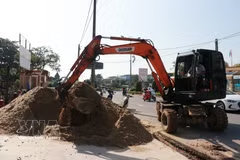
WB suggests Vietnam's focus on improving business climate ảnh 3Disbursement for public investment is still slow. (Photo: Vietnam+)

Vietnam’s economy picked up in Q3 thanks to a gradual recovery of the exports, however, domestic consumption remained subdued and credit growth continued to be slow, which reflect weak private domestic investment and investors’ confidence.

The WB said a strategic and well-prepared investment pipeline for 2024, and the next Medium-term Investment Plan (MTIP) with a focus on green, resilient and regional infrastructure will help bolster long-term economic development./.
VNA

See more

The sidewalks on Hung Vuong street in Quang Tri province are under renovation. (Photo: VNA)

Quang Tri approves 103 priority projects for investment during 2026–2030

The 103 projects are categorised into seven fields, comprising energy; logistics; tourism, services, and trade; green and high-tech agriculture; industry, industrial zones, and production infrastructure; urban development and commercial housing; and healthcare, wellness, and resort services.

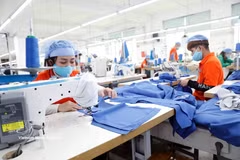
Workers make clothes for export to the Japanese market at Hung Viet Garment Company in Hung Yen province (Photo: VNA)

Vietnam’s textile-garment firms striving to achieve export targets, sustain employment

To achieve the annual target, textile and garment businesses are jointly implementing several core tasks, including diversifying export markets and partners, developing the supporting industries for raw materials and accessories to establish integrated supply chains, investing in technological innovation linked to AI, stepping up high-quality workforce training, promoting green transformation based on circular economy models, and building brands in both domestic and international markets.

Minister of Public Security General Luong Tam Quang (R) receives Choo Hyeong Wook, President and CEO of the Republic of Korea’s SK Innovation in Hanoi on November 16. (Photo: VNA)

Vietnam promotes international cooperation in energy, high technology

Minister of Public Security General Luong Tam Quang called on the RoK's SK Innovation to share experience and work with Vietnamese partners in developing clean and renewable energy, hydrogen, liquefied natural gas, energy storage technologies and carbon emission reduction solutions.

Delegates pose for a photo at the Chile-Vietnam Business Forum in Hanoi on November 16 (Photo: VNA)

Vietnam, Chile seek to expand trade ties

Chilean President José Antonio Kast pointed to potential for cooperation in agriculture and food, and called for stronger technical cooperation, better market access and closer links in innovation, technology, services and sustainable development.

Production of footwear for export at Lefaso Tra Vinh Industrial Investment and Production Joint Stock Company, Tra Cu commune, Vinh Long province (Illustrative image. Source: VNA)

VEFTA implementation requires exporters to restructure supply chains: Experts

Under VEFTA, tariff reductions to zero will be meaningless for Vietnam’s key export sectors, including textiles and garments, footwear, and agricultural and aquatic products, if goods are found to contain banned chemicals, violate rules of origin or lack transparency regarding their carbon footprints.

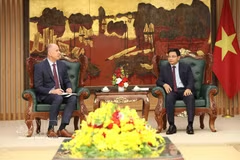
Deputy Prime Minister Nguyen Van Thang meets with Martin Sommer, head of the IMF’s Article IV consultation mission team to Vietnam, in Hanoi on November 13, 2026. (Photo: VNA)

IMF sees positive growth prospects for Vietnam, urges cautious monetary policy

Martin Sommer, head of the IMF’s Article IV consultation mission team to Vietnam, noted that inflation risks in Vietnam remain under control, but several factors could add to price pressures. He therefore called for cautious monetary policy management and readiness to respond promptly if inflationary pressures increased.

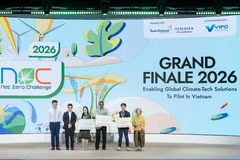
Representatives of the three first-prize-winning startups receive their awards at the event. (Photo: SGGP)

Seven green-tech startups secure 770,000 USD at Net Zero Challenge 2026

In its fourth year, the competition attracted more than 1,100 applications from 80 countries and territories, making it the most competitive edition since its launch in 2023. Nine finalists presented solutions in three categories, namely renewable energy and carbon removal; food systems and sustainable agriculture; and circular economy and waste management.