Webinar sheds lights on Vietnam-Latvia trade potential

Trade between Vietnam and Latvia reached 311.73 million USD in 2023, an increase of 33% from 2020, the year the EU-Vietnam Free Trade Agreement (EVFTA) came into effect, heard a recent webinar titled “Gateway to Vietnam.”
Webinar sheds lights on Vietnam-Latvia trade potential ảnh 1Poster of the webinar.
Berlin (VNA) – Trade between Vietnam and Latvia reached 311.73 million USD in 2023, an increase of 33% from 2020, the year the EU-Vietnam Free Trade Agreement (EVFTA) came into effect, heard a recent webinar titled “Gateway to Vietnam.”

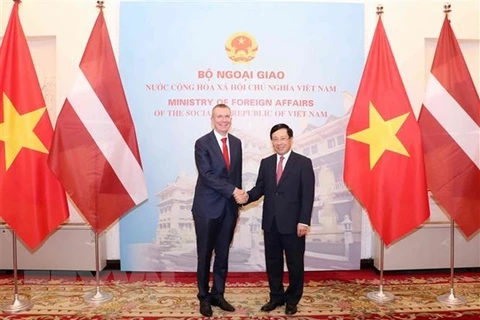
The event was co-organised by the Vietnamese Embassy and Trade Office in Sweden and Northern Europe and the Latvian Chamber of Commerce and Industry (LCCI).

In his remarks, Vietnamese Ambassador Tran Van Tuan expressed pleasure with the coordination between relevant Vietnamese and Latvian agencies in planning the virtual seminar as well as the participation of a Latvian business delegation in the upcoming Global Sourcing Fair 2024 in Vietnam from April 24-26.

The diplomat said he is confident that the activities will enhance mutual understanding and put forth concrete measures to strengthen bilateral cooperation, bringing greater benefits to both sides.

Currently, Latvia stands as Vietnam's largest economic partner in the Baltic region, while the latter is the former’s largest trading partner in the ASEAN region. Tremendous room remains for them to team up in various fields, particularly agro-forestry-fisheries, pharmaceuticals, education, science-technology, and labour.

However, despite the potential, Vietnamese goods are not widely present in Latvian distribution channels, and there are no major warehouses or supermarkets in the Northern European nation that import and distribute Vietnamese products. The main challenges include the considerable geographic distance and the lack of direct air or sea routes between the two countries.

Tuan suggested that as a first step, Vietnamese businesses could consider establishing warehouses and representative offices in Riga – the capital of Latvia – to better understand the Baltic market demands. They should increase participation in Latvia’s trade fairs and cultural-commercial events to promote Vietnamese products, he added.

He also called for the establishment of direct flight routes and maritime routes linking Vietnam's airports and ports to those in Latvia and the Baltic region./.
VNA
See more

Workers load rice bags onto a vessel for delivery. (Photo: VNA)

PM directs tasks to accelerate 2026 export growth

During January – February, Vietnam’s total export-import value hit 155.7 billion USD, up 22.3% year-on-year. Of the total, exports were estimated at 76.4 billion USD, up 18.3%, while imports totaled 79.3 billion USD, up 26.3%.

A quick report from data analytics platform Metric shows the number of active sellers across Shopee, TikTok Shop, Lazada and Tiki has dropped to just over 602,000, marking a year-on-year decline of more than 7%. (Illustrative photo: VNA)

Higher marketplace fees weigh on online sellers

Analysts identify rising operational costs as the key factor behind the exodus. In 2025, platforms simultaneously rolled out fee hikes ranging from 10–15%, significantly increasing the financial burden on merchants.

The latest approvals underscore the growing presence of Vietnamese rice in one of the world’s most demanding markets. (Photo: VNA)

Fragrant rice deepens EU market presence

Although the volume of individual shipments remains relatively modest, industry experts say the steady flow of exports reflects stable demand in the EU for high-quality rice.

Promoting stronger foreign direct investment (FDI) inflows is considered an important solution to help drive economic growth. (Photo: VNA)

Vietnam emerges as hub for high-quality FDI

Vietnam is gradually becoming a strategic destination for high-quality global FDI. Investment flows are increasingly directed toward sectors such as high-tech manufacturing, electronics, digital infrastructure, modern logistics, and industries that are closely linked to global supply chains.

Shrimp processing for export at Huy Nam company, An Giang province. (Photo: VNA)

Fisheries sector proactively adjusts to emerging challenges

In addition to food safety regulations, the US continues to closely monitor the origin of imported seafood through the Seafood Import Monitoring Programme (SIMP) administered by the National Oceanic and Atmospheric Administration (NOAA). Requirements linked to the Marine Mammal Protection Act (MMPA) are also a major concern for businesses.