Illustrative image (Source: Internet)
Hanoi (VNA) – Three early stagestartups from Cambodia, Laos, Myanmar, and Vietnam, and three more mature teamsoriginating from outside the Greater Mekong Subregion (GMS) have won prizes inthe Mekong Agritech Challenge (MATCh).
The first prize went to Cricket One (Vietnam)with sustainable and affordable protein product from crickets and AgUnity(Australia) with a blockchain platform that helps farmers share resources.
The second prize winners are KIU Global(operating in Cambodia, Laos, Myanmar, Vietnam), which provides a financialtechnology solution offering agricultural businesses access to credit, andVerifik8 (Thailand) with software that connects producers and buyers and helpsimprove performance in the agrifood supply chain.
Meanwhile, the third prize belongs to TunYat(Myanmar) and Enzootic, Ltd. (Israel and Hong Kong, China). While TunYat offersa rental solution that gives smallholder farmers access to larger machinery, Enzootic,Ltd. provides a cell transplantation technology for shrimp farming that yieldsall female shrimp producing more product with less losses.
The six MATCh winners presented outstandingtechnology solutions with high potential to advance agriculture in the GMS.Aside from prizes ranging from 2,000 – 5,000 USD equivalent, they will alsoreceive ongoing mentorship and training and will compete in the Singapore-basedFuture Food Asia Award Competition.
Earlier, 22 teams visited Hanoi to pitch theirtechnologies and solutions to a panel of industry experts and investors. Theywere from Cambodia, Laos, Myanmar, and Vietnam as well as Australia, China,India, Israel, the Netherlands, and Thailand. The teams also participated inbusiness matching, one-on-one meeting with mentors, and farm tours.
Connor McGuinness, Regional Programme Manager,Australian Government Department of Foreign Affairs and Trade, said: “Cambodia,the Lao PDR, Myanmar, and Vietnam all share deep agrarian legacies, and whilethese economies are diversifying, agriculture still has so much to offer as anengine of economic growth.”
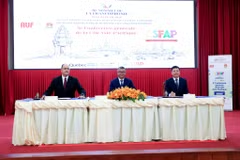
MATCh was co-organised by the Mekong BusinessInitiative, the Future Food Asia, and the GMS Core Agriculture SupportProgrammes, with funding and support from the Australian Government and theAsian Development Bank (ADB).
MATCh supports startups in agriculture todevelop products, network and learn from industry players, showcase theirsolutions, and access markets and funding. It is aimed at agritech and traditionalagriculture businesses with innovative and scalable solutions for Cambodia,Laos, Myanmar, and Vietnam.
The Challenge has tracks for businesses from insideand outside the GMS. MATCh will be powered by the MATCh Alliance, consisting ofkey regional and local players in the agribusiness innovation ecosystem.-VNA
VNA