Skilful artisans bring life to their works (Photo: VNA)
 Hanoi (VNA) - Carving wooden sculptures, especially for graves, is not only a special folk art of ethnic groups in the Central Highlands region but also reflects the spiritual life of people from community, particularly for the Ba Na and Jrai people - the two major ethnic groups in the north of the region.
The art of sculpting with wood is interesting to folklorists because it vividly shows the region’s culture of gongs and epics, and the rich spiritual life of ethnic groups living there.
Wooden sculptures of the Bahnar and Jrai people are divided into two groups - statues for decoration and for spiritual practices, particularly in the “Bo ma” (grave-abandoning ceremonies) of the Jrai people.
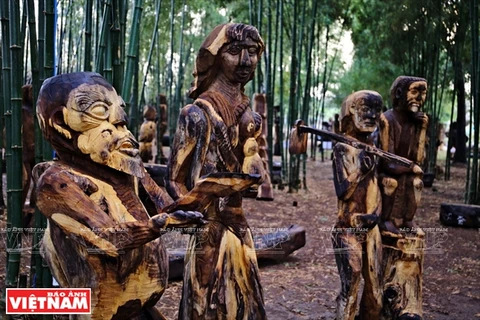
The most outstanding carvings are wooden statues around gravesites. Even village elders and researchers can’t say when these statues first appeared. For generations, Central Highlanders have built graves surrounded by wooden statues to honour their dead.
Wooden statues of the Jarai and Ba Na are diverse. At the front of the grave, there are often statues depicting the wish for fertility, reproduction, and growth, expressed by a mother holding a child, and people pounding rice. At the corners of the grave, there are statues of sitting people crying.
 Artisans making wooden statues (Photo: VNA)
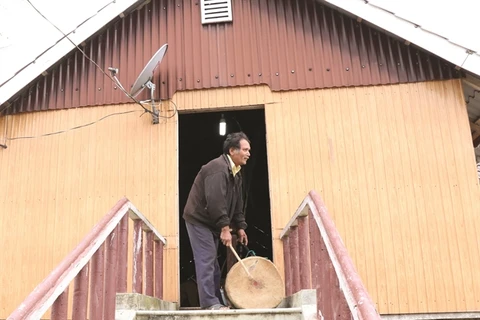
 Central Highlanders believe that death is not the end but a change, from moving to still life. The newly departed spirit wanders around where it lived. A farewell ritual called “abandoning the grave” is the last chance to see off the dead.
At that point, the spirit will go on to the other world. The family makes a promise for an “abandoning ceremony” at a later date, anywhere between three and seven years.
Until that date, the grave is regularly tended to and visited by family members and friends. They even eat and drink in the cemetery, in the belief that the spirit is still there.
The grave statues often depict birds, beasts, household utensils and groups of people standing, sitting, or hugging each other. The most popular statues are people sitting with their elbows on their knees, their arms holding their faces with sad-looking eyes. People say the statues represent the relatives, sitting beside the grave to talk with the dead person. There are joyful statues of people beating drums and gongs, pounding rice, men and women having sex, and pregnant women. The grave statues illustrate their belief that death is just a start in the spiritual world.
Statues for worship are often placed in sacred places, though the grave statues in the Central Highlands are often placed in nature, under the shade of trees, with no heed to weather. Grave statues are not sophisticated in technique and polish but they still look lively and impressive.
In the Central Highlands, there are some rather old, large graves. The statues there are made of durable wood which can bear harsh weather through several decades. When the forest areas were narrowed, people were forced to use lower-quality wood, which is prone to rotting, pests and the weather.
Artisan Ksor Kroh from Mrong Ngo village, Ia Ka commune, Chu Pah district of Gia Lai province, said that to carve high-quality statues, artists must spend a great amount of time making meticulous strokes with an axe and chisel to produce a perfect statue. Good statues must be beautiful, lively and close to the life of villagers, he added.
The number of people able to carve traditional statues is decreasing. The younger generation has shown little interest in the craft. Many communities cannot make grave statues anymore as a result.
To protect the folk art, Central Highlands provinces have organised festivals and statue carving contests.
Nguyen Duc Hoang, Vice Director of the Department of Culture, Sports and Tourism of Gia Lai province, said that to encourage the local community to maintain and promote the craft of wooden statue carving, the province has held wooden sculpturing contests, coordinating with the Department of Industry and Trade and local travel firms to turn small wooden statues into attractive souvenirs for visitors, creating a highlight for local tourism./.