Workshop helps fresh fruit exporters learn about China’s new regulations

Exporting fresh fruit in the context of China implementing Decrees 248, 249 and strengthening cold-chain food imports control were the topics of discussion at a workshop in the south central province of Binh Thuan on August 19.
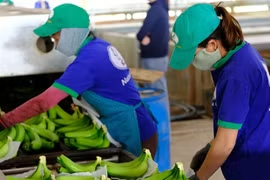
Workshop helps fresh fruit exporters learn about China’s new regulations ảnh 1Processing dragon fruits for export (Photo: VNA)
Binh Thuan (VNA) – Exporting fresh fruit in thecontext of China implementing Decrees 248, 249 and strengthening cold-chainfood imports control were the topics of discussion at a workshop in the southcentral province of Binh Thuan on August 19.

The event was co-organised by the Vietnam Sanitary andPhytosanitary Notification Authority and Enquiry Point (Vietnam SPS) and theprovincial Department of Agriculture and Rural Development.

According to the Vietnam SPS, China is currently the main market for Vietnam'sfruit and vegetable export. However, it is setting higherrequirements for agricultural imports, especially regarding traceability, foodsafety and hygiene, and COVID-19 prevention and control.

China’s Decree 248 on regulations on the registration and administrationof overseas producers of imported food requires that all overseas food manufacturers, processors, and storage facilities be registered with the General Administration of Customs of China (GACC) to export product to the country.

Meanwhile, under Degree 249 on administrativemeasures on import and export food safety, exporters are responsible for food safety even if their products have been shipped to China.

Both decrees took effect on January 1, 2022.

Vietnam SPS Director Le Thanh Hoa said the workshop aims toinform local firms on the decrees so that they can come up with suitablesolutions and orientations to ensure export to this big and potential market.

Reports presented gave information on a series of matters,including fresh fruit exports, food safety management, plantations, packagingand plant quarantine, among others.

Currently, Vietnam has 11 kinds of fruits that are exportedvia official channels to China. Of these fruits, Vietnam has signed with Chinaprotocols on phytosanitary requirements for three kinds, including mangosteen,passion fruit and durian.

Last year, Vietnam exported 3.55 billion USD worth ofvegetables and fruits, up 8.6% from a year earlier. Of the figure, 1.9 billionUSD came from shipments to China, an increase of 3%.

However, vegetable and fruit exports plunged 9.6 percent year-on-year to 508 million USD in the first two months of 2022 due to a sharp decrease in shipments to China, according to the General Department of Vietnam Customs.

Shipments to China fell nearly 26 percent year-on-year to worth 261 million USD in the period as a result of the neighbouring country’s stricter rules on imported food, causing severe backlogs at shared borders in the north./.
VNA
See more

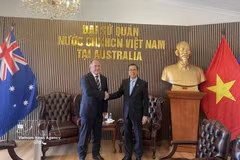
Speakers at the conference (from left): AVPI Advisory Board Chair Dr Le Thu Huong, Australian Ambassador to Vietnam Gillian Bird, and Vietnamese Consul General in Sydney Nguyen Thanh Tung. (Photo: VNA)

Vietnam, Australia turn momentum into practical cooperation

Vietnam and Australia should focus on promoting two-way investment, expanding cooperation linked to APEC 2027 and making better use of people-to-people connections. Vietnam needs capital, skills, technology, infrastructure, and energy transition expertise - areas where Australia could offer valuable support.

The interface of the National E-Procurement System. (Photo: muasamcong.mpi.gov.vn)

Vietnam to move PPP bidding online from 2027

From January 1, 2027, PPP project proposals must be submitted through the National E-Procurement System. From September 1, 2027, investor selection for PPP projects tendered through open bidding will move fully online.

An automated robot-based production line at CAYI Technology Vietnam Co., Ltd. in Yen Phong II-C Industrial Park, Bac Ninh city (Photo: VNA)

EuroCham: Business Confidence Index in Vietnam remains high at 78.3 in Q3

The survey found that 64% of respondents described their current business conditions as good or very good, while 28% maintained a neutral or cautious outlook, reflecting a wait-and-see attitude as international demand remains flat and businesses look for policy momentum to translate into faster procedures and more predictable outcomes.

Workers manufacture handheld power tools at the Keystone Electrical Vietnam factory in Lien Ha Thai Industrial Park, Thai Thuy commune, Hung Yen province (Photo: VNA)

Vietnam seeks to turn FDI inflows into domestic value added

Vietnam is shifting its FDI attraction strategy from expanding investment volumes to prioritising capital inflows that brings technology, knowledge, modern management practices and stronger links with domestic businesses, particularly in semiconductors, artificial intelligence (AI), chips and renewable energy.

At Yadea Vietnam’s smart manufacturing plant in Tan Hung Industrial Park, Bac Ninh province (Photo: VNA)

Vietnam ties FDI incentives to local supplier commitments

Incentives will increasingly hinge on investors’ performance and commitments, not just on landing projects. Key commitments include transferring technology to Vietnamese firms, training workers, providing technical support and opening FDI supply chains to domestic companies.

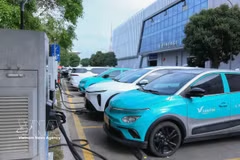
Green SM has launched all-electric taxi service in the US. (Illustrative photo: VNA)

Green SM launches all-electric taxi service in US

The move brings Green SM into one of the world’s most dynamic and demanding markets. It also marks another step in the international expansion of the Vietnamese mobility brand, following its rapid growth across markets in Asia and Europe.

An overview of the meeting between IMF Managing Director Kristalina Georgieva and ASEAN Finance Ministers and Central Bank Governors (Photo: VNA)

Vietnam strengthens financial cooperation at IMF-World Bank annual meetings

The Vietnamese Governor underscored the complementary roles of global and regional financial cooperation mechanisms, including the Chiang Mai Initiative Multilateralisation (CMIM) and the ASEAN+3 Macroeconomic Research Office (AMRO). He also highlighted the importance of technical assistance in fintech, digital transformation, cybersecurity and risk management.

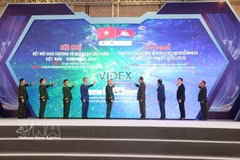
Representatives of the organising committee at the opening ceremony of the fair (Photo: VNA)

Vietnam-Cambodia trade expo promotes bilateral economic cooperation

The Vietnam-Cambodia Business Networking and Product Promotion Exposition has become a key trade promotion event, creating business and investment opportunities while strengthening mutual understanding and trust between the two countries’ armies, people and enterprises.