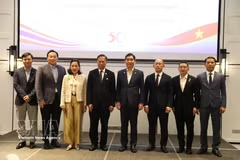
Workshop promotes Vietnam-India trade links

Vietnam and India should focus on fully tapping economic cooperation potential, especially in electricity production, the steel industry, hi-technology, sea port construction, hotel development.
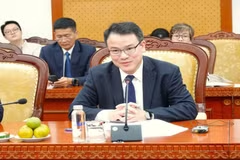
Workshop promotes Vietnam-India trade links ảnh 1Vietnamese Ambassador to India Ton Sinh Thanh speaks at the event (Source: VNA)

New Delhi (VNA) – Vietnam and India should focus on fully tapping economic cooperation potential, especially in electricity production, the steel industry, hi-technology, sea port construction, hotel development, traffic infrastructure and urban development, an Indian economic expert remarked.

Speaking at a workshop in West Bengal state on January 25, Former President of India ’s Merchant Chamber of Commerce and Industry (MCCI) Kumar Saraf, suggested the two countries consider a concessionary trade agreement, towards reducing tariff and non-tariff barriers for goods and services exports between the two countries.

Vietnam is one of the most dynamic economies in the region after nearly 30 years of its Renewal (Doi Moi) process, becoming one of the world leading exporter of rice, coffee and pepper, he stressed.

Vietnamese Ambassador to India Ton Sinh Thanh, highlighted the great potential for Vietnam and India to expand their trade and investment links.

According to Thanh , Vietnam is a member of 13 free trade areas. Apart from joining free trade agreements (FTAs) between ASEAN and India , China , the Republic of Korea (RoK), Australia , and New Zealand , Vietnam signed bilateral FTAs with the RoK and the Eurasia Economic Union (EAEU). Vietnam is also participating in FTA negotiations with the European Union and the Regional Comprehensive Economic Partnership (RCEP).

Vietnam-India trade ties has developed rapidly in recent years, hitting 5.6 million USD in 2014. In the first seven months of 2015, the figure reached over 3 billion USD. The two nations aim to lift their two-way trade to 15 billion USD by 2020.

Vietnam's key exports to India include mobile phones, electrics, rubber, cashews, textiles, steel and iron, and wool and wood products; while its main imports from India are machinery and chemicals.-VNA
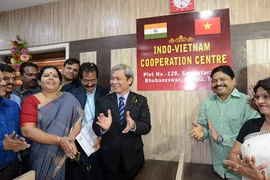
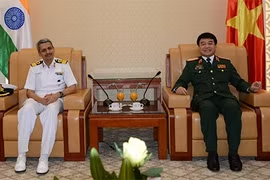
VNA

See more

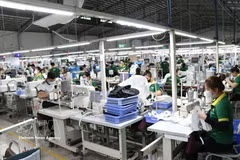
Production of footwear for export at Lefaso Tra Vinh Industrial Investment and Production Joint Stock Company, Tra Cu commune, Vinh Long province (Illustrative image. Source: VNA)

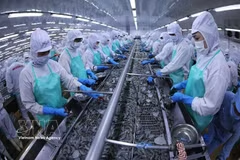
VEFTA implementation requires exporters to restructure supply chains: Experts

Under VEFTA, tariff reductions to zero will be meaningless for Vietnam’s key export sectors, including textiles and garments, footwear, and agricultural and aquatic products, if goods are found to contain banned chemicals, violate rules of origin or lack transparency regarding their carbon footprints.

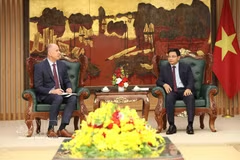
Deputy Prime Minister Nguyen Van Thang meets with Martin Sommer, head of the IMF’s Article IV consultation mission team to Vietnam, in Hanoi on November 13, 2026. (Photo: VNA)

IMF sees positive growth prospects for Vietnam, urges cautious monetary policy

Martin Sommer, head of the IMF’s Article IV consultation mission team to Vietnam, noted that inflation risks in Vietnam remain under control, but several factors could add to price pressures. He therefore called for cautious monetary policy management and readiness to respond promptly if inflationary pressures increased.

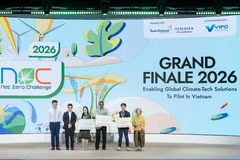
Representatives of the three first-prize-winning startups receive their awards at the event. (Photo: SGGP)

Seven green-tech startups secure 770,000 USD at Net Zero Challenge 2026

In its fourth year, the competition attracted more than 1,100 applications from 80 countries and territories, making it the most competitive edition since its launch in 2023. Nine finalists presented solutions in three categories, namely renewable energy and carbon removal; food systems and sustainable agriculture; and circular economy and waste management.

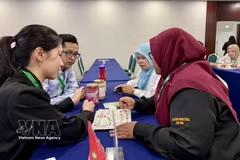
Vietnamese and Malaysian businesses connect at the event (Photo: VNA)

Vietnam, Malaysia connect businesses to boost bilateral trade cooperation

It centred on a business-to-business (B2B) matchmaking session, bringing Vietnamese and Malaysian companies together to discuss import-export needs, seek partners and explore cooperation. Vietnamese businesses aimed to connect with Malaysian importers, distributors and retailers, while expanding access for their products to Malaysia and other markets.