Workers load rice sacks for exports (Photo: VNA)
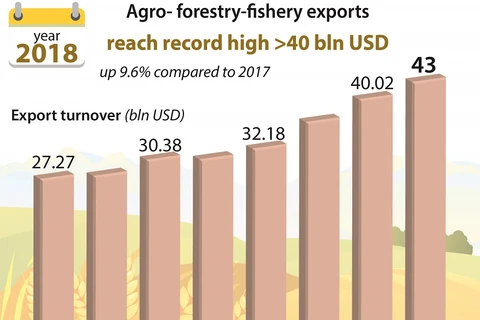
 Hanoi (VNA) – Vietnam’s agro-forestry-fishery exports in February hit 1.93 billion USD, bringing the figure in the first two months of this year to 5.5 billion USD, a decrease of 1.6 percent year-on-year, according to the Ministry of Agriculture and Rural Development (MARD).
In the two months, the revenue of farm produce exports stood at 2.71 billion USD, a drop of 10.1 percent; while that of animal husbandry hit 77 million USD, down 7 percent.
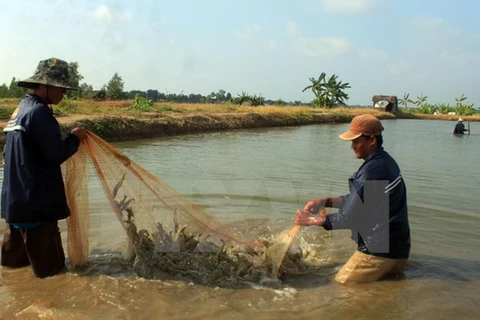
Meanwhile, the country earned 1.11 billion USD from aquatic products, a rise of 4.4 percent, and 1.5 billion USD from forestry products, up 12.8 percent.
In February, Vietnam shipped 399,000 tonnes of rice abroad worth 169 million USD. Rice shipments in the first two months reached 837,000 tonnes with 364 million USD, up 1.1 percent in volume but down 10.4 percent value against the same period last year.
The Philippines was the leading export market of Vietnamese rice, accounting for 46.7 percent of the market share. A working delegation of the MARD is set to visit the country to bolster rice exports at some point in this year’s first quarter.
To bolster rice exports to China, the MARD has instructed relevant agencies to review and assess the competence of 22 exporting firms in accordance with an announcement of China’s General Administration of Customs, according to the Department of Plant Protection.
Vietnam exported 228,000 tonnes of rubber in the two-month period and earned 293 million USD, surging by 22.4 percent in volume and 6.8 percent in value over the previous year.
Coffee shipments in February were estimated at 143,000 tonnes worth 285 million USD, raising the figure to 326,000 tonnes worth 610 million USD in the year’s first two months, a year-on-year decline of 7.5 percent in volume and 10.8 percent in value.
Meanwhile, the country exported 31,000 tonnes of peppercorns in two months, raking in 92 million USD and increasing 4.3 percent in volume but tumbling 20.4 percent in value.
In February, Vietnam imported 1.8 billion USD worth of agro-forestry-fishery products, bringing the two-month figure to 4.59 billion USD, increasing 3 percent year-on-year. –VNA
In the two months, the revenue of farm produce exports stood at 2.71 billion USD, a drop of 10.1 percent; while that of animal husbandry hit 77 million USD, down 7 percent.
Meanwhile, the country earned 1.11 billion USD from aquatic products, a rise of 4.4 percent, and 1.5 billion USD from forestry products, up 12.8 percent.
In February, Vietnam shipped 399,000 tonnes of rice abroad worth 169 million USD. Rice shipments in the first two months reached 837,000 tonnes with 364 million USD, up 1.1 percent in volume but down 10.4 percent value against the same period last year.
The Philippines was the leading export market of Vietnamese rice, accounting for 46.7 percent of the market share. A working delegation of the MARD is set to visit the country to bolster rice exports at some point in this year’s first quarter.
To bolster rice exports to China, the MARD has instructed relevant agencies to review and assess the competence of 22 exporting firms in accordance with an announcement of China’s General Administration of Customs, according to the Department of Plant Protection.
Vietnam exported 228,000 tonnes of rubber in the two-month period and earned 293 million USD, surging by 22.4 percent in volume and 6.8 percent in value over the previous year.
Coffee shipments in February were estimated at 143,000 tonnes worth 285 million USD, raising the figure to 326,000 tonnes worth 610 million USD in the year’s first two months, a year-on-year decline of 7.5 percent in volume and 10.8 percent in value.
Meanwhile, the country exported 31,000 tonnes of peppercorns in two months, raking in 92 million USD and increasing 4.3 percent in volume but tumbling 20.4 percent in value.
In February, Vietnam imported 1.8 billion USD worth of agro-forestry-fishery products, bringing the two-month figure to 4.59 billion USD, increasing 3 percent year-on-year. –VNA
VNA