Tet, or Lunar New Year, is an opportunity for descendants to invite the souls of their ancestors to join the family’s Tet celebration. (Photo: iStock)
 Hanoi (VNA) – Ancestor worship, an ancient Vietnamese tradition, is a ritual practice paying tribute to deceased family members and reminding people of their roots.
The practice reflects the influence of patriarchy and Confucianism on Vietnamese culture.
Since Confucianism was introduced to Vietnam during the Chinese domination, filial piety, the most fundamental of Confucian values, has been very much appreciated in Vietnamese families.
Accordingly, children are obliged to respect their parents in life and to remember them after they die. The practice of ancestor worship is thus an expression of “filial piety” toward deceased parents, relatives and ancestors.
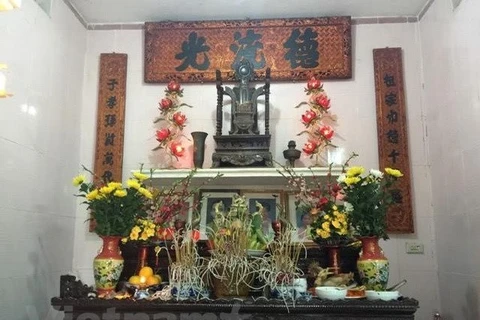
Most Vietnamese families have an ancestral altar placed in a prominent place of the house.
The ancestral altar is set with ancestral tablets and pictures, together with an incense burner bowl in the centre as a symbol of the stars. Inside the bowl usually stands a circular incense stick that represents the universe. Two candles are placed on the sides of the altar to embody the sun (left) and the moon (right).
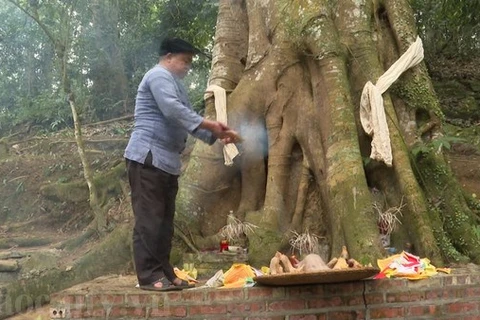
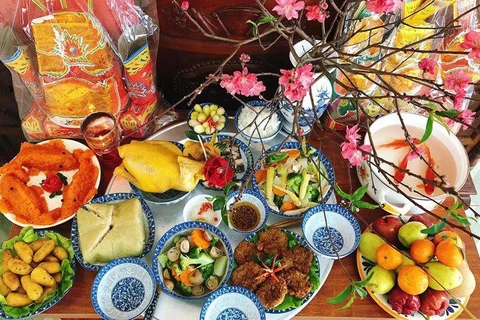
On special occasions like ancestors’ death anniversaries or the Lunar New Year, special rites are performed to communicate with the dead. The rites consist of making offerings of fruits, foods and wine; lighting the candles; and burning incense before praying in front of the altar.
Tet, or Lunar New Year, is the most important festival of the year for Vietnamese people and a time for family reunions. It is an opportunity for descendants to invite the souls of their ancestors to join the family’s Tet celebration.
On these days, every home has a tray filled with five types of fruits placed on the ancestral altar. The fruits may include a bunch of bananas, pomelo, persimmon, pear and tangerine in different colours to represent the desire for “phu” (prosperity), “quy” (notability), “tho” (longevity), “khang” (health) and “ninh” (peace).
The altar may also be decorated with a branch of peach blossoms in warm pink to drive away evil spirits and bad luck.
The ancestral altar occupies a prominent place in every Vietnamese home, no matter whether the family is rich or poor. It is a manifestation of the country’s culture that shows its respect for both the past and the future./.