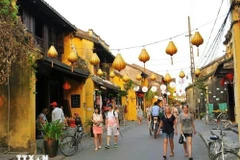
Tourists in Hoi An (Photo: VNA)
 Quang Nam (VNS/VNA) - The ancient city of Hoi Anis being challenged by mass tourism, traffic congestion, underdevelopedwaste management, vendors, street food quality and poor design and operation ofhomestays that have badly impacted the UNESCO-recognised World HeritageSite.
Noise and dust pollution, unfair competitionamong tourism services and harassment have all been recorded inrecent years.
Owners of centuries-built houses had leased themout, leaving a spiritual void in the town for generations ofits people.
Vice Chairman of the Quang Nam TourismAssociation Vo Phung said the Old Quarter covering just 1sq.km hostedat least 10,000 visitors each day, creating pressure on vulnerable infrastructure,architecture, the environment and traffic.
The gentle lifestyle of the old streetshad been replaced by noisy vehicles, annoying vendors and streetfood carts, Phung said.
Deputy Director of Hoi An’s Information andCulture Centre Nguyen Phuong Dong said the Old Quarter hadbecome overloaded over the past 20 years since it was recognised asa World Heritage Site by UNESCO.
“Although we charge locals 80,000 VND andforeigners 120,000 VND to enter, the Old Quarter still hosts from 10,000to 13,000 visitors each day, which is three times more than it can take,”Dong said.
“At least 8,000 visitors flock into townfrom 3pm to 9pm, and it’s chaos. Sometimes, it's difficult for localresidents and tourists to move comfortably in the pedestrian area,” he said.
Luu Van Anh, a restaurant owner in Hoi An,suggested new night performances and art spaces should be built on An BangBeach, Tra Que Village or Phan Boi Chau Street to create more options forvisitors in the evening.
“There are no more options for tourists atnight. The city could host nighttime entertainment, markets and artperformances to ease congestion in the Old Quarter,” hesuggested.
“More pedestrian bridges should bebuilt over the Hoai River because An Hoi Bridge gets really busy atnight. Street art plans for Phan Boi Chau – outside the Old Quarter – have yetto be realised, along with activities or events at night. Shops often closeat 8pm, except restaurants, cafés and spas,” Anh said.
Tran Thanh Chau, from Silk Sense Resort and Spa,said a tourism database should be developed to identify differentclasses of tourists before proposing a solution for the overloadding.
He said the city could offer a 50 percentdiscount for entrance tickets between 8am and 2pm, which would helpreduce numbers during rush-hour (from 3pm to 10pm).
Tran Tan Van, Chairman of the Vietnam ArchitectsAssociation, warned that ancient architecture in Hoi An would be damaged due toredecoration or redesign.
“The architecture is a priceless heritagefor Hoi An's people,” he said.
“More shopping centres and entertainment spaces,art stages, fashion stores, a night market and pedestrian streets should becreated to reduce congestion,” he added.
He said the city should move its administrativecentre and stage agency buildings to outside the Old Quarter toreserve more space for tourists.
Homestays
Tran Thi Ngoc Dung, from the city’s Informationand Culture Centre, said 302 homestays had been established in the citywith a total of 1,100 rooms.
“Homestay services have been booming, fromsix places with 31 rooms to 302 with 1,187 rooms in 2018,creating 1,000 jobs and revenue of 13.7 billion VND,” Dung said.
“Homestays now look like two-star hotels thanksto a decor makeover, but they're still lacking cultural activities,” she said.
“Tourists need to join in community activitiessuch as going to the market, cooking or even going to a family wedding orparty.”
Pham My, a tour operator, said most homestays inHoi An focused on room service rather than community-based lifestyle andcultural exchanges.
“It’s false in terms of design andarchitecture. Rural houses in Hoi An's suburban areas must be restored towhat they were in the past,” My explained.
“Street food is also poor and takes upspace. Vendors badger tourists to buy fruit, tofu and toys,” he said.
My added that eye-catching souvenirs wererare in Hoi An, only clay toys, lanterns and poorly designedcarpentry could be found.
He said local residents should be educatedabout environmental protection, waste management and recycling, andfood safety.
Phan Xuan Anh, a tour operatorat Saigontourist agency, said the environment needed cleaning up in CamThanh commune and An Bang beach.
He suggested homestay owners shouldimprove their English and knowledge of history and culture tooffer support for tourists during their stay.
Hoi An releases 33,500 tonnes of rubbisheach year, but there is no standard waste processing plant in the city.
The city welcomed 1.7 million tourists in thefirst nine months of the year, of which 1.4 million were foreigners, earning198 billion VND (8.6 million USD) – a 28 percent jump from the sameperiod last year./.
VNA