ASEAN cooperation more important than ever: Singaporean expert

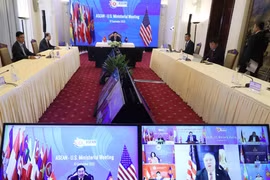
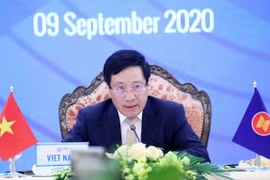
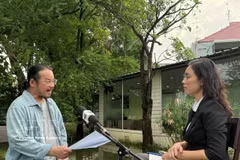
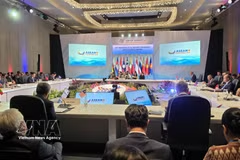
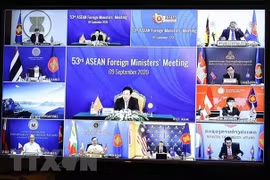
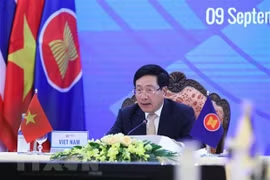
Complicated external situation has made collaboration within the ASEAN bloc more important than ever before, a Singaporean expert told the Vietnam News Agency on the occasion of the 53rd ASEAN Foreign Ministers Meeting and related conference underway in Hanoi.
Singapore (VNA) – Complicated external situation has madecollaboration within the ASEAN bloc more important than ever before, aSingaporean expert told the Vietnam News Agency on the occasion of the 53rd ASEAN Foreign Ministers Meeting and related conference underway in Hanoi.

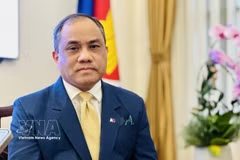
Dr Malcolm Cook, a visiting senior fellow with the Institute of Southeast AsianStudies (ISEAS)-Yusof Ishak Institute, said the COVID-19 pandemic, the US-Chinarivalry and concern-causing activities by China have greatly constrainedASEAN’s agenda and ability to act collectively.

Completion of the Regional Comprehensive Economic Partnership (RCEP) would be agood sign, showing that the bloc is able to facilitate greater regionaleconomic integration at a time when this is impossible through the World TradeOrganisation (WTO), he said.
Regarding Vietnam’s role as the ASEAN Chair in 2020 inpromoting joint regional efforts to deal with the challenges, Cook said thecountry has done a good job during the COVID-19 pandemic.

The country has supported the ASEAN and ASEAN mechanisms so as to address thepandemic’s impact in the region, while maintaining progress on core ASEANinitiatives like RCEP, he said.

“Vietnam has been given a very toughtask as chair of ASEAN and so far has handled it well”, Cook emphasised./.
VNA
See more

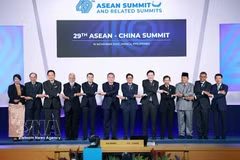
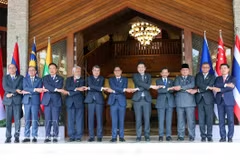
Prime Minister Le Minh Hung (fifth, left) and other ASEAN leaders and Chinese Premier Li Qiang at the 29th ASEAN-China Summit (Photo: VNA)

PM suggests priorities for elevating, deepening ASEAN-China cooperation

First, Prime Minister Le Minh Hung stressed that the two sides should continuously strengthen strategic trust and maintain an environment of peace and stability. The PM called for expanded exchanges and cooperation, stronger coordination in responding to emerging non-traditional challenges, and enhanced cooperation at the United Nations and other multilateral forums.

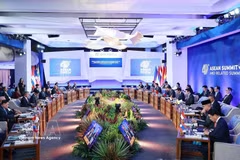
An overview of the dialogue between ASEAN leaders and the ASEAN Business Advisory Council (ASEAN-BAC) in Manila on November 15 (Photo: VNA)

Vietnam puts forward priorities to advance ASEAN cooperation

Appreciating ASEAN-BAC’s report and recommendations, Deputy Minister of Foreign Affairs Dang Hoang Giang, head of Vietnam’s ASEAN Senior Officials’ Meeting (SOM) delegation, called for simplifying procedures, reducing costs, accelerating digitalisation, upgrading the ASEAN Single Window (ASW) and effectively implementing the ASEAN Digital Economy Framework Agreement (DEFA) to make the regional market more accessible.

An overview of the ASEAN Leaders’ Interface with Representatives of the ASEAN Inter-Parliamentary Assembly (AIPA) in Manila on November 15 (Photo: VNA)

Vietnam proposes three key directions for ASEAN-AIPA cooperation

Prime Minister Le Minh Hung affirmed that close and effective coordination between the governments and parliaments of member states is a foundation and important driving force for ASEAN to realise its vision of a united, resilient, dynamic and people-centred community.

ASEAN signs Digital Economy Framework Agreement

ASEAN signs Digital Economy Framework Agreement

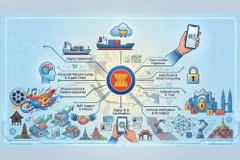
The Digital Economy Framework Agreement (DEFA), the bloc’s first standalone and legally binding digital economy agreement, establishes common rules covering digital trade, cross-border data flows, electronic payments, cyber security and artificial intelligence (AI).

An overview of the ASEAN Foreign Ministers’ Meeting on November 14, 2026 (Photo: VNA)

Vietnam backs ASEAN culture of consultation, dialogue, preventive diplomacy

Deputy Minister of Foreign Affairs Dang Hoang Giang stressed that amid conflicts and instability in various parts of the world, ASEAN should give top priority to strengthening the foundations of peace and stability, uphold the rule of law and promote the bloc’s principles and norms of conduct, particularly the Treaty of Amity and Cooperation in Southeast Asia (TAC).

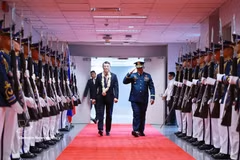
The welcome ceremony for Prime Minister Le Minh Hung at Ninoy Aquino International Airport on November 14 afternoon (Photo: VNA)

Vietnamese PM arrives in Philippines for 49th ASEAN Summit

PM Le Minh Hung’s attendance underscores Vietnam's sustained commitment to the bloc, which aligns consistently with the foreign policy set forth by the 14th National Party Congress, which defines ASEAN as a bloc of strategic importance and a top priority in Vietnam’s external relations.

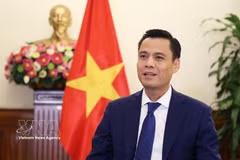
Deputy Minister of Foreign Affairs Dang Hoang Giang. Photo: VNA

Vietnam aims to promote ASEAN unity, resilience and practical cooperation: Deputy FM

Prime Minister Le Minh Hung's attendance at the 49th ASEAN Summit and related summits in Manila, the Philippines, from November 14-17 aims to concretise Vietnam's foreign policy of independence, self-reliance, resilience, multilateralisation and diversification, and reaffirm ASEAN's position as Vietnam's foremost strategic priority in its foreign policy.

A road is under construction in Dong Nai city, Vietnam. (Photo: VNA)

ADB: Southeast Asia needs 7.1 trillion USD in infrastructure investment by 2040

ADB estimates that the region will need an average of 476 billion USD in infrastructure investment annually during 2026–2040, equivalent to 8.7% of GDP. However, at current investment levels, government budget resources would cover only around 45% of this demand, leaving an annual financing gap of 264 billion USD.

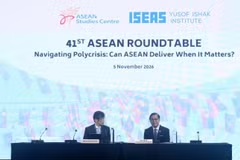
Thai Deputy Prime Minister and Minister of Foreign Affairs Sihasak Phuangketkeow (R) takes part in the Q&A session at the 41st ASEAN Roundtable. (Photo: VNA)

Thailand calls on ASEAN to proactively address polycrisis

Thai Deputy Prime Minister and Minister of Foreign Affairs Sihasak Phuangketkeow noted that no single member state could tackle challenges ranging from major-power competition and economic fragmentation to climate change and energy and food security on its own. Regional cooperation is therefore a strategic imperative, enabling ASEAN not only to overcome crises but also to sustain its development momentum.