ASEM members share experience in climate change adaptation

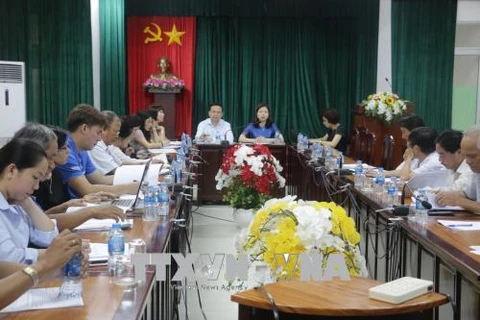
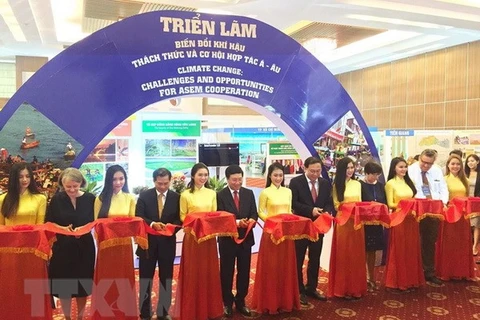
Representatives from member countries of the Asia-Europe Meeting (ASEM) shared their experiences in coping with climate change on June 19, part of the ASEM Conference on Climate Action to Achieving the Sustainable Development Goals - Ways Forward in Can Tho city.
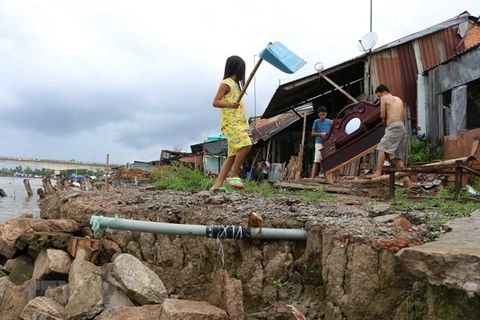
ASEM members share experience in climate change adaptation ảnh 1Houses are temporarily reinforced in the face of erosion on the banks of the Cai Con River in Mai Dam town of Chau Thanh district, the Mekong Delta province of Hau Giang (Photo: VNA)

Can Tho (VNA) –Representatives from member countries of the Asia-Europe Meeting (ASEM) sharedtheir experiences in coping with climate change on June 19, part of the ASEM Conferenceon Climate Action to Achieving the Sustainable Development Goals - Ways Forwardin Can Tho city.

Filip Kusmierski, an expert on climatechange policy of the Polish Ministry of Environment, said to deal with climatechange, the key solution is to reduce greenhouse gas emissions into theenvironment through projects on researching, developing and promoting the useof clean energy like solar, wind and geothermal energy.

At the conference, Poland introduced aproject on improving governments’ and relevant sides’ capacity of collecting,managing, analyzing and using data of the energy sector to serve the making ofdecisions and the building of action plans on green growth in developingcities.

Another solution to curb greenhouse gasemissions is to boost the sustainable use and resilience of agricultural landresources, according to Diji Chandrasekharan Behr, a senior natural resourceeconomist at the World Bank Group.

She said recent studies found thatagricultural land degradation has become increasingly popular in many ASEMeconomies, including Vietnam where more than 50 percent of the natural landarea nationwide faces the risk of erosion, threatening ecological balance andeconomic development.

The economist highlighted the necessityto use advanced technologies to survey the degradation situation and assessclimate change impacts on agricultural land and land use changes so as to buildsolutions to effectively and sustainably use agricultural land resources ineach region.

Meanwhile, Robbert Moree, a strategicadvisor at the Dutch Ministry of Infrastructure and Water Management, presentedan effective solution to respond to the sea level rise which is “Building withNature” that makes use of natural sand to reinforce beaches.

He said the Netherlands will sharesolutions to the sea level rise with cities in deltas around the world,including the Mekong Delta city of Can Tho.

Elaine Joyce Borejon, from the ClimateChange Commission of the Philippines, said the Philippines is also one of thecountries particularly vulnerable to climate change impacts, especially the sealevel rise.

The Philippines has built climatechange and sea level rise scenarios which serve as a basis for ministries,sectors and localities to take actions, she said, adding that the country hasalso made climate risk assessments for each region to devise suitable responseplans.

Countries should combine climate changeresponse in their development policies, she added.

Vietnam is assessed as one of thecountries hardest hit by climate change. In particular, the Mekong Delta regionis one of the three deltas in the world most vulnerable to sea level rise,together with the Nile River Delta in Egypt and the Ganges River Delta inBangladesh.

The ASEM Conference on Climate Action to Achieving the Sustainable DevelopmentGoals - Ways Forward is one of the most important inter-regional events onclimate change and the only one of ASEM 2018 hosted by Vietnam. It is aninitiative of Vietnam which was approved at the 13th ASEM Ministerial Meetinglast November in Myanmar and won support and sponsorship from manycountries.-VNA
VNA
See more

Delegates launch the Green Hero Solution project in Ho Chi Minh City on March 12, 2026. (Photo: VNA)

Vietnam, Denmark cooperate to pilot circular food model

Under the “Green Hero Solution” project, organic food waste will be collected from partner organisations and businesses and processed into compost. The compost will then be used at two Food Bank community gardens, where fresh vegetables will be grown to support disadvantaged households.

Deputy Prime Minister Tran Hong Ha meets with UNDP Resident Representative Ramla Khalidi and WHO Representative in Vietnam Angela Pratt in Hanoi on March 11. (Photo: VNA)

Vietnam steps up partnership with UNDP, WHO in tackling air pollution

Highlighting Vietnam’s close partnership with the two UN agencies, Deputy PM Ha highly appreciated their important contributions to the country’s development over the years, particularly in policy consultation, institutional reform and promoting sustainable development initiatives.

The groundbreaking ceremony for the Phu Cu waste-to-energy plant project in Doan Dao commune, Hung Yen province, on March 6 (Photo: VNA)

Hung Yen breaks ground on 4 trillion VND waste-to-energy plant

With a population of about 3.5 million, Hung Yen generates around 1,850 – 2,000 tonnes of household waste each day, along with about 1,000 tonnes of waste from production and business establishments, posing a major challenge for the locality.

A cycling convoy from the former Binh Duong province (now part of Ho Chi Minh City) parades through the streets to raise awareness in support of Earth Hour 2025. (Photo: VNA)

Earth Hour 2026 launch event rescheduled

The launch ceremony of a nationwide campaign that calls on all citizens to use energy economically and efficiently in response to Earth Hour 2026 will be held on the morning of Saturday, March 21, instead of March 7 as initially planned.

Nghe An neutralises 350kg unexploded wartime bomb (Photo: VNA)

Nghe An authorities safely dispose of 350kg wartime bomb

After inspection, military engineers identified the object as an MK-82 high-explosive bomb, measuring 20cm in diameter and 155cm in length, weighing about 350kg and still fitted with an intact detonator. The bomb was believed to be left over from the war.

Vietnam expands coastal forests to bolster green growth

Vietnam expands coastal forests to bolster green growth

Restoring and developing forests as part of the 2026–2030 coastal forest protection and development project is still a big job. The plan aims to plant 5,088 hectares — including 3,236 hectares of mangroves and 1,852 hectares on soil and sandy land — and to enrich, restore, and improve 1,514 hectares of existing forests, with 683 hectares of mangroves and 831 hectares on soil and sand.

The People’s Committee of Dakrong commune in the central province of Quang Tri, in coordination with the Dakrong Forest Protection Station hand over a small-clawed otter to the Cuc Phuong National Park and the Wildlife Rescue Centre in Vietnam (Photo: VNA)

Quang Tri hands over rare otter to Cuc Phuong National Park

The People’s Committee of Dakrong commune in the central province of Quang Tri, in coordination with the Dakrong Forest Protection Station, on February 26 handed over a small-clawed otter to the Cuc Phuong National Park and the Wildlife Rescue Centre in Vietnam for further care and rehabilitation.

UNESCO Representative to Vietnam Jonathan Wallace Baker and Japanese Ambassador Ito Naoki at the signing ceremony (Photo: baoquocte.vn)

UNESCO, Japan sign deal to bolster Vietnam’s disaster early warning

Climate change adaptation remains a top priority in Vietnam’s development strategy and national security outlook through 2050. Vietnam will maintain close cooperation with Japan, UNESCO and other partners to guarantee the project’s effectiveness and advance common goals.