Bad weather causes spike in children attending hospitals

The number of children in many localities being hospitalised has kept increasing over recent days due to unfavourable weather conditions.
Bad weather causes spike in children attending hospitals ảnh 1A doctor examines a baby at hospital. (Source: VNA)

Hanoi (VNA) – The number of children in many localities being hospitalised has kept increasing over recent days due to unfavourable weather conditions.

Unusual changes between hot and cold weather, coupled with rains and high humidity has created conditions for the development of diseases in children, according to doctors.

Most of the children have been hospitalised for diseases relating to respiratory problems like bronchitis and pneumonia, digestive ailments or dengue fever.

The Hanoi-based National Hospital of Pediatrics has received around 3,500 children for health check-ups and treatment each day over the past week, according to Head of the hospital’s Health Check-up Department Truong Thuy Vinh.

The figure represents an increase of 500-1,000 children compared to an average day.

“Unusual changes in weather conditions have caused many children to suffer from diseases relating to respiratory problems. There were days when 70-80 percent of children that I checked had respiratory problems,” said Nguyen Thi Mai Hoan, Deputy Head of the hospital’s Respiratory Disease Department.

When the weather changed, children, especially those with weak immune systems, were more likely to catch respiratory diseases, she said.

“The respiratory department is always overloaded on these days, forcing us to make use of spaces along corridors and between patients’ rooms to place some beds and baby cots for the kids, but some children still had to share beds,” she said.

Director of the Hanoi’s Preventive Health Centre, Nguyen Nhat Cam, warned that there was a high risk of outbreaks of these diseases if no measures were taken by authorised agencies, hospitals and the local people.

Meanwhile, in HCM City, apart from the risks of spreading of dengue fever and Zika virus, hospitals have also had to continue dealing with respiratory diseases and hand-foot-mouth disease.

The municipal Health Department reported that 84 children were hospitalised for hand-foot-mouth disease last week, 12 percent more than the figure for the whole past month. It brings the total number of patients with hand-foot-mouth disease to 952.

In the Mekong Delta province of Tien Giang, the number of children being hospitalised also increased as a result of the prolonged hot weather. Most of them suffered from respiratory diseases, dengue fever, diarrhea and hand-foot-mouth disease.

The Tien Giang Hospital admitted more than 100 children each day for such diseases, said director of the provincial Health Department Tran Thanh Thao.

The province recorded nearly 600 cases of dengue fever and 140 cases of hand-foot-mouth disease by the end of March, Thao said.-VNA
VNA

See more

A doctor provides dental checkup for a student. (Photo: VNA)

Free health checkups for children ahead of new school year

According to the Hanoi Department of Health, the city has 4,776 educational institutions with more than 2.2 million preschool and school students. The health campaign will run from August 18 to September 4, targeting 100% coverage before the new school year begins.

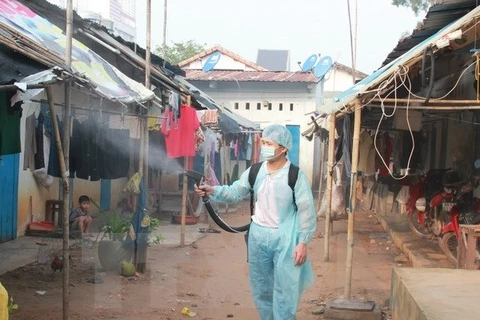
Spraying insecticide to prevent dengue fever in Dan Hoa commune, Hanoi. (Photo: VNA)

Hanoi steps up dengue prevention as cases rise

According to the Hanoi Centre for Disease Control (CDC), 316 dengue cases were recorded across 74 communes and wards in the city from August 7-14, up 81 from the previous week. Eleven new outbreaks were also reported, bringing the total number since the beginning of 2026 to 63, with 24 still active.

Screening and early cancer detection using advanced medical equipment at a healthcare facility (Photo: VNA)

Vietnam targets Southeast Asia’s leading medical tourism position by 2030

Medical tourists to Vietnam currently mainly comprise overseas Vietnamese and visitors from Cambodia, Laos, the Republic of Korea, Japan, Australia and several European countries. Popular services include cosmetic dentistry, assisted reproduction, aesthetic medicine, general health check-ups and some advanced medical specialties.

An ambulance from the pre-hospital emergency care service in Phu Quoc special zone in An Giang province. (Photo: VNA)

Pre-hospital emergency care system to be launched nationwide

From 2027, the national pre-hospital emergency management platform will be put into operation, connecting data with the 113, 114 and 115 emergency call systems to facilitate rapid emergency dispatch and improve public access to emergency services.

Foreign patients travel to Vietnam for robotic cancer surgery at one-tenth of US costs

Foreign patients travel to Vietnam for robotic cancer surgery at one-tenth of US costs

With robot-assisted surgery costing tens of thousands of dollars in the US and Singapore, a growing number of international patients are traveling to Vietnam for robotic cancer surgery, including procedures for prostate, gynecological and gastrointestinal cancers, using the US made da Vinci Xi system at costs starting from just 3,000 USD.

Under a phased rollout beginning in 2026, every resident in Ho Chi Minh City will receive at least one annual health check-up or health screening. (Photo: VNA)

Ho Chi Minh City develops integrated multi-tier healthcare system

Under the new model, healthcare is organised into interconnected levels based on people's needs rather than administrative boundaries. Patients can move seamlessly between levels while their electronic health records and treatment information remain connected through digital platforms, referral systems, telemedicine, electronic medical records, and integrated health databases.

Doctors conduct heart and lung examinations for workers. (Photo: VNA)

Draft policy encourages people to prepare for old age from middle age

A draft circular guiding the implementation of the National Target Programme on Health Care, Population and Development (2026-2035) marks a shift from focusing solely on elderly care to encouraging healthy and independent ageing through early preparation. It covers healthy lifestyles, regular health check-ups, financial planning, suitable employment and home-based elderly care skills.