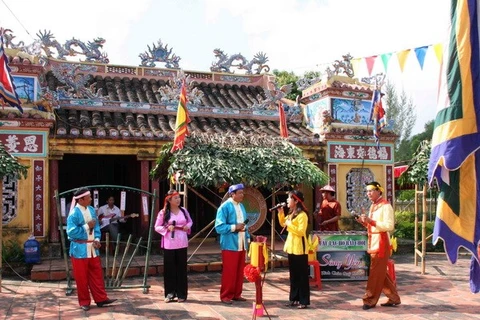
Tran Huu Phuoc (right) and his wife Le Thi Hoa (centre) guide their oldest son Tran Hue Thien in singing bai choi (Source: baobinhdinh.com.vn)
 Binh Dinh (VNA) - The evening has set, and Tran Huu Phuoc sits in front of his house to sing bai choi, a traditional music genre, after a hard day's work.
This has now become a habit with 47-year-old Phuoc, from the central province of Binh Dinh's Nhon Chau commune in Cu Lao Xanh Island, for the past many years. It has helped him release stress after a hectic day and find some peace, he said.
Bai choi singing, a folk art form that originated in the southern-central region of Vietnam, is popular in the central provinces of Thua Thien-Hue, Quang Nam and Binh Dinh, as well as Phu Yen and Khanh Hoa.
It includes traditional values and tunes of numerous types of Vietnamese music.
In love with singing since he was a little boy, Phuoc tried to travel and meet old people in the island to collect as many songs as possible and to learn from those who were experienced in singing these songs.
"I used to listen to my grandmother singing when I was young and gradually also learnt how to sing," Phuoc said.
"I do not know exactly when I fell in love with it," he said.
"Bai choi is so good. It is easy to get addicted to once you have listened to it," he said.
Bai choi, a traditional game, was invented nearly 400 years ago and serves as a community game for the Tet (Lunar New Year) holidays in the central region. The game often takes place on a wide yard in front of the communal house and brings the entire community together.
These songs are about festivals, daily life and work, and the singing is accompanied by traditional instruments.
Phuoc has actively participated in bai choi singing during local festivals or other festive events where he was entrusted to act as head of the game.
The person who is chosen as head of the game must learn by heart different bai choi songs and must know how to apply these folksongs in different situations.
"It requires a lot of practice to become the head of the game. I decided to not drink alcohol or beer since I was young, in order to retain my voice quality," Phuoc said.
In 2011, Phuoc joined a class on bai choi singing held by Binh Dinh province's Quy Nhon City Cultural Centre. He then came back to the island and co-founded a bai choi association with other local fishermen.
This form of singing also created a chance for Phuoc to meet his future wife, Le Thi Hoa, who has also grown up with bai choi just as Phuoc.
They met during singing performances and the love for the folksongs brought them together.
To satisfy their love for bai choi singing, Phuoc and his wife actively participated in performances across the province. They also often go to the mainland on weekends to perform for local people and tourists.
"Earning extra income from such performances is not our main purpose. The most important thing is that we can sing and indulgence ourselves," Hoa said.
"It is also great to encourage others to listen to it, to understand more about it and to fall in love with this form of music," she said.
Their love for bai choi has been passed on to their children, and the entire family still performs together, whenever they have free time.
What worries Phuoc the most now is finding ways to keeping this traditional music alive.
"It would be a great pity if fewer people sing bai choi and this traditional music is downgraded," he said.
In 2010, the Ministry of Culture, Sports and Tourism worked with Binh Dinh cultural authorities to revive the game in the central region after decades of it lying idle.
The ministry has assigned Binh Dinh to chair the profiling for bai choi's UNESCO heritage status.-VNA