During the first two months of social distancing, July and August, basa harvesting decreased by 20 percent and 44.9 percent respectively, (Source: congthuong.vn
 During the first two months of social distancing, July and August, basa harvesting decreased by 20 percent and 44.9 percent respectively, compared to the same period last year. Output decreased by 77 percent in the first half of this month.
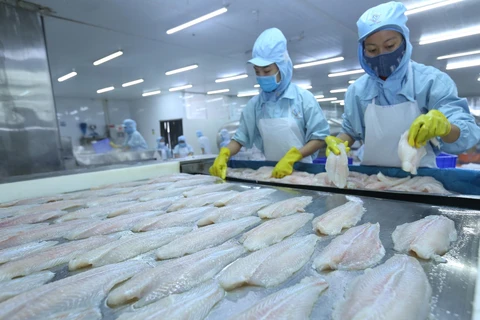
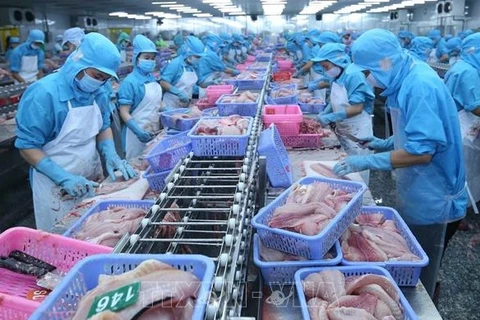
There are 106 basa processing factories registered for export in five provinces including An Giang, Dong Thap, Can Tho, Hau Giang and Vinh Long, employing about 190,000 people.
As of the beginning of this month, 52 of these processing plants across five provinces had to temporarily shut down, while over 70 percent of employees were out of work.
Due to both the shortage of labour and the splitting of remaining shifts, as per pandemic prevention methods, capacity is currently only 30-40 percent of what it was at the beginning of July this year.
However, total turnover is estimated at 1.054 trillion USD over the past nine months, equaling 106.2 percent over the same period last year, showing the potential of the market without COVID-19 complications.
The Vietnam Association of Seafood Exporters and Producers (VASEP) said that, due to social distancing and strict travel restrictions, the supply chain from fish farming to the factory had been disrupted.
As a result, it is possible that there will be a shortage of basa fish, which in turn could lead to a shortage of raw materials next year.
On top of this, due to the delay in harvesting the fish may become oversized and reduce in quality. Input costs have also increased dramatically, causing farmers prices to increase.
These are big obstacles for enterprises, particularly small and medium enterprises less able to cope with prolonged financial challenges.
Facing these difficulties, businesses have called for procedures to be simplified unilaterally across provinces, for financial relief to the industry and help to prevent shortages.
In addition, experts have suggested that a detailed roadmap be provided to navigate the post-pandemic period, with specific regulations and policies for businesses to proactively calculate plans for recovery.
They also asked the government to consider reducing bank interest rates, debt rescheduling and tax breaks, to allow businesses to resume production.
Duong Nghia Quoc, Chairman of the Vietnam Pangasius Association, said that in order to sustainably develop the industry in the last months of this year and next year, it was necessary to remove some of the difficulties faced by farmers and exporters caused by COVID-19; in particular, increasing vaccination for workers so that they could return to work soon.
On the other hand, he also emphasised that the quality of the market needed to be maintained in line with environmental goals, as well as developing domestic and international markets through new sales channels.
Quoc also noted that it was necessary to improve the brand image of Vietnamese basa fish. Focusing on developing existing markets the US, EU, China, and ASEAN, which has a market share of 50-60 percent, is vital, as is supporting the application of science and technology in seed production, rearing, and feeding./.
VNA