Binh Lieu’s untouched beauty lures visitors

Binh Lieu district in Quang Ninh province, which is well known for its hills covered in ravishing white reeds, is emerging as a magnet to visitors, especially during autumn, the most beautiful season of the year.
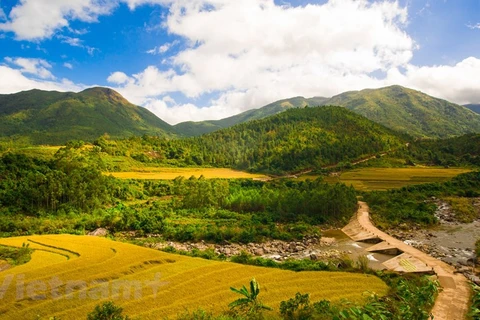
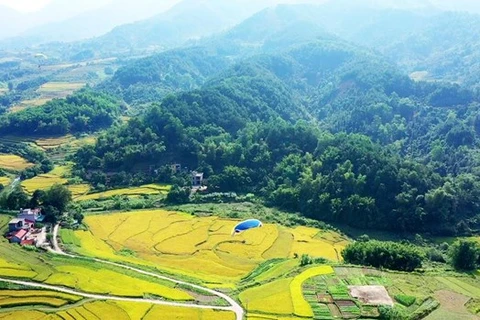
Binh Lieu’s untouched beauty lures visitors ảnh 1A terraced rice field in Binh Lieu (Photo: VNA)

Quang Ninh (VNA) - Binh Lieu district in Quang Ninh province, which is well known for its hills covered in ravishing white reeds, is emerging as a magnet to visitors, especially during autumn, the most beautiful season of the year.

Compared to other more famous tourist destinations in Quang Ninh such as Ha Long Bay, Co To, or Quan Lan, Binh Lieu is just an obscure name. But this cannot hide the attractiveness of the region, especially to younger tourists.

Located in the northeast, more than 100km away from the centre of Ha Long City and right next to the border with China, the mountainous district has a peaceful atmosphere and spectacular landscapes of untouched beauty.

In July and August, the district is decorated with the golden colour of terraced fields as they enter harvest season, while in March and April, trẩu flowers (Vernicia Montana) bloom, which are only found in Binh Lieu, and the whole region bursts in an array of stunning colours.

Though it is beautiful in every season, many will like it best in the autumn.

When autumn comes, the hills of Binh Lieu are covered with white reeds, creating spectacular romantic views for travellers. Thus the area is known as the 'Reed Kingdom'.

These white reed hills can be found on border patrol road at an altitude of 700m, just west of Binh Lieu. To get there, tourists have to travel from Binh Lieu Town to Hoanh Mô, and then to Ngan Chuong Village in Luc Hon Commune.

From here, tourists can start the journey to visit the border route, which is about 16km long. Many majestic landmarks are numbered and prove popular places for young travellers to take photos.

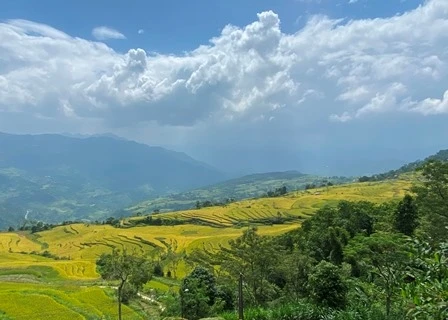
Along the way, visitors can enjoy wonderful views of terraced fields, small villages hidden behind mountains and clear blue skies.

The small road leading to the reed fields is right on top of a high hill, and it is likened to walking on a back of a giant dinosaur. It is known locally as 'the spine of the dinosaur'.

It is also considered the biggest challenge of the whole journey as it leads to the peak of the highest mountain of Binh Lieu.

In the past there there was no road and travellers had to walk through many hidden dangers. However, a more than one-metre wide road was completed in 2018 and it is now more convenient, including 2,000 steps and guard rails on both sides.

To reach the landmark, it takes about 2 hours.

Besides natural beauty, tourists can also experience and witness the lives of local ethnic minorities.

A total of 96 percent of Binh Lieu’s population are ethnics, the highest concentration of minorities in the whole country. The Tay accounts for the majority, 51.27 percent. Others include the Dao (28.21 percent) and San Chay (15.25 percent).

Each ethnic group retains its own cultural values and unique dishes elaborately cooked with local ingredients. Some outstanding local dishes are five-colour sticky rice, black chicken, arrowroot noodles, and stir-fried wild bamboo shoot.

The patterns on the clothing of each group also vary, with the Dao embroidering using colourful thread, while the Tay and San Chi preferring to dye their fabrics in indigo and blue.

The mountainous district also has its own intangible cultural heritage, notably festivals including the Luc Na festival and the singing festival in March. During the festival, visitors can watch locals playing folk games like tug of war, and enjoy their unique traditional songs.

Relatively unspoilt by development, the cultural features of the ethnic communities in Binh Lieu are mesmerising, and the untouched landscapes make it an amazing place for tourists to explore./.
VNA

See more

The Ba Trieu Temple in Thanh Hoa province (Photo: VNA)

Thanh Hoa taps digital transformation to boost heritage tourism

With 28 nationally-recognised intangible cultural heritage elements, Thanh Hoa province has prioritised integrating conservation with tourism development. Digital transformation, in particular, is seen as a crucial bridge connecting tradition with innovation, helping heritage sites become more accessible and engaging.

Pristine white-sand beach on Cu Lao Cham Island, Da Nang city, is a magnet for visitors. (Photo: VNA)

Vietnam – a safe destination amid global uncertainties

Despite global tourism headwinds linked to geopolitical conflicts, transport disruptions and surging travel expenses, Vietnam’s tourism sector has sustained strong growth, underscoring the destination’s resilience and rising international profile.

A border guard at the Mong Cai International Border Gate processes exit procedures for passengers at the Bac Luan 1 border gate in Quang Ninh province. (Photo: VNA)

Vietnam, China promote AI application in cross-border tourism cooperation

During the programme, participants will attend intensive courses delivered by AI technology experts, China–ASEAN policy researchers, and tourism specialists. The curriculum focuses on the application of big data in tourism policy planning, the development of cross-border tourism products, and the building of joint tourism brands.

The sea area off the southern coast of Phu Quoc Island. (Photo: VNA)

UK newspaper praises Phu Quoc’s unspoilt charm amid tourism boom

Phu Quoc is positioned as a compelling alternative – even a potential rival to Phuket – for travellers seeking authenticity in Southeast Asia. Its appeal lies not only in scenic beauty and fresh seafood, but also in the harmonious coexistence of modern tourism and enduring local culture.

At an elevation of 1,700 metres above sea level, the summit of Pu Luong is increasingly emerging as an ideal destination for trekking - a form of adventure tourism that combines hiking with nature exploration and physical as well as mental endurance. (Photo: VNA)

Vietnam eyes becoming region’s leading tourism destination

Vietnam has in recent years undergone a notable transformation in its tourism development strategy, placing a strong emphasis on nature-based and eco-tourism. This shift is not merely aligned with global trends, but represents a necessary step towards safeguarding valuable natural resources, while appealing to a growing segment of environmentally conscious travellers.

Foreign tourists in a photo with local residents. (Photo: VNA)

Vietnam serves 6.76 million foreign arrivals in Q1

China and the Republic of Korea (RoK) continued to lead as Vietnam’s largest source markets in the quarter, with 1.4 million and 1.3 million visitors respectively, accounting for around 40% of total arrivals.

Cua Viet beach is a magnet for both locals and visitors during holidays. (Photo: VNA)

Quang Tri seeks to unlock potential of marine tourism’s “golden triangle”

Cua Tung, Cua Viet and Con Co special zone are identified as three key destinations of marine tourism, and to transform this “tourism triangle” into premium and peaceful resorts, a new strategy is needed to enhance attractiveness to high-end travellers seeking private spaces as the strength of these places lies in their pristine and tranquil beauty.

A corner of the Phu Quy special zone in Lam Dong province (Photo: VNA)

Phu Quy moves to unlock potential as premier marine tourism hotspot

Under a resolution of the provincial Party Congress for the 2025–2030 term, the locality prioritises spatial planning of the marine economy, focusing on emerging sea-based industries linked with environmental protection and national defence. Located 56 nautical miles offshore, Phu Quy is a central pillar of this vision.

Khanh Hoa province pioneers green, sustainable tourism

Khanh Hoa province pioneers green, sustainable tourism

With its comprehensive transport infrastructure, world-class bays, and a diverse tourism ecosystem, Khanh Hoa is regarded as one of Vietnam’s leading coastal tourism hubs. To rise into the ranks of top destinations in the region and globally, the central province is working to complete strategic infrastructure while attracting investment to develop in-depth and high-end tourism products.