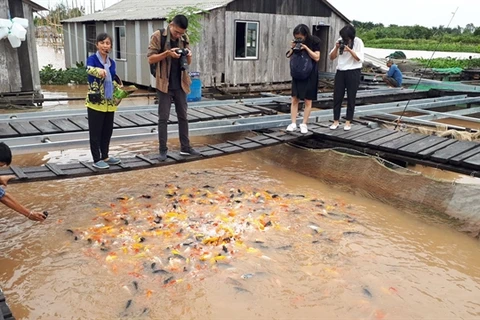
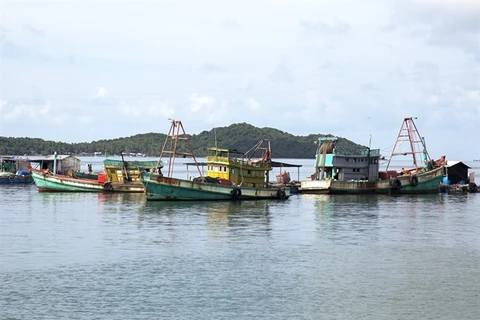
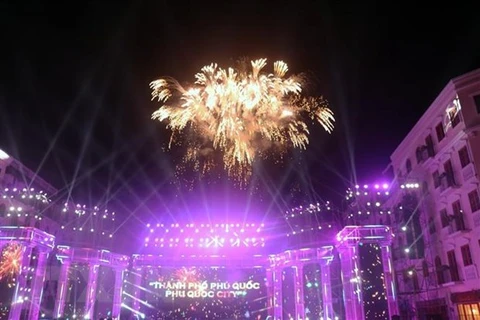
An artificial beach inside the VinWonders theme park on Phu Quoc island (Photo: VNA)
 Kien Giang (VNA) - Huynh Quang Hung, Chairman of the Phu Quoc City People’s Committee, talks to the Vietnam News Agency on the establishment of Phu Quoc city – the country’s first island city.
Can you tell us what will Phu Quoc city focus on as a city for tis development?
Phu Quoc City is established on the basis of the status quo of the entire natural area and population size of 179,480 of Phu Quoc district.
The city comprises of nine communal administrative units, namely Duong Dong and An Thoi wards and seven communes of Ham Ninh, Duong To, Ganh Dau, Bai Thom, Cua Duong, Cua Can and Tho Chau.
Phu Quoc will take advantage of all the resources of the central authorities and the province to support and mobilise other legal capital sources to focus on technical and social infrastructure development to upgrade Bai Thom, Cua Can, Cua Duong, Duong To, Ganh Dau and Ham Ninh to become wards of Phu Quoc city.
The city will also improve the quality of planning and forecasting work in line with central and provincial orientations, speeding up the completion of the socio-economic development orientation of Phu Quoc in accordance with general planning to build Phu Quoc - an economic zone and a special economic administrative unit.
In the near future, Phu Quoc city will complete the 1/500 scale of detailed planning of urban areas in Duong Dong and An Thoi urban areas associated with the urban development programme.
This focuses on reviewing, adjusting the detailed and specialised plannings in accordance with Decision No. 633 and No. 868 of Prime Minister Nguyen Xuan Phuc on Phu Quoc development planning.
In 2021-2025, Phu Quoc will strive to meet the criteria of first-class urban areas. The development of urban areas will be associated with promoting sustainable socio-economic development and effective use of land for construction.
It will invest in technical infrastructure while controlling environmental quality and improving the capacity and efficiency of State management of urban governments to turn Phu Quoc city into an engine of development for the province, a high-class tourism and service centre of the country and Southeast Asia.
This seeks to develop the Phu Quoc city into a hub for trade, tourism, politics, culture, and science and technology in 2026-2030. The city will prioritise investment in education, enhancing the quality of human resources to meet its requirements.
It will also strive to strengthen connectivity between urban areas and residential areas, improving the livelihoods of locals, gradually turning the city into a modern, civilised and harmonised urban area.
What are the priorities for the investment and development of Phu Quoc city?
Phu Quoc city will focus resources on development and perfecting technical and social infrastructure in order to create more favourable conditions for rapid and sustainable socio-economic development in line with the special administrative-economic unit model.
The city will push the development of the marine economy, setting up large scale financial centres and shopping services that are competitive. It will adjust resort tourism development properly with suitable market segmentation and create many high-quality service products, especially those with competitiveness and unique features.
Administrative procedures will be simplified while incentives will be offered to investors who engage in implementing projects, production and trading in the city.
Phu Quoc will focus on developing tourism, trade and service industries and turns tourism into a key economic sector of the city. It will seek to build a brand name for Phu Quoc tourism with many unique and high-quality products of Phu Quoc which are imbued with national cultural identity and are environmentally friendly. The development of community-based tourism and ecotourism will also be encouraged.
The city has suggested the Government open more domestic and international routes, develop public transport on the island, promote advertising and tourism promotion to attract more tourists and develop human resources to meet the requirements of tourism development in Phu Quoc.
Phu Quoc will promote the development of different types of services including finance, banking, telecommunications, transportation, healthcare and entertainment to meet tourists’ demand. It will also facilitate the implementation of the non-tariff zone project, calling for investment in the infrastructure of Duong Dong and An Thoi trading centres, the system of supermarkets and traditional markets at communes as well as improving the quality and prestige of Phu Quoc brands such as fish sauce and pepper.
Phu Quoc city will also look to improve the quality of education and training, taking care of cultural and human development and ensuring social security.
The city has set a target of achieving total fishery output of 201,000 tonnes per year, fish sauce processing of 12 million litres per year and pepper output of 500 tonnes per year by 2025. It is also striving to obtain a State budget revenue increase of 11.7 percent annually on average and the number of tourists coming to Phu Quoc to reach 10 million or up 15 percent per annum, including 4 million are foreign visitors.
What measures have been drafted by the city to realise the targets?
The city will concentrate on enhancing the capacity of leaders, cadres and promoting the people’s consensus on the development of the city.
In addition to promoting investment and spreading the image of Phu Quoc as a safe and friendly destination, the city will strengthen the use of science and technological advances.
It will seek to develop educational and health networks and the forming of resort tourism. The city will also implement projects to ensure stable livelihoods for people and improve people's knowledge, especially foreign language training in schools and the community./.
Can you tell us what will Phu Quoc city focus on as a city for tis development?
Phu Quoc City is established on the basis of the status quo of the entire natural area and population size of 179,480 of Phu Quoc district.
The city comprises of nine communal administrative units, namely Duong Dong and An Thoi wards and seven communes of Ham Ninh, Duong To, Ganh Dau, Bai Thom, Cua Duong, Cua Can and Tho Chau.
Phu Quoc will take advantage of all the resources of the central authorities and the province to support and mobilise other legal capital sources to focus on technical and social infrastructure development to upgrade Bai Thom, Cua Can, Cua Duong, Duong To, Ganh Dau and Ham Ninh to become wards of Phu Quoc city.
The city will also improve the quality of planning and forecasting work in line with central and provincial orientations, speeding up the completion of the socio-economic development orientation of Phu Quoc in accordance with general planning to build Phu Quoc - an economic zone and a special economic administrative unit.
In the near future, Phu Quoc city will complete the 1/500 scale of detailed planning of urban areas in Duong Dong and An Thoi urban areas associated with the urban development programme.
This focuses on reviewing, adjusting the detailed and specialised plannings in accordance with Decision No. 633 and No. 868 of Prime Minister Nguyen Xuan Phuc on Phu Quoc development planning.
In 2021-2025, Phu Quoc will strive to meet the criteria of first-class urban areas. The development of urban areas will be associated with promoting sustainable socio-economic development and effective use of land for construction.
It will invest in technical infrastructure while controlling environmental quality and improving the capacity and efficiency of State management of urban governments to turn Phu Quoc city into an engine of development for the province, a high-class tourism and service centre of the country and Southeast Asia.
This seeks to develop the Phu Quoc city into a hub for trade, tourism, politics, culture, and science and technology in 2026-2030. The city will prioritise investment in education, enhancing the quality of human resources to meet its requirements.
It will also strive to strengthen connectivity between urban areas and residential areas, improving the livelihoods of locals, gradually turning the city into a modern, civilised and harmonised urban area.
What are the priorities for the investment and development of Phu Quoc city?
Phu Quoc city will focus resources on development and perfecting technical and social infrastructure in order to create more favourable conditions for rapid and sustainable socio-economic development in line with the special administrative-economic unit model.
The city will push the development of the marine economy, setting up large scale financial centres and shopping services that are competitive. It will adjust resort tourism development properly with suitable market segmentation and create many high-quality service products, especially those with competitiveness and unique features.
Administrative procedures will be simplified while incentives will be offered to investors who engage in implementing projects, production and trading in the city.
Phu Quoc will focus on developing tourism, trade and service industries and turns tourism into a key economic sector of the city. It will seek to build a brand name for Phu Quoc tourism with many unique and high-quality products of Phu Quoc which are imbued with national cultural identity and are environmentally friendly. The development of community-based tourism and ecotourism will also be encouraged.
The city has suggested the Government open more domestic and international routes, develop public transport on the island, promote advertising and tourism promotion to attract more tourists and develop human resources to meet the requirements of tourism development in Phu Quoc.
Phu Quoc will promote the development of different types of services including finance, banking, telecommunications, transportation, healthcare and entertainment to meet tourists’ demand. It will also facilitate the implementation of the non-tariff zone project, calling for investment in the infrastructure of Duong Dong and An Thoi trading centres, the system of supermarkets and traditional markets at communes as well as improving the quality and prestige of Phu Quoc brands such as fish sauce and pepper.
Phu Quoc city will also look to improve the quality of education and training, taking care of cultural and human development and ensuring social security.
The city has set a target of achieving total fishery output of 201,000 tonnes per year, fish sauce processing of 12 million litres per year and pepper output of 500 tonnes per year by 2025. It is also striving to obtain a State budget revenue increase of 11.7 percent annually on average and the number of tourists coming to Phu Quoc to reach 10 million or up 15 percent per annum, including 4 million are foreign visitors.
What measures have been drafted by the city to realise the targets?
The city will concentrate on enhancing the capacity of leaders, cadres and promoting the people’s consensus on the development of the city.
In addition to promoting investment and spreading the image of Phu Quoc as a safe and friendly destination, the city will strengthen the use of science and technological advances.
It will seek to develop educational and health networks and the forming of resort tourism. The city will also implement projects to ensure stable livelihoods for people and improve people's knowledge, especially foreign language training in schools and the community./.
VNA