Forces hostile to the Vietnamese revolution have been trying to promotethe so-called peaceful evolution in a bid to undermine the socialistregime, with one of their ploys being the call for “depoliticising thearmy” which is the core force safeguarding the achievements ofproletarian revolution in the country.
Colonel VuKhanh from the Ministry of National Defence’s Military StrategyInstitute, has laid bare the groundless and artificial nature of the“apolitical military” argument in a recent article.
Citing the well-known military theorist Clausewitz (1780-1831) viewthat “War is the continuation of politics” and the military comes intobeing to meet the needs of war, which was widely recognised by bothcapitalist and proletarian military sciences, Colonel Khanh pointed outthat this automatically means that no army in the world is “politicallyneutral” or “stays out of politics”, because any war has it ownpolitical goal, reflecting the political stance of the sides, so theparticipating militaries are all geared to serve the political goals ofthe war.
Furthermore, the colonel stressed that the militaryalways bears the nature of the ruling class. The military is part of theState and an armed tool of the State to protect the achievements thatthe ruling political forces have obtained through struggles for power.
Thefounding and development history of the military in the world showedthat the army is a historical social phenomenon and a product of theclass struggle, thus bearing the nature of the class which organises,educates, trains and uses it. The army’s fighting goals and ideals areto serve those of the class which organises it. There is no classless,super-class and neutral military.
The world realityshowed that the military of any country is an important political forcethat any ruling State and class try their best to control to protecttheir political and economic interests. The call for the army to obeyonly the State but not the Communist Party is, in fact, to change thearmy’s stand from that of the working class to that of the bourgeoisieclass, thus pushing the “self-evolution” and “self-transformation”process in the military and in society towards the overthrowing of thesocialist regime without wars.
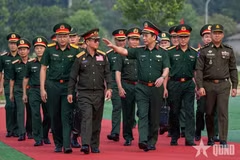
It is a well-known fact that theVietnam People’s Army (VPA) was born from the masses’ politicalmovements, and founded and trained by the Communist Party of Vietnam andPresident Ho Chi Minh to grasp power and protect the revolutionaryadministration, so it is a reliable political force of the Party andState.
The military is a core force of Vietnam ’s armedforces. It is the army of the people and for the people and is ready tofight and sacrifice itself for the independence and freedom of thefatherland, socialism and the happiness of the people.
During its70-year history of development, the VPA is always absolutely loyal tothe Party, the country and people. This is first of all reflected in theunity of its fighting goals and the Party’s political objectives, whichis national independence in close association with socialism.
Colonel Khanh emphasized that fighting the plot of “depoliticising thearmy” and building a politically strong military are two aspects inbuilding a revolutionary, regular, elite and modern people’s army.
Heunderlined the need to make each officer, Party member and person awareof the hostile forces’ schemes and plots in deploying the “peaceevolution” strategy, including the propaganda on an apolitical military.
V.I.Lenin once said that “no one can destroy us, but our own mistakes. Ifwe cause divisions due to mistakes, everything will collapse”. No matterhow many wicked plots hostile forces deploy, they cannot achieve theirgoal of making the Vietnamese army “stay out of politics” or“politically neutral”, he concluded.-VNA