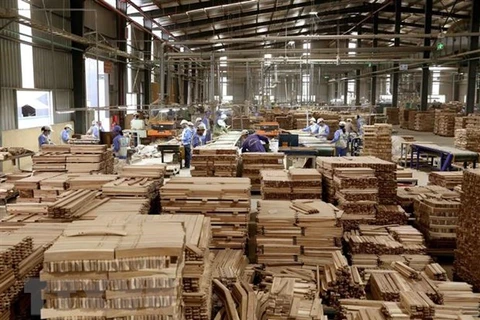
Photo: Illustration image (Photo: VNA)
 Hanoi (VNA) - From the beginning of the year, the Government and the banking sector have implemented a range of solutions to support businesses affected by COVID-19.
However, many businesses have not been able to access bank capital because most of their production premises, machinery and equipment are rented, not enough for mortgage. In addition, under the direction of the State Bank of Vietnam, commercial banks are not allowed to provide subprime loans, so the financial situation of this sector is even more difficult.
To find solutions to support businesses, Vietnam News Agency reporter had an interview with Dr. Nguyen Tri Hieu, an expert in banking and finance about this issue.
- Currently, the deposit and lending interest rates are low. In your opinion, is there a lot of room to reduce interest rates?
Mr. Nguyen Tri Hieu: The current interest rate level, in my opinion, is appropriate. At present, the gap between the deposit interest rates and inflation is not big, so the interests of depositors and the macro balance of the economy must be considered. Although I hope to see lower interest rate, in the current situation, I think the room to reduce interest rates is narrow.
- How do you comment on the "health" of businesses in the present time?
Mr. Nguyen Tri Hieu: According to the General Statistics Office, in the past 10 months, there have been nearly 85,600 enterprises temporarily suspending their business, waiting for dissolution procedures, up 15.1 percent over the same period last year.
Many businesses, mainly operating in the fields of hotels, resorts, tourism, transportation, retail, consumer goods, import and export, are severely affected by the epidemic.
Currently, there is a high demand for working capital demand of small and medium sized enterprises to maintain liquidity.
Despite the capital needs of large enterprises, many businesses do not have access to bank capital because most of the production premises, machinery and basic equipment are rented, not enough for mortgage. Besides, under the direction of the State Bank, commercial banks are not allowed to make subprime loans, so the financial situation of this sector falls into "poor".
- In your point of view, what are the necessary solutions for businesses, especially small and medium enterprises, to thrive at this moment?
Mr. Nguyen Tri Hieu: In my opinion, the Government should come up with a plan to direct the State Bank of Vietnam to establish a credit group. All banks are required to participate in this group, with the participation rates equivalent to 3-3.5 percent per total outstanding loans of each bank. The main objective of the group is not profitability, but rather to support businesses that are struggling with the impact of the COVID-19 pandemic.
The State Bank acts as a leading agency to establish the group, but there must be a commercial bank to manage it. It must also have a credit committee that reviews the loan applications of businesses. When the credit board approves a credit, the banks will commit to disburse according to the proportion of participation in the credit group.
- The question is where to get the money from?
Mr. Nguyen Tri Hieu: The banks now have very good liquidity. CASA deposit is the amount of money that gets deposited in the current and savings accounts of bank customers. It is the cheapest and major source of funds for banks. CASA of the Vietnamese banking system accounts for about 20 percent of the total mobilized capital. Banks can use that source to join the credit group, where they can lend money at a very low interest rate, about 3-5 percent per year.
- In fact, right after the epidemic broke out, the State Bank issued Circular 01 to support businesses and introduced a number of preferential credit packages for businesses. How do you comment on this?
Mr. Nguyen Tri Hieu: It is true that Circular 01 came out very promptly, restructured the repayment term, exempted and reduced interest rates, supported customers affected by COVID-19 and saved the economy this time.
Credit institutions have also built action plans to support customers through reducing deposit interest rates, saving costs to reduce lending interest rates; to deploy loan programs with preferential interest rates to customers in industries severely affected by the pandemic.
The Government has also launched a number of credit packages to support the economy such as a 300 trillion VND package of banks, a 180 trillion VND fiscal support package, a 62 trillion VND package for people in difficulty due to COVID-19, and a 16 trillion VND loan package to support businesses to pay their employees ... These loan packages are considered to come at a right time. However, the implementation is ineffective, not many businesses, people continue were able to access.
- Thank you!