Carbon market development key to green transition

Low-carbon economic development towards a circular economy is becoming an inevitable tendency in the framework of the green transition with the creation and development of carbon markets seen as an increasingly crucial tool.
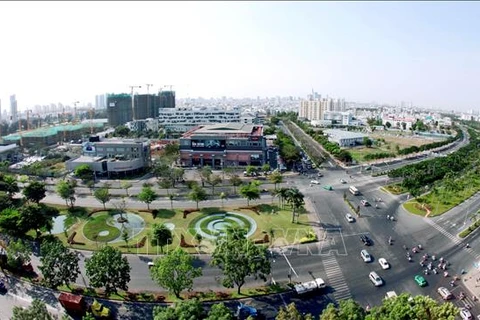
Carbon market development key to green transition ảnh 1Illustrative photo (Photo: VNA)
Hanoi (VNS/VNA) — Low-carbon economic developmenttowards a circular economy is becoming an inevitable tendency in the frameworkof the green transition with the creation and development of carbon marketsseen as an increasingly crucial tool.

The World Bank Group's Country Report on Climate and Developmentfor Vietnam in 2022 highlights that the effects of climate change cost thecountry roughly 10 billion USD in 2020, approximately 3.2% of GDP. By 2050, theentire economic expense associated with climate change could reach 523 billion.

The carbon market has been identified as a key solution for Vietnam to reachits net zero goal in the near future, according to Pham Viet Bien Cuong,Director of the Centre for Environmental Protection and Response to Climate Change.

Global trade and investment are driving the development and acceleration ofgreen standards, incorporating new requirements related to labour, theenvironment, sustainable development and the reduction of carbon emissions.

In addition, there is an increasing need for bilateral and internationalcooperation, as well as efforts related to green fields. Vietnam has a greatchance to achieve its green transformation objectives and establish its placein the world's green value chains at this pivotal juncture.

Cuong also said that the basic principle of the market's operation was thatpolluters should compensate for their emissions into the atmosphere byexchanging and trading carbon credits.

Factories and manufacturing companies emit a certain amount of CO2. If theyexceed the allowed level, they must buy more carbon credits. On the flip side,businesses emitting less than the limit can sell their extra carbon credits tothose exceeding the limit, according to Cuong.

The carbon credit market plays a vital role in helping enterprises and thecountry's economy shift from brown to green, lowering greenhouse gas emissionsand boosting national GDP and company profits.

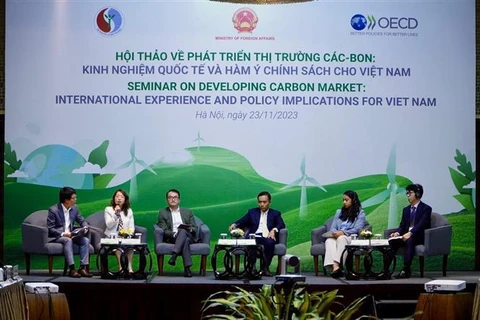
At a seminar last week about developing the carbon market, Nguyen Minh Vu,Deputy Foreign Minister, affirmed that green transformation was a new drivingforce for sustainable growth and a key strategy for Vietnam to establish its positionin the global green value chain.

The Organisation for Economic Cooperation and Development (OECD)highlighted the Vietnamese Government's efforts to promote green growth andsustainable development and expressed their impression of the country's commitmentto net-zero emissions made at the 26th UN Climate Change Conference (COP26).They maintained that Vietnam had enormous potential for creating a vibrant,effective, and high-quality carbon market.

To date, Vietnam is one of the four nations with the highest number ofinvestment projects registered under the clean development mechanism, havingreceived 40.2 million carbon credits to date for 150 projects.

However, Vietnam is facing many challenges in the carbon marketconstruction and development process, such as a lack of legal framework,international cooperation, and limited awareness.

To deal with these problems, Vietnam has issued a number of significantstrategic initiatives on sustainable development and green growth, one of whichis a development plan for instruments related to carbon pricing, particularly amarket for compliant carbon.

Vietnam intends to guide the implementation of domestic and internationalcarbon credit exchange and offsetting mechanisms in accordance with theprovisions of law and international treaties, accelerate the development ofregulations on carbon credit management and greenhouse gas emission quotaexchange activities, and pilot a carbon credit trading floor starting in 2025./.
VNA

See more

A company in Da Nang operates a customer relationship management system supported by AI chatbots. (Photo: VNA)

AI drives rise of sleepless enterprises in Vietnam

The concept of a sleepless enterprise does not necessarily mean making employees stay on the job all the time. Instead, it's about building intelligent systems that can respond to customers, process transactions, monitor operations, analyse data and flag risks continuously.

Head of the Vietnam Trade Office in Australia Tran Thi Thanh My (Photo: VNA)

Vietnam, Australia eye 20 bln USD trade target

The head of the Vietnam Trade Office in Australia hoped that the visit by Party General Secretary and State President To Lam will mark a new milestone, opening the door for firms on both sides to forge stronger links and launch concrete cooperation agendas, helping hit that 20 billion USD trade goal sooner rather than later.

Phu Quoc pepper products, granted three stars under the OCOP programme in An Giang province, are displayed at an exhibition of outstanding OCOP products from the Mekong Delta. (Photo: VNA)

Phu Quoc leverages OCOP programme to take local specialities global

Better known as one of Vietnam’s premier island destinations, Phu Quoc is leveraging its “One Commune, One Product” (OCOP) programme to transform traditional specialities into internationally recognised products, integrating local agriculture, food processing and tourism to promote sustainable economic growth.

Production at an FDI enterprise in Tay Ninh province. (Photo: VNA)

FTA Index 2025 to be unveiled later this month

The index is designed to provide valuable information not only for State management agencies but also as an important reference for businesses, foreign investors, and industry associations in planning investment and business activities in Vietnam.

Air Premia, a carrier of the Republic of Korea, will resume flights between Incheon and Ho Chi Minh City from November 5. (Photo: The Courtesy of Air Premia)

Air Premia to resume Incheon–Ho Chi Minh City route from November

Flights will depart Incheon International Airport at 6:40 pm (RoK time) and arrive at Tan Son Nhat International Airport in Ho Chi Minh City at 11 pm (Vietnam time). Return flights will leave Ho Chi Minh City at 12:30 am on Mondays, Tuesdays, Thursdays, Fridays and Sundays, landing in Incheon at 7:40 am.

Production at Viet Hai High-Tech Structure Production Company Limited in Vung Ang Economic Zone. Ha Tinh province aims to develop Vung Ang Economic Zone into a regional centre for industry, energy, seaports and logistics (Photo: VNA)

Revised master plan of Vung Ang EZ approved

The adjustment aims to create a more rational development framework to maximise the zone’s potential and advantages while providing a legal foundation for construction management and ensuring sustainable development.

Illustrative image (Photo: VNA)

Vietnam looks to domestic market to sustain wood industry growth

Vietnam’s wood sector has long been a top foreign-currency earner. Exports of wood and wooden products neared 17.3 billion USD in 2025, reaching more than 160 countries and territories and clearing the high bars set by the US, the European Union and Japan.

Delegates at the event (Photo: VNA)

Vietnam remains key market for Polish food producers

The campaign promotes selected European Union agricultural and food products, including fresh, chilled and frozen beef and pork, fresh apples, apple juice and dried apples, targeting consumers, importers, distributors, retailers and the hospitality sector.

Wei Xiaoli, a representative of Shandong Jindafeng Machinery Co., Ltd., in an interview granted to the Vietnam News Agency. (Photo: VNA)

Chinese firms see strong potential for agricultural mechanisation cooperation with Vietnam

Business representatives said mechanisation not only helps reduce reliance on manual labour but also improves production efficiency, shortens planting and harvesting times, reduces post-harvest losses and enhances the quality of agricultural products. For rice-producing countries like Vietnam, they noted, accelerating mechanisation is an inevitable trend to strengthen the competitiveness of the agricultural sector.

Community-led fisheries groups have become frontline defenders of coastal fisheries. (Photo: VNA)

Community-led fisheries groups strengthen IUU fight in Ha Tinh

With a long coastline and abundant inshore fishing grounds, Ha Tinh has long identified the marine economy as a key growth driver. However, growing fishing pressure and destructive practices have posed major management challenges. Community-led self-management initiatives are now providing an effective solution.

At the VIFC-HCMC (Photo: VNA)

700 bln USD for net zero: Vietnam bets on VIFC

Assoc. Prof. Dr. Nguyen Huu Huan, Vice Chairman of the Executive Board of VIFC-HCMC, said the VIFC will focus on building market infrastructure needed to bridge the gap between big investment pledges and bankable projects.