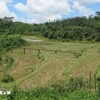
Illustrative image (Photo: VNA)
 Dak Lak (VNS/VNA) - Man-made forests in Dak Lak province’s M’ Drak district offer stable incomes to local residents who are allowed to exploit them while increasing forest cover.
The district, which has the largest afforested area in the Central Highlands province, has 15,000ha of man-made forests, mostly with acacia trees.
Acacia has been planted in the district since 1996 and on a large scale since 2010, mostly in Ea Trang, Cu K’roa and Cu M’ta communes.
In Ea Trang, more than 1,000 households tend 4,000ha of acacia for a living.
Y Man Nie, who has 3ha, said he used to grow short-term crops like corn and cassava on his land but was plagued by high costs and inconsistent yields.
After the province decided to afforest vacant lands and bare hills, he began to grow acacia and has had two harvests so far, he said.
“In the first year … the trees were small and I could intercrop corn or cassava with acacia to prevent the growth of weeds and earn an additional income.”
Last year, he harvested acacia wood and used the proceeds to build a new house, he said.
Y Doi Nie, chairman of the Ea Trang Commune People’s Committee, said the local soil is unfertile and not suitable for growing traditional crops like coffee and pepper, but is good for acacia.
Acacia offers high economic value since its cost from planting to harvest over five years is 20 million VND (860 USD) per hectare while the income is 50 – 70 million VND (2,150 – 3,000 USD), he said.
The plant is easy to grow and requires low production costs and less tending, with weeding only required in the first year. From the second year until harvest time, households only need to prevent fires.
Along with growing forests for wood, the district has also developed the production of wood-related products.
The Tien Nam Co-operative in M' Drak town’s Hamlet 7 tends 4,000ha of forest, has a factory to produce 100,000 tonnes of wood shavings a year and buys most forest wood in the town.
It exports wood shavings to Japan.
The co-operative also provides full- and part-time jobs to around 500 people, mostly from local ethnic groups.
Nguyen Van Hue, deputy director of the Tien Nam, said the demand for wood from man-made forests is huge globally.
“The co-operative aims to develop its man-made forests sustainably and meet international standards to enhance product value.”
Forest cover increase
Growing forests has helped the district increase its forest cover and prevent illegal logging of natural forests, according to its Forest Protection Bureau.
Le Ngoc Tam, deputy head of the bureau, said the district has a forest coverage rate of 53 percent as against the province’s 39 percent.
Most vacant lands and bare hills have been planted with acacia, he said.
In the past, when local residents had not planted the forests and were growing mostly vegetables and other short - term crops, they encroached on natural forests or illegally logged them, according to the district Forest Protection Bureau.
But in recent years the planting of forests has been providing jobs with high incomes for many people, and the so the phenomena have declined, it said.
Hoa Quang Khiem, chairman of the district People’s Committee, said it has been determined that forestry is an important sector and policies to develop it, especially man-made forests, are in place.
The policies have been received a warm response from local households and businesses, he said.
The district now harvests 1,000ha of afforested areas a year and gets more than 100,000cu.m of wood.
It plans to plant more forests in the east and southeast, according to its People’s Committee.
It has developed linkages between stakeholders in planting and processing to increase the efficiency of afforestation.
It next plans to grow large trees in afforested areas to increase their value and benefit to the environment./.
The district, which has the largest afforested area in the Central Highlands province, has 15,000ha of man-made forests, mostly with acacia trees.
Acacia has been planted in the district since 1996 and on a large scale since 2010, mostly in Ea Trang, Cu K’roa and Cu M’ta communes.
In Ea Trang, more than 1,000 households tend 4,000ha of acacia for a living.
Y Man Nie, who has 3ha, said he used to grow short-term crops like corn and cassava on his land but was plagued by high costs and inconsistent yields.
After the province decided to afforest vacant lands and bare hills, he began to grow acacia and has had two harvests so far, he said.
“In the first year … the trees were small and I could intercrop corn or cassava with acacia to prevent the growth of weeds and earn an additional income.”
Last year, he harvested acacia wood and used the proceeds to build a new house, he said.
Y Doi Nie, chairman of the Ea Trang Commune People’s Committee, said the local soil is unfertile and not suitable for growing traditional crops like coffee and pepper, but is good for acacia.
Acacia offers high economic value since its cost from planting to harvest over five years is 20 million VND (860 USD) per hectare while the income is 50 – 70 million VND (2,150 – 3,000 USD), he said.
The plant is easy to grow and requires low production costs and less tending, with weeding only required in the first year. From the second year until harvest time, households only need to prevent fires.
Along with growing forests for wood, the district has also developed the production of wood-related products.
The Tien Nam Co-operative in M' Drak town’s Hamlet 7 tends 4,000ha of forest, has a factory to produce 100,000 tonnes of wood shavings a year and buys most forest wood in the town.
It exports wood shavings to Japan.
The co-operative also provides full- and part-time jobs to around 500 people, mostly from local ethnic groups.
Nguyen Van Hue, deputy director of the Tien Nam, said the demand for wood from man-made forests is huge globally.
“The co-operative aims to develop its man-made forests sustainably and meet international standards to enhance product value.”
Forest cover increase
Growing forests has helped the district increase its forest cover and prevent illegal logging of natural forests, according to its Forest Protection Bureau.
Le Ngoc Tam, deputy head of the bureau, said the district has a forest coverage rate of 53 percent as against the province’s 39 percent.
Most vacant lands and bare hills have been planted with acacia, he said.
In the past, when local residents had not planted the forests and were growing mostly vegetables and other short - term crops, they encroached on natural forests or illegally logged them, according to the district Forest Protection Bureau.
But in recent years the planting of forests has been providing jobs with high incomes for many people, and the so the phenomena have declined, it said.
Hoa Quang Khiem, chairman of the district People’s Committee, said it has been determined that forestry is an important sector and policies to develop it, especially man-made forests, are in place.
The policies have been received a warm response from local households and businesses, he said.
The district now harvests 1,000ha of afforested areas a year and gets more than 100,000cu.m of wood.
It plans to plant more forests in the east and southeast, according to its People’s Committee.
It has developed linkages between stakeholders in planting and processing to increase the efficiency of afforestation.
It next plans to grow large trees in afforested areas to increase their value and benefit to the environment./.
VNA