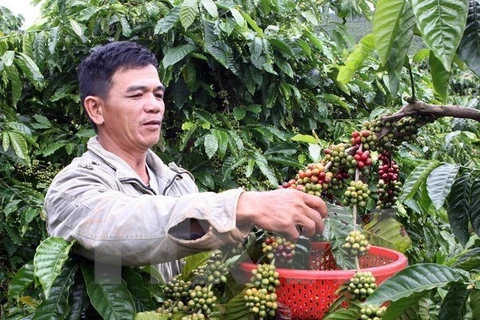
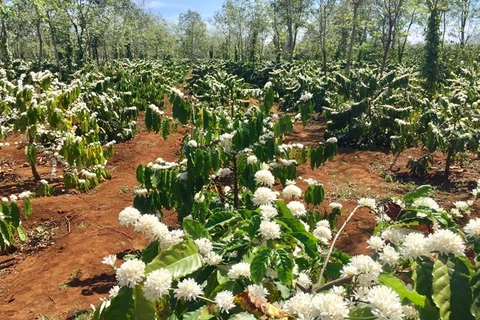
A coffee farm in the Central Highlands (Photo: VNA)
 Dak Lak (VNA) – The Central Highlands has become a major agricultural production hub of Vietnam, producing many high-demand products and bringing home multi-billion-USD export revenue.
The region, consisting of Kon Tum, Gia Lai, Dak Lak, Dak Nong and Lam Dong provinces, has a natural area of 54,637 sq.km (5,463,700 hectares). About 74.25 percent of the basalt soil area in Vietnam is in this region.
Annual crops cover 850,100ha of the region’s 2 million ha of farm land, and the remaining 1.15 million ha are perennial plants, according to the Steering Committee for the Central Highlands region.
With favourable natural conditions, the provinces have developed large-scale production areas specialising in coffee, pepper, rubber, cashew, tea, maize and cassava.
The Central Highlands is home to more than 576,800ha of coffee trees (or nearly 90 percent of Vietnam’s total coffee area). Dak Lak has the largest area (over 204,000ha), followed by Lam Dong, Dak Nong and Gia Lai.
Despite prolonged drought in the 2016-2017 crop, the region harvested 2.5 tonnes of coffee beans per hectare on average, three times higher than the world’s robusta coffee productivity. Its total output was over 1.3 million tonnes of coffee beans, 93.3 percent of national coffee production.
The five provinces have applied high technology in coffee production, developed geographical indicators for coffee and promoted connections between farmers and businesses.
Centralised rubber planting areas have also been developed in the Central Highlands. At least 192,207 tonnes of latex are extracted every year, 18 percent of Vietnam’s rubber latex output.
Over 71,000ha of pepper trees and 74,000ha of cashew trees are grown in the region, generating more than 120,877 tonnes of peppercorns and 67,276 tonnes of cashew nuts yearly.
The Central Highlands also posts annual tea output of over 228,000 tonnes, accounting for 24 percent of Vietnam’s tea production. It has also grown 235,226ha of hybrid maize, producing at least 1.3 million tonnes of corn each year or 25 percent of the country’s corn output.
Agriculture has contributed to local socio-economic development, political security and social order and safety and improving ethnic minorities’ living standards.
The Steering Committee for the Central Highlands said more and more successful agricultural production models have been developed in the region, generating from 500 million VND to billions of VND per hectare in income for farmers.
However, local agricultural advantages haven’t been fully tapped, Chairman of the committee To Lam said recently.
He pointed to low labour productivity, unprocessed products with low added value and competitiveness and the lack of science-technology in production, preservation and processing.
To Lam, also Minister of Public Security, asked the steering committee, the Ministry of Agriculture and Rural Development, the Ministry of Planning and Investment, the Ministry of Science and Technology, banks and the regional provinces to issue support programmes and favourable policies for hi-tech agriculture.
Businesses must play a central role in helping the region’s key agricultural products engage in the domestic and global value chains, he added.
He called for amendments to policies on land, investment and credit for agricultural development. Both domestic and foreign economic elements need to be encouraged to step up the processing of main products.
He also highlighted the need to strengthen human resources training for sustainable agricultural development.-VNA
The Central Highlands is home to more than 576,800ha of coffee trees (or nearly 90 percent of Vietnam’s total coffee area). Dak Lak has the largest area (over 204,000ha), followed by Lam Dong, Dak Nong and Gia Lai.
Despite prolonged drought in the 2016-2017 crop, the region harvested 2.5 tonnes of coffee beans per hectare on average, three times higher than the world’s robusta coffee productivity. Its total output was over 1.3 million tonnes of coffee beans, 93.3 percent of national coffee production.
The five provinces have applied high technology in coffee production, developed geographical indicators for coffee and promoted connections between farmers and businesses.
Centralised rubber planting areas have also been developed in the Central Highlands. At least 192,207 tonnes of latex are extracted every year, 18 percent of Vietnam’s rubber latex output.
Over 71,000ha of pepper trees and 74,000ha of cashew trees are grown in the region, generating more than 120,877 tonnes of peppercorns and 67,276 tonnes of cashew nuts yearly.
The Central Highlands also posts annual tea output of over 228,000 tonnes, accounting for 24 percent of Vietnam’s tea production. It has also grown 235,226ha of hybrid maize, producing at least 1.3 million tonnes of corn each year or 25 percent of the country’s corn output.
Agriculture has contributed to local socio-economic development, political security and social order and safety and improving ethnic minorities’ living standards.
The Steering Committee for the Central Highlands said more and more successful agricultural production models have been developed in the region, generating from 500 million VND to billions of VND per hectare in income for farmers.
However, local agricultural advantages haven’t been fully tapped, Chairman of the committee To Lam said recently.
He pointed to low labour productivity, unprocessed products with low added value and competitiveness and the lack of science-technology in production, preservation and processing.
To Lam, also Minister of Public Security, asked the steering committee, the Ministry of Agriculture and Rural Development, the Ministry of Planning and Investment, the Ministry of Science and Technology, banks and the regional provinces to issue support programmes and favourable policies for hi-tech agriculture.
Businesses must play a central role in helping the region’s key agricultural products engage in the domestic and global value chains, he added.
He called for amendments to policies on land, investment and credit for agricultural development. Both domestic and foreign economic elements need to be encouraged to step up the processing of main products.
He also highlighted the need to strengthen human resources training for sustainable agricultural development.-VNA
VNA