Central Highlands works toward sustainable forest development

The Ministry of Agriculture and Rural Development held a conference on May 24 to deploy a freshly approved project on sustainable forest recovery and development in the Central Highlands for 2016-2030.
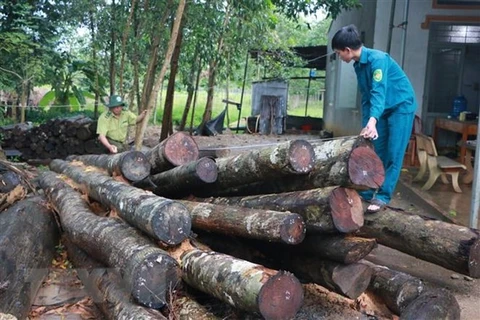
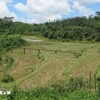
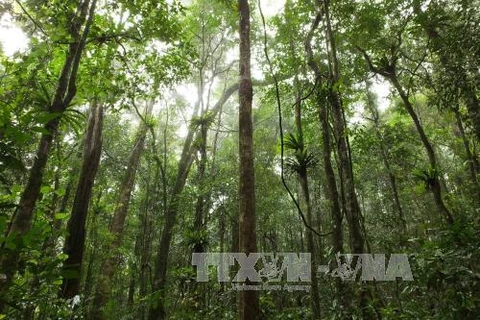
Central Highlands works toward sustainable forest development ảnh 1Inside the Ta Dung natural reserve in the Central Highlands province of Dak Nong (Illustrative photo: VNA)

Lam Dong (VNA) – The Ministry of Agriculture andRural Development held a conference on May 24 to deploy a freshly approvedproject on sustainable forest recovery and development in the Central Highlandsfor 2016-2030.

The entire project costs over 28.55 trillion VND (1.22billion USD), of which 7.8 trillion VND is sourced from the state budget, 3.75trillion VND from official development assistance, and the rest from othersources.

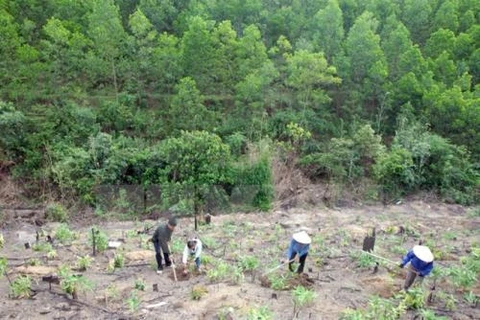
It aims to push the region’s total forest areas to 2.72million hectares and coverage rate to 49.2 percent by 2030. Other works includemanaging sustainable forest development, protecting the environment andbiodiversity, and offering environmental forestry services.

In order to achieve the targets, the ministry set out keytasks such as protecting the current 2.2 million ha of natural forests andboosting community-based forest management. The planting of 7,100 ha ofprotection forests and 136,600 ha of production forest were also a part of theplan.

It also requested that relevant agencies and the fiveCentral Highlands provinces work together in implementing the project in asynchronous manner.

Deputy Minister of Agriculture and Rural Development Ha CongTuan recommended that localities orientate forestry work toward the formationof value chains, expand production forests, and obtaining sustainable forestcertificates.

The Central Highlands spans 5.4 million ha with a populationof about 5.1 million. The local areas earmarked for forestry developmentamounted to 3.2 million ha, accounting for 19.9 percent of the country’s total.

In 2018, the region had 2.55 million ha of forests, up 3,502ha from 2017, with forest coverage rate hitting 46.1 percent.–VNA 
VNA
See more

Quang Tri recently received two endangered pangolins from local resident. (Photo published by VNA)

Two pangolins handed over to authorities in Quang Tri

At around 8:30 pm on April 12, Le Thanh Tung, a resident of Thuong Nghia hamlet in Cam Lo commune, and his friend spotted the two pangolins, weighing over 4 kg, while working near the Cam Lo–La Son Expressway.

A view of Phong Nha - Ke Bang National Park in Da Nang city (Photo: VNA)

Phong Nha – Ke Bang: untapped biological treasure in Truong Son mountains

Unlike ecosystems where species inventories are largely complete, Phong Nha–Ke Bang National Park remains scientifically “open,” with each survey revealing new findings. Recent studies - from local research projects to international collaborations - have recorded additional bird species and identified the rare parasitic plant Sapria himalayana, which only survives in intact primary forests.

The interface of Vietnam Weather KTTV mobile application (Photo: baochinhphu,vn)

Application of dangerous weather warning introduced

All unusual weather events, from widespread thunderstorms, lightning strikes, landslides, flash floods, tropical depressions to strong winds at sea, are continuously updated from official data sources of the NCMHF and meteorological stations and prominently displayed on the main interface.

An overview of the kick-off meeting for the “Sustainable Management of Substances Controlled by the Montreal Protocol” project (Photo: VNA)

Vietnam launches 13 mln USD project to phase out ozone-depleting substances

Funded by the Multilateral Fund for the Implementation of the Montreal Protocol and implemented through the World Bank (WB) and the United Nations Environment Programme (UNEP), the project aims to help Vietnam meet its international commitments in managing and phasing out controlled substances. It will run from 2026 to 2031 with a total budget of over 13 million USD.

Tram Chim National Park and the Mekong Conservancy Foundation (MCF) organise the workshop on sustainable restoration of wetland ecosystems in the Mekong Delta on March 24. (Photo: VNA)

Solutions sought to restore Mekong Delta wetland ecosystems

Experts at the workshop described wetlands as the “ecological heart” of the Mekong Delta, playing a vital role in water storage and regulation, climate moderation, carbon sequestration, biodiversity conservation, and livelihoods for millions of people through aquaculture, agriculture, and ecotourism. These ecosystems also help reduce disaster risks and enhance climate resilience.

Deputy Minister of Agriculture and Environment Le Cong Thanh speaks at the ceremony to launch major environmental campaign. (Photo: VNA)

Vietnam calls for collective action on water, air, climate and sustainable future

Deputy Minister of Agriculture and Environment Le Cong Thanh underscored that water, climate, and energy are fundamental pillars of sustainable development. In Vietnam, water resources and weather patterns influence every aspect of life, from food and water security to livelihoods, ecosystem stability, and economic growth.