Childhood vaccinations in Vietnam sharply declined during COVID-19 pandemic

A total of 67 million children around the world, including nearly 250,000 in Vietnam, missed out on vaccinations between 2019 and 2021, with vaccination coverage levels decreasing in 112 countries, UNICEF warned on April 20 in a new report on immunisation.
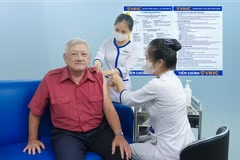
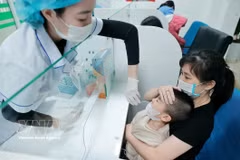
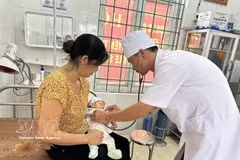
Childhood vaccinations in Vietnam sharply declined during COVID-19 pandemic ảnh 1A child in Hai Ba Trung district, Hanoi, receives an injection of vaccine against infectious diseases. (Photo: VNA)
Hanoi (VNS/VNA) - A total of 67 million children aroundthe world, including nearly 250,000 in Vietnam, missed out on vaccinationsbetween 2019 and 2021, with vaccination coverage levels decreasing in 112countries, UNICEF warned on April 20 in a new report on immunisation. 

“The State of the World’s Children 2023: For Every Child,Vaccination” revealed that 48 million children globally didn’t receive asingle routine vaccine, also known as “zero-dose”.

Vietnam was listed as the 18th country in the world with thelargest number of zero-dose children, as 187,315 children under one year olddid not receive any vaccinations in 2021, the year of the severe fourth wave ofCOVID-19 infections with stringent lockdown measures in place.

Worldwide, the children who are missing out live in the poorest,most remote and marginalised communities, at times impacted by conflict.

New data produced for the report by the International Centre forEquity in Health found that in the poorest households, one in five children arezero-dose. Among the wealthiest, this number is just one in 20. It foundunvaccinated children often live in hard-to-reach communities such as ruralareas or urban slums.

They often have mothers who cannot go to school and are givenlittle say in family decisions.

These challenges are greatest in low- and middle-income countries,where about one in ten children in urban areas are zero doses and one in six inrural areas.

In Vietnam, data showed that the prevalence of zero-dose childrenin urban areas was almost 1.5 times higher than those living in rural areas(6.3%-4.2%), while the prevalence in the poorest households was almost doublethose in the wealthiest (13.5%-6.6%)

“The pandemic interrupted childhood vaccination almost everywhere,including in Vietnam, especially due to intense demands on health systems, thediversion of immunisation resources to COVID-19 vaccination, health workershortages and stay-at-home measures," said Lesley Miller, UNICEFDeputy Representative in Vietnam.

"Added to this is a current delay in the procurement ofvaccines. We are deeply concerned about the possibility of outbreaks ofvaccine-preventable diseases – measles in particular.

“Children born just before or during the pandemic are now movingpast the age when they would normally be vaccinated, underscoring the need forurgent action to catch up on those who were missed and prevent deadly diseaseoutbreaks.”

The report also showed that the public perception of theimportance of vaccines for children declined during the COVID-19 pandemic in 52out of 55 countries studied.

Vaccine confidence is volatile and time specific. However, thereport warns the confluence of several factors suggests the threat of vaccinehesitancy may be growing. These factors include uncertainty about the responseto the pandemic, growing access to misleading information, declining trust inexpertise, and political polarisation.

To vaccinate every child, it is vital to strengthen primary healthcare and provide its mostly female front-line workers with the resources andsupport they need.

The report finds women are at the front line of deliveringvaccinations, but they face low pay, informal employment, lack of formaltraining and career opportunities and threats to their security.

To address this child survival crisis, UNICEF is calling ongovernments to double down on their commitment to increase financing forimmunisation and to work with stakeholders to unlock available resources, tourgently implement and accelerate catch-up vaccination efforts to protectchildren and prevent disease outbreaks. 

The report is urging governments to; urgently identify and reachall children, especially those who missed vaccinations during the COVID-19pandemic; strengthen demand for vaccines, including by building confidence;prioritise funding to immunisation services and primary health care; and buildresilient health systems through investment in female health workers,innovation and local manufacturing.

“Vietnam’s successful experience in its mass immunisation campaignagainst COVID-19 laid a good foundation for the country to immediately addressthe current delays in procurement of vaccines and fast-track catch-up forchildren who have missed out on routine immunisations”, said UNICEF DeputyRepresentative Miller

“Routine immunisation and strong health systems are our best shotat preventing future pandemics, unnecessary deaths and suffering.”/.
VNA

See more

Male plastic surgery: Why masculine aesthetics require a different approach

Male plastic surgery: Why masculine aesthetics require a different approach

Plastic surgery has long been associated with procedures for women, but men also seek treatment for abdominal fat, enlarged breasts and age-related changes around the eyes and face. The American Society of Plastic Surgeons (ASPS) includes liposuction, gynecomastia surgery and eyelid surgery among procedures performed on male patients.

A speaker delivers presentations at the conference (Photo published by VNA)

Vietnam, Denmark expand cooperation in high-tech healthcare

Ambassador Nguyen Le Thanh called on Vietnamese and Danish partners to identify priority areas and promote research and training programmes, knowledge transfer and technology application in line with Politburo's Resolution No. 57-NQ/TW on breakthroughs in science – technology development, innovation and national digital transformation.

Ho Chi Minh City has favourable conditions for developing the ecosystem, including a large population, diverse healthcare needs and an extensive public and private medical network. (Illustrative photo: VNA)

Ho Chi Minh City develops multi-tier elderly care network amid population ageing

Dr. Huynh Minh Chin, Deputy Director of the department, said rising elderly care needs are putting pressure on traditional family-based care, as older people increasingly face multiple chronic illnesses, mobility problems, malnutrition, dementia and depression, requiring continuous support and closer coordination among hospitals, grassroots healthcare facilities, families and social support institutions.

Local residents in Mondulkiri province, Cambodia, receive free medical check-ups and health consultation. (Photo: VNA)

Free medical examinations provided to remote communities in Cambodia

Vietnamese Ambassador Nguyen Minh Vu said the programme has been jointly organised by the embassy and the hospital annually in various Cambodian localities to provide healthcare support to disadvantaged households and contribute to the Cambodian Government’s efforts to improve public health. The initiative also reflects close cooperation in healthcare and the strong bonds between the people of Vietnam and Cambodia.

With the assistance of robotic-assisted laparoscopic surgery, doctors successfully perform a complex operation (Photo: VNA)

Vietnam advances towards high-quality, specialised healthcare

Recent developments in Hanoi and other localities highlight efforts to develop specialised treatment, standardise professional practices and apply artificial intelligence (AI) and advanced medical techniques, towards a more modern healthcare system.

Collecting a sample from a pediatric patient for influenza testing (Photo: VNA)

Ho Chi Minh City acute respiratory infections surge over 64%

According to the Ho Chi Minh City Centre for Disease Control (HCDC), influenza viruses are are among the fastest-rising pathogens, with 151 positive samples in a single week. Influenza A is the dominant strain, with A/H1N1pdm09 in 116 samples, or nearly 77%.

A doctor at Trung Nguyen Medical Station in Te Lo commune, Phu Tho province, examines a child patient. (Photo: VNA)

Phu Tho builds hospital culture to improve patient satisfaction

In recent years, alongside efforts to improve the quality of medical examinations and treatment, Phu Tho province’s health sector has focused on creating civilised, friendly hospital environments and strengthening healthcare workers’ sense of responsibility and service-oriented attitudes, with the aim of earning patients’ trust and satisfaction.