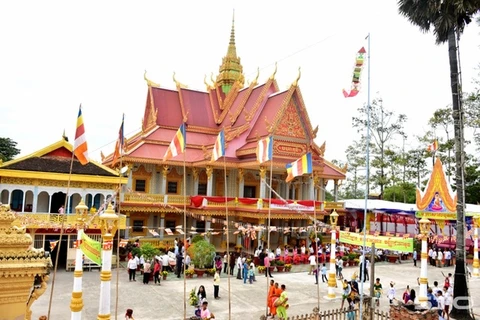
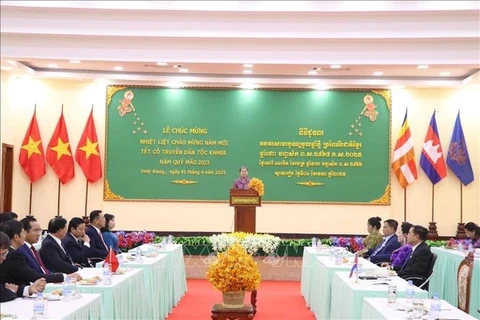
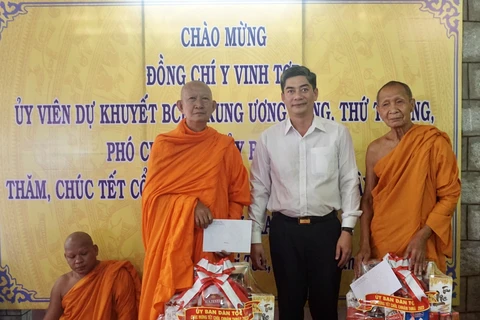
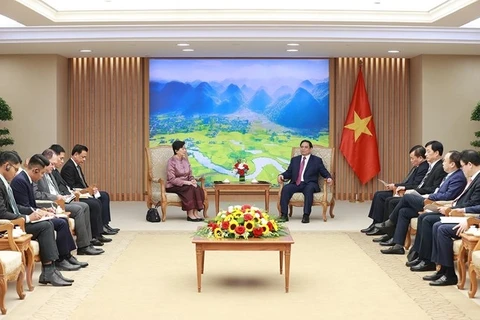
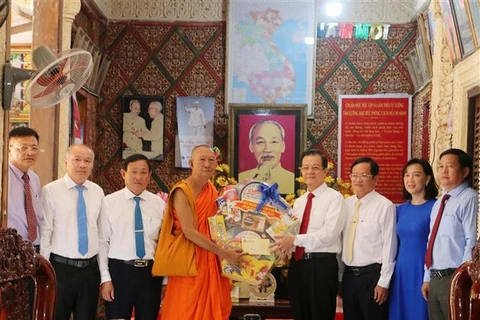
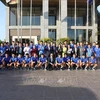
The ritual of Maha Sangkran marks the end of the year and the beginning of a new one. (Photo: VNA)
 Hanoi (VNA) – The Chol Chnam Thmay Festival of the Khmer ethnic minority people usually takes place around mid-April every year, expressing their wish for a new year with favourable weather and bumper crops. This year, the festival takes place from April 14 to 16, 2023.
The Chol Chnam Thmay Festival features the culture of the Mekong Delta and typical rice-growing residents in Southeast Asia, including the Khmer people whose festivals are closely associated with the life cycle of rice.
Residents think that the time that they choose to hold the festival is the transition period between rainy and sunny seasons when plants and trees grow well. So, it is considered as the beginning of a favourable year.
The festival does not only help unite the community but also is an occasion for people to communicate with nature through the rain-praying ritual. Additionally, the festival is an occasion for the Khmer people to pay tribute to their ancestors.
Major events in the Khmer people’s community always take place at leisure time when people are not busy with the farming work.
As it means welcoming the rainy season and new crops and is the biggest festival of the year, in the past, the new year celebration of the Khmer people lasted from 10 to 15 days. In recent decades, in the trend of simplifying the festival in general, the festival takes place only in three days.
For the Khmer, the Chol Chnam Thmay Festival also marks the end of a drought period and the start of a new period with abundant rainwater for a new crop.
This shows simple thinking but high optimism, willingness to overcome difficulties, and forward looking Khmer people.
Ahead of the Chol Chnam Thmay Festival, the Khmer people prepare rice to make traditional cakes, and buy new clothes, particularly for children to go to pagoda and to go out with friends.
They also fill all containers at their houses with water. On festival days, the villages of the Khmer are always bustling. The locals decorate their homes and go to pagoda to help monks clean the pagodas as well as preparing for the festival. For the Khmer, the pagodas play an important role in their cultural life. All religious rituals and communal activities take place in the pagodas. The Khmer has an attachment to the pagodas from birth until death.
On the New Year's Eve, on the altar of each house, there is a banquet with five flower branches, five candles, five incense sticks, five grains of rice, and kinds of fruits.
All family members sit cross-legged in front of the ancestral altar, offer incense, and bow three times to see off the old Tevoda and receive the new Tevoda, hoping for blessings.
They believe that Tevoda is a God sent by heaven to take care of the people throughout the coming year. As a new year comes, another God will come down to take over.
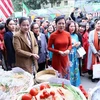
 The Khmer flock to the pagodas during their traditional festival.(Photo: VNA)
 For the Khmer, the pagodas are sanctuaries and also common homes for the whole community. Therefore, all festivals are gathered at the pagodas, especially the celebration of Chol Chnam Thmay New Year.
Many rituals imbued with Buddhist cultural beliefs of the Khmer community take place during the Chol Chnam Thmay Festival. On the first day of the celebration (called Chol Sangkraan Thma), villagers dress up and take offerings to the local pagodas for the mahasangkran procession ceremony and say a prayer for the new year.
On the second day, called Wonbof, the families offer food to monks and build a hillock of sand in front of the pagodas to pray for good weather and a bumper crop.
On the last day called Lom Sak, villagers prepare water and fresh flowers and then attend the Buddhist bathing ceremony in the pagodas.
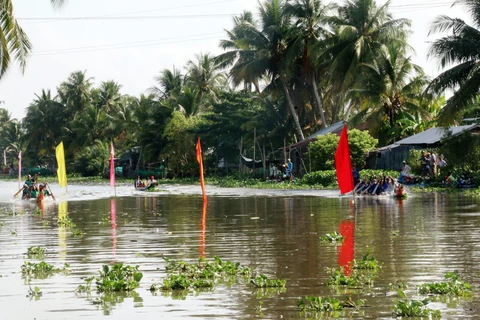
Every year, besides the Chol Chnam Thmay Festival, the Khmer people in the southern region also have major festivals such as Sen Dolta; Ok Om Bok Festival, and Ngo Boat Racing Festival./.