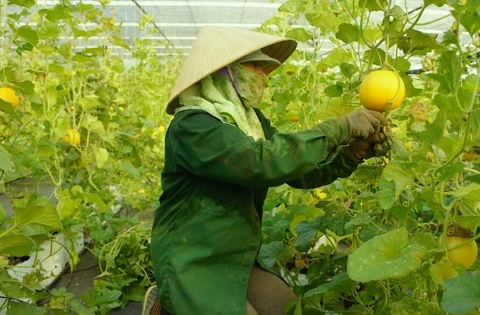
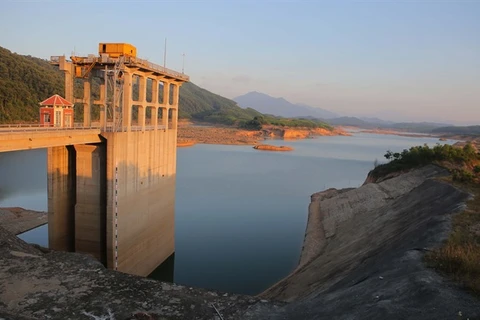
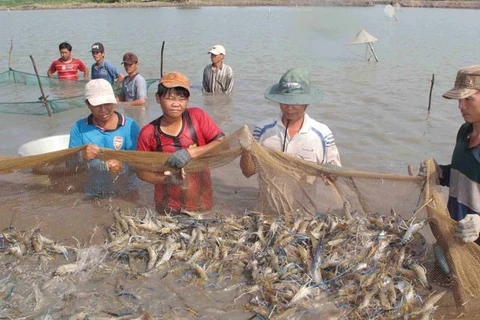
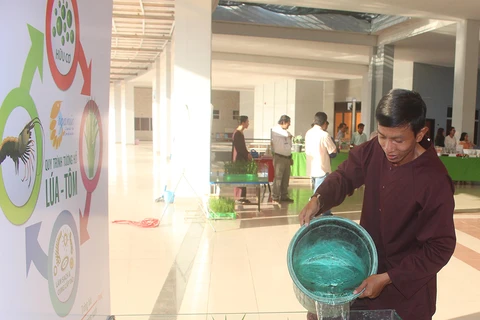
Climate-smart agriculture is defined as agricultural practices that sustainably increase productivity and system resilience while reducing greenhouse gas emissions (Photo: VNA)
 Hanoi (VNS/VNA) - The adoption of climate-smart agriculture (CSA) will improve the productivity and quality of agriculture, increase farmers’ incomes and reduce their vulnerability to adverse climatic phenomena, according to experts.
CSA is defined as agricultural practices that sustainably increase productivity and system resilience while reducing greenhouse gas emissions.
The Agricultural Environmental Institute under the Ministry of Agriculture and Rural Development (MARD) forecast that climate change will reduce the yield of rice by 0.41 and 0.72 tonnes per hectare by 2030 and 2050, respectively. Others crops like maize will decrease by 0.44 and 0.78 tonnes per hectare by 2030 and 2050, respectively.
Agricultural production is affecting the climate and environment. Thirty-nine percent of all greenhouse gas emissions in Vietnam are caused by agriculture.
As Vietnam is one of the most vulnerable nations to climate change, CSA has been applied in a number of localities with a view to deal with the problem, ensuring national food security, green growth and sustainable agriculture.
In addition to promulgating policies, Vietnam has also joined the Global Alliance on Climate Change Smart Agriculture, promoting research, technology and policy approach to agriculture adapting to climate change, practices and sharing experiences on CSA. That will contribute to successful implementation of the scheme on greenhouse emission reduction by 2020 and the restructuring agriculture and rural development scheme.
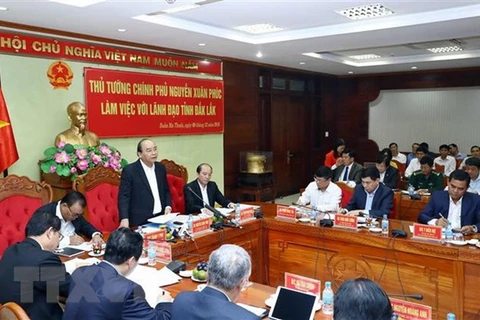
Deputy Prime Minister Trinh Dinh Dung emphasised the need to adopt modern technology at a meeting to review 5 years of agricultural restructuring in late November.
“Vietnam’s agricultural sector is facing many opportunities for development because the country has signed free trade agreements with other countries. Therefore, it is necessary to build a smart, modern Vietnamese agriculture sector to improve competitiveness, adapting to climate change, increasing added value and improving the lives of farmers,” he said.
According to MARD, research and development activities relating to CSA have been implemented in recent years with the participation of various government agencies, international and local organisations as well as the private sector in Vietnam. Some of these are the testing and development of CSA models, scaling of CSA technologies and practices and publication of books on CSA.
These activities have promoted CSA as a feasible and comprehensive approach to ensure agricultural productivity, adapt to climate change and achieve mitigation targets.
Quang Tri province is a typical example.
Ha Sy Dong, Vice Chairman of the Quang Tri provincial People’s Committee, told Viet Nam News that the adoption of CSA has proven effective for farmers as it helped increase productivity by 1.2-1.5 times compared with traditional methods.
A number of measures have been carried out by local authorities over the past two years.
Accordingly, Quang Tri offered many incentives to encourage companies to invest in agriculture, research and selection of new varieties which are suitable to local soil and climate as sell as restoring strains with high economic efficiency.
Farmers who joined CSA production models would receive technical training and capital support to purchase varieties, micro-organisms and water saving equipment.
Results from the summer-autumn crop of 2018 showed that advanced technology application combining proper use of fertilisers could yield higher productivity, reduce the need for pesticides and improve farmer households’ income 30 percent compared to normal cultivation, he said.
The initial success of new agricultural models has contributed to raising people’s awareness about environmental protection and minimising the impact of climate change in production activities.
Le Thi That, a farmer from Trieu Phong district’s Trieu Dong commune, said the model has enabled local residents to cultivate drought resilient rice strains in fields that frequently lack water and decrease water consumption through water efficient techniques.
Dong said that Quang Tri province now has nearly 1,000 ha of land using the CMS model, 860 ha of which is for rice cultivation. It plans to expand the scale to 3,500 ha, with rice accounting for 3,000ha in the coming years.
“With the success of organic and high-tech agriculture models, it is expected that more and more people will engage in the occupation and get rich on their own land,” he said.-VNS/VNA
VNA