Cocoa farmers say things could be better

Despite some encouraging results, Vietnam's cocoa sector has not enjoyed stable development in the past decade, a review meeting heard in HCM City on July 28.
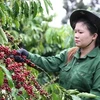
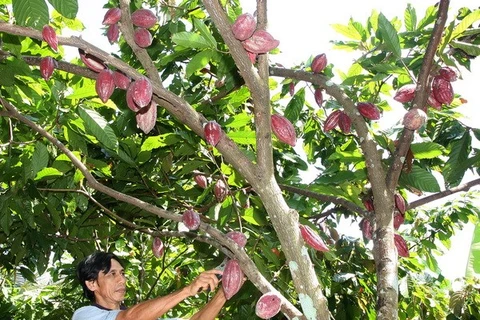
 Cocoa farmers say things could be better ảnh 1A Government plan for until 2020 targets having 35,000ha under cocoa by 2015 with an average output of 1 tonne per hectare and 50,000ha by 2020 with 1.19 tonnes. Photo: cacaovietnam

Despite some encouraging results, Vietnam's cocoa sector has not enjoyed stable development in the past decade, a review meeting heard in HCM City on July 28.

Nguyen Van Hoa, Deputy Head of the Crop Production Department, said in the past years annual output had been 5,000-6,000 tonnes of cocoa beans.

Farming models intercropping cocoa with coconut or cashew had offered high yields, he said.

Companies had done research to come up with cocoa-based products and use cocoa shells to grow mushroom or turn them into fertiliser, he said.

But generally the sector's development had not met expectations, he admitted.

A Government plan for until 2020 targets having 35,000ha under cocoa by 2015 with an average output of 1 tonne per hectare and 50,000ha by 2020 with 1.19 tonnes.

But Nguyen Nhu Hien of the department said the cocoa cultivation area had shrunk dramatically to 11,698ha by the end of last month compared to the peak of 25,700ha in 2012.

Productivity remained low at 0.8 tonnes of dry bean per hectare on average because of the high density of plants, improper shade management and lack of investment in fertilisers, pest control and others, he said.

Besides, price volatility and the lack of linkage in the cocoa value chain had made farmers feel unsecure about cocoa farming, he said.

Gricha Safarian, Managing Director of Puratos Grand-Place Indochina, said "unfair repartition" [of profits] between stakeholders in the supply chain, lack of training to improve yield and quality, and competition with other crops and pre-financing of fertilisers are among factors affecting cocoa sustainability around the world, including Vietnam.

Farmers only got around 4 percent of the profit while manufacturers and distributors got 63 percent, he said.

Phan Huy Thong, Director of the National Agriculture Extension Centre and Head of the Vietnamese Cocoa Committee, said cocoa had been considered a tree that could help eliminate hunger and poverty and introduced to disadvantaged households in difficult areas.

This had yielded poor results, and this approach needed to be changed, he said.

Cocoa was not an easy tree to grow since it needs proper farming and intensive techniques, he said.

He concurred with Dinh Hai Lam, Cocoa Development Manager at Mars Incorporated, who said the sector needed the participation of businesses and investors through the establishment of large-scale farming and for them to have closer linkages with farmers.

In this model, businesses would play a leading role in technology transfer and provide inputs and ensure sales outlets for small households, the two agreed.

Thong said global demand for cocoa was increasing, especially in India and China. Experts forecast a shortage of one million tonnes by 2020, which offered cocoa growing countries, including Vietnam, a great opportunity, he said.

He called on all stakeholders to join hands to develop the sector and ensure fair distribution of profits among them.

The sector should focus on improving quality of the bean by training farmers, investing in infrastructure for purchasing and processing cocoa, and improving irrigation, he said.

Dr Truong Hong, Deputy Director of the Central Highlands Agriculture and Forestry Science Institute, said creating new strains, especially those than can adapt to climate change, was very important.

Besides, firms should focus on further processing of the beans to serve both the domestic and export markets, he said.

Thong said his centre as well as the department would collect feedback from meeting participants and send it to the Ministry of Agriculture and Rural Development to tweak cocoa zoning plans and adopt appropriate measures to ensure sustainable development of the sector.-VNA
See more

Customs officers inspect vehicles and imported goods at the Huu Nghi International Border Gate in Lang Son province. (Photo: VNA)

Customs intensify crackdown on counterfeit goods, trade fraud

The customs sector has identified the fight against smuggling, trade fraud, counterfeit goods and intellectual property violations as a key task. Customs units nationwide have stepped up inspections and supervision of import-export activities along major routes and at key checkpoints.

Workers process clams for export at the factory of Thanh Hoa Fishery Import-Export JSC in Thanh Hoa province. (Illustrative photo: VNA)

Vietnam notifies WTO committee of goods origin management reforms

The information presented by Vietnam attracted attention from others WTO members amid global efforts to accelerate the digital transformation of import – export procedures and improve the implementation of rules of origin to enhance supply chain adaptability.

A Petrolimex worker refuels a motorbike. (Photo: VNA)

Energy imports surge in first quarter of 2026

Data from Vietnam Customs shows that the country spent approximately 2.93 billion USD importing nearly 3.37 million tonnes of petroleum products in the first quarter of 2026, an increase of 77.8% in value and over 44% in volume compared to the same period last year.

A perspective of the Quang Ninh 1 Wind Power Plant project (Photo: Quang Ninh provincial Department of Construction)

Quang Ninh gives nod to first offshore wind power plant

The project is expected to have a designed capacity of 50 MW and will be implemented in nearshore waters of the Co To special zone. It will be the first offshore wind power project in the province, playing a pioneering role in tapping Quang Ninh’s abundant renewable energy potential.

Viettel launches the Unitel Logistics brand in Laos. (Photo: VNA)

Vietnamese firms expand global footprint

The Government recently approved the “Go Global” programme for 2026-2030, which identifies the private sector as a key driving force in Vietnam’s international expansion process. It aims to help Vietnamese private enterprises strengthen their overseas presence in a comprehensive, effective and sustainable manner through international investment, business activities and deeper integration into regional and global supply and value chains.

Vietnam and Cambodia are seeking to strengthen supply chain connectivity and promote sustainable border trade at a trade promotion conference in Vietnam's Mekong Delta province of Dong Thap on May 15. (Photo: https://thoibaonganhang.vn/)

Vietnam, Cambodia eye stronger border trade, supply chain connectivity

Vietnam–Cambodia trade ties have grown rapidly in recent years, becoming one of the major pillars of economic cooperation in the Mekong sub-region. The two countries share a 1,137-km border and an increasingly developed network of international and secondary border gates, facilitating cross-border trade, logistics and investment.

Illustrative image. (Photo: VNA)

Three proposals to connect overseas Vietnamese resources with private economy at home

There are currently many Vietnamese IT specialists working in technology corporations, banks, start-ups and innovation ecosystems across Canada. With appropriate mechanisms in place, this workforce could become a technology bridge, helping Vietnamese enterprises access management expertise, technical solutions, international standards and partnership networks in North America.

The Nguyen Van Linh–Nguyen Huu Tho intersection fully opens both underpasses to traffic, helping ease congestion in the area. (Photo: VNA)

Ho Chi Minh City pushes for full public investment disbursement

Ho Chi Minh City was allocated a record 147.599 trillion VND (5.6 billion USD) in public investment capital for 2026, up 22.6% from last year and accounting for nearly 14.6% of the nation’s total public investment budget. However, disbursement by the end of April remained below the national average.

Visitors explore Quang Tri province’s OCOP products (Photo: VNA)

Quang Tri links OCOP products with tourism to expand farm produce markets

The central province currently has 160 OCOP products developed by cooperatives, cooperative groups and businesses, including two five-star and 31 four-star products. These locally distinctive products are gradually becoming "ambassadors" showcasing Quang Tri’s culture and identity to domestic and international visitors.