Committee for Management of State Capital debuts

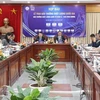
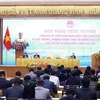
The Committee for Management of State Capital (CMSC), known as the “super committee”, made its debut in Hanoi on September 30 in the witness of Prime Minister Nguyen Xuan Phuc.
Committee for Management of State Capital debuts ảnh 1Prime Minister Nguyen Xuan Phuc witnesses the launch of the Committee for Management of State Capital (CMSC) in Hanoi on September 30. (Photo: VNA)

Hanoi (VNA) – The Committee for Managementof State Capital (CMSC), known as the “super committee”, made its debut inHanoi on September 30 in the witness of Prime Minister Nguyen Xuan Phuc.

The CMSC will manage 19 State-owned economicgroups and corporations. According to consolidated financial statements byDecember 31, 2017, the total value of State equity at these 19 groups and corporationsreached more than 1 quadrillion VND (43 billion USD) and the total value ofassets was 2.3 quadrillion VND (99 billion USD).

According to the 2018 decree guiding itsestablishment, the committee is responsible for managing State capital at theenterprises where the State holds a 100 percent stake and at joint stockcompanies and limited liability companies with multiple members where the Statehave invested its capital.

The committee, established by the Government,has one chairperson and at most four vice chairpersons appointed or dismissedby the Prime Minister.

The aforementioned 19 enterprises are run byfive ministries. Topping the list is the State Capital Investment Corporation(SCIC) under the management of the Ministry of Finance. The remaining 18 SOEsare managed by four ministries, including the Ministries of Industry and Trade(MoIT), Transport (MoT), Agriculture and Rural Development (MARD), andInformation and Communications (MIC).

Most of the names on the list are enterprisesunder the management of MoIT and MoT, comprising of six groups and sixcorporations.

At the launching ceremony, the committee andthese five ministries signed memoranda of understanding (MOU) on the transferof the rights of State representatives at these aforementioned enterprises tothe committee.

Addressing the ceremony, Prime Minister NguyenXuan Phuc said improving the efficiency of the use of the State capital, thusenhancing the competitiveness of the whole economy, was a basic requirement toboost the role of the State sector.

This is the reason for the establishment of thecommittee, he said, emphasising the great expectations of not only theGovernment but the public on great changes in the thinking and governance ofthe committee.

The Prime Minister said these enterprises are atthe core of the national economy. The committee must work to overcome theweakness and create a big difference to the State sector and each enterprise toincrease its efficiency, he said.

He requested the committee toquickly strengthen and streamline its operations. It needs to set objectivesand indicators to evaluate the effectiveness of each department and staff.

PM Phuc also required the committee to reinforceits accountability and build the monitoring mechanism for representatives atthese enterprises to limit the loss of State capital.

Each department in the committee should have ameasure of its performance and improvement each year, he said, and added thatthe committee and its subordinate units must apply state-of-the-art technologyin governance.

He requested the committee after one year ofoperation to evaluate its progress towards “contributing to growth, employmentand State budget, and moreover to develop a fair and equal playing field forall economic sectors”.

The government leader asked relevant ministriesand these State enterprises to coordinate with the committee to carry out thetransfer immediately, without affecting the management of State capital andequitisation process of State-owned enterprises.

Also at the ceremony, the CMSC signed an MOUwith Singapore’s Temasek Holdings to exchange business information andshare experiences in modern capital management in accordance with the marketmechanism.-VNA

VNA

See more

Key export sectors such as textiles – garments, footwear and furniture, along with many signature products of Da Nang, have strong potential to expand their markets through online export channels. (Photo: VNA)

Da Nang seeks to boost online exports

To help businesses go global, Da Nang is shifting from supporting individual online activities to developing an integrated ecosystem covering products, branding, platforms, payments, logistics, legal issues and market information. This is also part of the city’s e-commerce development orientation for 2026-2030, which identifies e-commerce as an important component of the digital economy.

Deputy Minister of Foreign Affairs Le Thi Thu Hang receives Rolf Mutzenich, a member of the Foreign Affairs Committee of the German Bundestag, in Hanoi on August 18. (Photo: baoquocte.vn)

Vietnam welcomes German firms’ expansion

Vietnam welcomes and stands ready to create favourable conditions for German businesses to expand their investment and operations in the country, particularly in infrastructure, smart seaports, renewable energy, high-speed railways, science and technology, and high-quality human resource training.

Khanh Hoa province has the largest sheep population in Vietnam, with around 100,000 individuals. (Photo: VNA)

Khanh Hoa province explores Halal ecosystem development

Khanh Hoa aims to estabish itself as a Halal-friendly destination while supporting businesses in expanding export markets, attracting strategic partners and investors, and drawing projects from countries with strong Halal logistics, tourism, manufacturing, processing and agriculture sectors.

The proportion of Vietnamese goods remains high at supermarkets. (Photo: VNA)

Vietnamese brands win over domestic consumers to go global

Amid increasingly fierce global competition, the goal is no longer simply to increase domestic consumption of Vietnamese goods, but to develop strong Vietnamese brands capable of winning consumers through quality, innovation and added value, thereby creating a stepping stone for expansion into international markets.

Illustrative image (Photo: VNA)

Automated VAT refunds to be rolled out from December

As of August 11, VAT refunds rose 32% from a year earlier, reaching 64.4% of the full-year estimate. Tax authorities issued 11,627 refund decisions totaling 111.726 trillion VND (4.26 billion USD), up 9% by volume. The payouts improved cash flow for companies and supported production, trade and exports.

ST25 rice is the centrepiece of the Vietnam Goods Week at Selgros. (Photo: VNA)

ST25 rice officially enters Selgros wholesale supermarket chain in Germany

The placement of ST25 rice on Selgros shelves not only creates an additional opportunity for German consumers to access Vietnamese rice products, but also contributes to efforts to increase the added value of Vietnamese agricultural products by shifting the focus from volume to quality, branding and value.

Trains on the elevated section of the Cau Giay – Nhon route in Hanoi provide convenient transportation for local residents. (Photo: VNA)

Multimodal connectivity to drive Vietnam’s transport infrastructure

Under the proposed approach, roads would serve mainly as connectors and for first- and last-mile transport; railways would handle large volumes over long distances; maritime transport would serve import and export cargo; inland waterways would carry large volumes at low cost; and air transport would focus on fast delivery and high-value goods.

Amata Industrial Park in Dong Nai city (Photo: VNA)

Green shift powers investment in southeast Vietnam

The Amata Industrial Park in Dong Nai City, established 32 years ago and covering more than 500ha, is home to over 160 domestic and foreign businesses. Selected in 2020 as one of three national pilot sites for conversion into an eco-industrial park, Amata has raised its compliance with the international eco-industrial park framework from 41% to 86% in 2024, and is working towards becoming Dong Nai's first certified eco-industrial park.

At a port in Ho Chi Minh City (Photo: VNA)

Multi-channel capital mobilisation needed to achieve double-digit growth

The Ministry of Finance estimates development investment for 2026-2030 at a minimum of 38.5 quadrillion VND (1.48 trillion USD), or about 40% of GDP. The state budget is expected to provide only about 20%, or more than 7.7 quadrillion VND, leaving over 80%, or more than 30 quadrillion VND, to be raised from the broader economy. That makes expanding capital mobilisation channels beyond bank credit essential.

An aerial view of the Nhieu Loc – Thi Nghe area in Ho Chi Minh City. The southern metropolis is home to the Vietnam International Financial Centre. (Photo: VNA)

Vietnam International Financial Centre launches membership registration system

Integrated into the official Vietnam International Financial Centre portal at vifc.gov.vn, the online system for registering and recognising members provides a unified online service channel through which investors, organisations and businesses can complete procedures related to membership, from new registration and recognition to information updates and termination of membership.