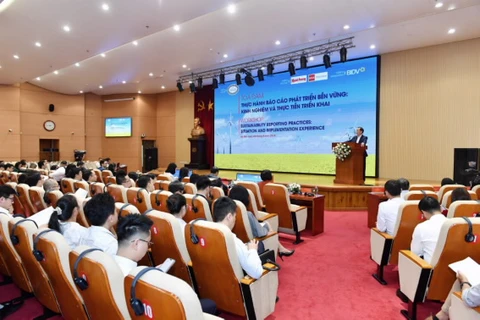
Hanoi (VNS/VNA) - Companies should apply international financial reporting standards (IFRS) to improve transparency and increase the chances to expand globally, experts have said.
IFRS is widely applied in more than 120 countries and territories around the world to ensure transparency and consistency but remains unpopular with enterprises in Vietnam.
Vietnam currently applies Vietnam Accounting Standards (VAS).
The Ministry of Finance in 2020 approved a project on applying financial reporting standards in Vietnam which aims at applying IFRS and new Vietnam Financial Reporting Standards (VFRS). Accordingly, IFRS is expected to be made compulsory after 2025.
According to Phan Huu Thang, President of the Vietnam Industrial Park Finance Association (VIPFA), financial reporting and accounting are necessary for enterprises, especially those in industrial zones looking to attract foreign investment inflows.
Nguyen Thi Thuy from the AudiCare Vietnam Training Centre said that financial reports which meet IFRS help increase transparency, professionalism and opportunities to compete in the global market, attract investments and expand opportunities for cheap loans as well as create favourable conditions for doing business globally.
In fact, few Vietnamese firms have thorough understandings about IFRS while there are still gaps in compliance with financial reporting standards, Thuy said.
Applying IFRS can be complicated and costly in terms of training and changes in the system and constant compliance, she pointed out. In addition, adjusting IFRS to ensure appropriateness to existing legal frameworks is not an easy job.
She pointed out that VAS has 26 standards while IFRS has 41. It might take enterprises at least three or four years of training to prepare data for their first IFRS report.
Companies should select professional consultants to improve transparency and trustworthiness for their financial reports, she said.
Nguyen Chi Dung from EY Vietnam said that tax authorities tend to apply risk-based management principles in tax inspection and change their approaches in inspecting.
Around 90% of enterprises in the inspection plan are automatically selected through the risk assessment system which assesses the risk level through enterprises’ financial reports, customs declarations, banking transactions and e-invoices, he said.
The focus of 2024 tax inspection includes enterprises operating in sectors which have high risks for tax evasion such as real estate, construction, raw material trading, retail, plastic product manufacturing and trading, communication, advertising and e-commerce.
It is necessary for enterprises to improve their internal processes, comply with tax laws and regularly update tax policies, Dung said.
In addition, enterprises should improve compliance with international standards to take opportunities for international expansion./.
See more
Intel deepens engagement in Vietnam’s semiconductor industry
According to the Saigon Hi-Tech Park (SHTP) management board, Intel has relocated part of its production line from Costa Rica to SHTP as part of its global manufacturing restructuring strategy aimed at improving efficiency and competitiveness.
70,000 tonnes of rice granted “Low-emission Green Vietnamese Rice” label
The certified rice has not only been exported to Japan but also reached markets in Europe and Oceania.
Trade office strengthens Vietnam – Morocco business connectivity
Many Moroccan businesses expressed interest in establishing long-term direct import partnerships with Vietnamese manufacturers, particularly in agricultural products, processed foods and consumer goods.
Biofuel ready for nationwide rollout
For biofuels, particularly E10, to develop successfully, stronger and more coordinated policies are needed, especially pricing mechanisms capable of creating a sufficiently attractive gap between E10 and mineral-based petrol, an expert has said.
Auto industry split over proposal to scrap business conditions
Some argue that removing conditions entirely could lead to an influx of low-cost imports and weaken domestic production capacity, while others say the current system imposes unnecessary costs and slows innovation.
Singaporean banks see more opportunities in Vietnam
Singapore’s banks are expanding their presence in Vietnam to seize opportunities from the market’s increasing integration into Asian trade and surging corporate financing needs.
Removing bottlenecks to promote intellectual property valuation
As the economy increasingly shifts towards knowledge-based growth, innovation and digital transformation, demand for IP and technology valuation is becoming more urgent.
Reference exchange rate rises slightly on May 14
The State Bank of Vietnam set the daily reference exchange rate at 25,126 VND/USD on May 14, up only 3 VND from the previous day.
Vietnam cements status as world’s No.2 coffee producer, robusta powerhouse
Vietnam cements its position as the world’s second-largest coffee producer and leading robusta supplier, latest data by the United States Department of Agriculture (USDA) showed.
Intellectual property key to helping Vietnamese firms escape outsourcing trap
Companies that register industrial designs in both Vietnam and export markets, with properly licensed software, have significantly strengthened their competitiveness and tripled profit margins compared to five years ago.
Da Nang promotes investment attraction to achieve over 11% growth
Da Nang's foreign direct investment (FDI) attraction showed strong growth, reaching 237.7 million USD, double the level recorded a year earlier. The city granted licences for 47 new FDI projects, approved capital adjustments for 16 projects and recorded 10 transactions involving capital contributions and share acquisitions in economic organisations.
Vietnam pivots to selective, high-quality FDI attraction for sustainable growth: Deputy PM
The FDI sector remains a key pillar of Vietnam’s economy, with more than 46,500 valid projects and total registered capital exceeding 543 billion USD so far. Disbursed capital has reached around 357.6 billion USD. The FDI sector contributes over 20% of GDP, accounts for around 70% of total export turnover, and creates jobs for millions of workers. Vietnam continues to rank among ASEAN’s leading FDI destinations despite global investment slowdowns.
Honda Vietnam proposes investment incentives for hybrid, electric vehicle production
Honda Vietnam called for reduced registration fees for hybrid vehicles to a maximum of 50% of the level applied to internal combustion engine vehicles of the same category. The company also called for stronger support for supporting industries and higher localisation rates in electric motorcycle production.
PM draws red line on May 10 as public capital disbursement lags
A recent PM directive set a May 10 deadline for ministries, agencies and localities to complete detailed allocations of the 2026 public investment capital plan.
Session highlights synergy promotion for FDI, domestic enterprises
A Party official has urged the Vietnamese business community to improve corporate governance, technological capacity, production standards, workforce quality and international connectivity to strengthen ties with the FDI sector.
Arkia Israeli Airlines announces direct flights to Ho Chi Minh City
Arkia Israeli Airlines on May 12 announced plans to launch direct flights from Tel Aviv to Ho Chi Minh City, marking a further expansion of the carrier’s operations in Vietnam.
Vietnam’s aquatic product exports aim for 12 billion USD target
According to the Vietnam Association of Seafood Exporters and Producers (VASEP), the seafood export turnover during the January-April period was estimated at 3.7 billion USD, up nearly 15% year-on-year.
Customs intensify crackdown on counterfeit goods, trade fraud
The customs sector has identified the fight against smuggling, trade fraud, counterfeit goods and intellectual property violations as a key task. Customs units nationwide have stepped up inspections and supervision of import-export activities along major routes and at key checkpoints.
Vietnam strives to sustain dragon fruit exports to EU
Food safety warnings from the EU declined sharply from 64 cases in 2024 to 17 in 2025 thanks to strengthened inspections, traceability measures and corrective actions.
Vietnam notifies WTO committee of goods origin management reforms
The information presented by Vietnam attracted attention from others WTO members amid global efforts to accelerate the digital transformation of import – export procedures and improve the implementation of rules of origin to enhance supply chain adaptability.