Vietnam makes bold step to improve business climate: VCCI report

Vietnam’s business and investment climate is showing marked improvements following sustained reform efforts, with enhanced access to business-related information and regulations, reduced unofficial costs, and effective administrative reforms, according to the latest survey by the Vietnam Chamber of Commerce and Industry (VCCI).

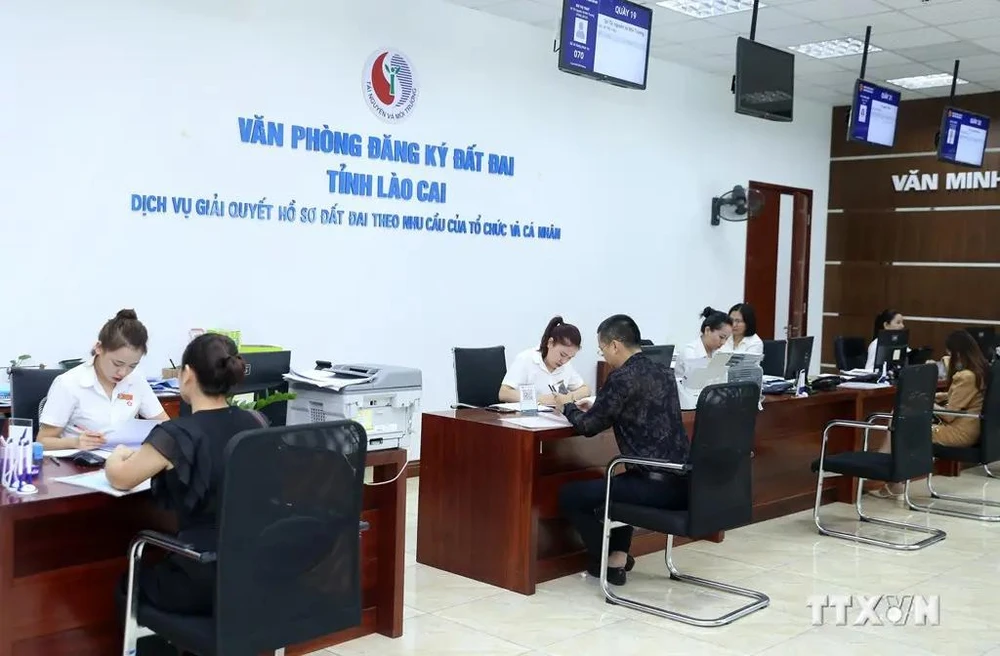
At the one-door administrative unit of the Public Administration Service Center in Lao Cai province (Photo: VNA)

Hanoi (VNA) – Vietnam’s business and investment climate is showing marked improvements following sustained reform efforts, with enhanced access to business-related information and regulations, reduced unofficial costs, and effective administrative reforms, according to the latest survey by the Vietnam Chamber of Commerce and Industry (VCCI).

So far this year, the business community has witnessed positive policy shifts from regulatory bodies, with the government actively addressing outdated regulations and streamlining administrative procedures. However, enterprises have higher expectations on the reforms and resolve to handle the bottlenecks of the regulations.

One major concern remains fire safety regulations, including specifications for fire-resistant paint, fire resistance ratings, fire separation distances, and water supply system having creating significant obstacles for businesses. Many completed buildings remain unused due to the requirements, resulting in substantial losses for firms and society.

Dialogues have been held between state management agencies and associations and businesses to revise the law on fire prevention and fighting to remove roadblocks for them.

The transit cargo regulations have challenged the logistics sector as well. According to Chairman of the Vietnam Logistics Business Association Dao Trong Khoa, Vietnamese transport companies have faced penalties for violations of transit cargo regulations although they are not allowed to verify the contents of the cargoes while the goods’ information in the customs declaration is provided by their partners.

Environmental protection fees for emissions present another obstacle, with potential overlaps with the environmental protection law. VCCI Deputy Secretary General and head of the chamber’s Legal Department Dau Anh Tuan said that while economic tools are crucial for environmental protection, businesses already face multiple environmental obligations, including solid waste, wastewater, and hazardous waste fees.

Vietnam has enacted the environmental protection tax law, which levies taxes on petroleum and coal, the primary fuels responsible for emissions. Current environmental protection laws stipulate the issuance of environmental permits, which include provisions regarding the quantity and quality of emissions as well as automatic and periodic monitoring measures.

Most businesses have complied with these obligations, enabling government agencies to gather sufficient data to impose taxes on emissions rather than taxing input fuels, he said.

Tuan added that although competent ministries and sectors have reviewed and built measures to reduce and simplify various business – related requirements over the recent three years, they have not met businesses’ expectations. He expressed his hope for continued reform efforts to address investment barriers and business constraints./.
VNA

See more

Seafood section with a wide range of products. (Illustrative photo: VNA)

Processed seafood industry seeks stronger foothold in domestic market

As seafood exports face growing challenges from the global economic slowdown, technical barriers in importing markets, and rising input costs, developing the domestic market is increasingly seen as a strategic direction to stabilise production, maintain supply chains, and reduce dependence on external markets.

Party General Secretary To Lam (R) receives China’s Luxshare-ICT Group Vice Chairman Wang Laisheng in Hanoi on November 15. (Photo: VNA)

Party Chief receives Vice Chairman of China’s Luxshare-ICT Group

Party General Secretary To Lam affirmed that the Party and State consistently welcome foreign enterprises to invest and succeed in Vietnam, pledging equal treatment for all investors and continued efforts to improve the business environment towards greater fairness, transparency and convenience.

Illustrative photo (Photo: VNA)

Vietnam Online Shopping Day – Online Friday 2025 opens

Vietnam Online Shopping Day – Online Friday 2025 is not only the biggest online shopping event of the year, but also spreads the message of smart, responsible and sustainable consumption, contributing to promoting the strong development of Vietnam's digital economy in the new era.

Thi Khui, Director of Bu Lach Organic Cashew Cooperative, signs a cashew purchasing cooperation agreement with a representative of Intersnack Vietnam Cashew Company Limited. (Photo: Dong Nai Newspaper)

Ethnic woman grows cashew cooperative's international success

With strong support from local authorities, Khui persuaded 165 farming households to adopt organic cultivation practices. The cooperative now oversees a raw material area of 1,000 hectares, establishing a solid foundation for large-scale organic production.

The 20th meeting of the Vietnam-RoK Joint Economic Committee takes place in Seoul on November 14. (Photo: VNA)

Vietnam, RoK seek new drivers to advance comprehensive cooperation

The RoK is also Vietnam’s largest foreign investor. As of the end of September, Korean investors operated 10,301 valid projects with combined registered capital of 94.2 billion USD, topping both capital value and number of projects among 154 countries and territories investing in Vietnam. Korean enterprises contribute roughly 30% of Vietnam’s total export value.

Workers process aquatic products for exports. (Photo: VNA)

Workshop seeks to boost agro-forestry-aquatic exports to EU

Participants underlined the importance of complying with the EU’s strict standards, stepping up national branding, developing green and clean products aligned with European consumer preferences and, particularly, embedding cultural value and compelling Vietnamese stories in each product.