Conference seeks to improve quality of Vietnamese cashew

As global demand increases for cashew, Vietnam, the world’s largest exporter of the nut, could grab an even bigger market share by improving quality, a conference heard in central Da Nang city.
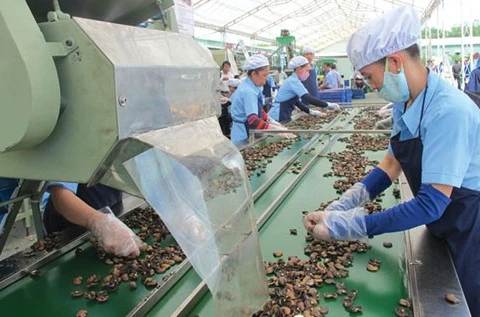
Conference seeks to improve quality of Vietnamese cashew ảnh 1Proccessing cashew for export (Photo: VNA)


Da Nang (VNA)
- As global demand increases for cashew, Vietnam, the world’s largest exporter of the nut, could grab an even bigger market share by improving quality, a conference heard in central Da Nang city recently.

Ranjeet Wallia, President and CEO of Chi Commodities Handlers Inc, said global demand is up 53 percent since 2010 and cashew is now the second most consumed tree nut.

According to him, the US buys more than 30 percent of Vietnam’s exports, mainly for snacking and making cereal, energy bars, milk and healthy foods.

Joseph Lang, managing director of Kenkko House, one of Europe’s largest dealers of nuts and dried fruits, said the growth of the cashew market in Europe over the last three years has been tremendous with Europe now representing around 25 percent of cashew exports from Vietnam and having growth by well over a third over the period.

Demand is expected to continue increasing because consumers are more aware of the nut’s nutritional value, according to Lang.

Cashew currently has a tighter supply scenario and has consequently seen price rise.

The recent increase in price is likely to worry buyers, including retailers and food processors.

According to Lang, consumers are becoming more and more demanding about transparency. They want to know where their foods come from, what’s in it and how it has been produced.

“That means we need to be more transparent, provide greater information and show evidence that our product is not infested, is of high quality, comes from a reliable and sustainable source of supply and generally satisfies the expectations of today’s well informed customer.”

Vietnam currently accounts for half of the world’s cashew exports, and has been the leading exporter for the last 10 years.

Its cashew products are exported to 80 countries and territories, with the US, Europe, and China being the main markets.

According to the Ministry of Industry and Trade, the country exported 290,000 tonnes worth 2.32 billion USD in the first 10 month of this year, a year-on-year increase of 5.5 percent in volume and 16.4 percent in value.

The full year’s exports are expected to reach a record 3 billion USD, with kernel accounting for 2.8 billion USD.

Nguyen Duc Thanh, chairman of the Vietnam Cashew Association (Vinacas), pointed to the fact that the Vietnamese cashew industry faces high risk due to its massive reliance on imported raw materials, which also makes it hard for processors and exporters to control quality or food safety and hygiene.

Demand for raw nut imports doubled in 2013-16, he said.

He quoted quality checking company Vinacontrol as saying the quality of raw cashew imported from Africa had been lower this year compared to last, affecting Vietnamese exporters.

The association would work with African countries to persuade them to refuse export quotas to firms not fulfilling their contracts with Vietnamese firms, he

said.

Companies need to have a strategy to develop raw material sources, and be more careful about importing raw nuts, he said.

The association listed specifications for raw cashew nuts and displayed samples of purchase contracts.

Vietnam and African countries like Ivory Coast and Nigeria discussed ways to boost co-operation in cashew trade.-VNA

VNA

See more

Pham Van Cong, Chairman of the Vietnam Cashew Association, speaks in a conference reviewing the industry’s 2025 performance and deploying procurement plans for 2026 in HCM City on March 13. (Photo: VNA)

Cashew sector braces for challenges in 2026 amid global uncertainties

Vietnam’s cashew industry recorded export turnover of about 5.5 billion USD in 2025, the highest level ever. He noted that the result reflects the industry’s remarkable development, dynamism and timely adaptation to complex and unpredictable challenges both domestically and globally.

An Phát Complex Industrial Park in Hai Phong City is one of the eco-friendly industrial parks. (Photo: VNA)

Green industrial parks become new magnet for FDI

Statistics show that about 80% of FDI enterprises prioritise investing in industrial parks with green energy infrastructure, reflecting a growing shift in investment preferences amid tightening global environmental standards.

Wood panel production at the Thuan An Wood JSC in Ho Chi Minh City (Photo: VNA)

Vietnamese businesses ride wave of investment in green manufacturing

Recent developments in private investment show that as confidence in the private sector has grown and is a key driver of economic development, investors are strengthening support for enterprises not only through capital but also management expertise and market connectivity.

Officers and soldiers of Son Tra Border Guard Station, Da Nang City Border Guard Command tell local fishermen about IUU fishing. (Photo: VNA)

Fishing solidarity groups help Vietnam with IUU “yellow card” warning removal

Over the years, coastal authorities in Da Nang have intensified efforts to educate fishermen about regulations, particularly the need to avoid illegal fishing in foreign waters. Local administrations and competent forces have also strengthened vessel registration and inspection procedures, installed vessel monitoring systems and ensured transparent declarations of catches at ports.

Representatives of Central Retail Vietnam and Lotte Plaza Market sign a distribution cooperation agreement at the networking event in Ho Chi Minh City on March 13. (Photo: VNA)

Vietnamese firms step up cooperation with international distribution chains

Connecting Vietnamese businesses with international distribution networks has been a key component of government-led trade promotion programmes for many years, which are designed to help domestic companies place goods directly into global retail systems rather than exporting solely through intermediaries.

Direct Hanoi–Amsterdam flights by Vietnam Airlines to begin on June 16. (Photo: Vietnam Airlines)

Vietnam Airlines to launch direct Hanoi–Amsterdam service on June 16

Under the plan, the Hanoi–Amsterdam route will commence operations on June 16, 2026, with an expected frequency of three return flights per week using modern wide-body Airbus A350 aircraft. This will be the first direct air link between Vietnam and the Netherlands, helping to shorten travel time and enhance connectivity between Vietnam and one of Europe’s key economic, logistics and aviation transit hubs.

Farmers harvest the 2025 Winter–Spring rice crop in An Giang province. (Photo: VNA)

An Giang accelerates export shift to meet green consumption trends

To enhance competitiveness, authorities are assisting businesses in obtaining globally recognised certifications such as GlobalG.A.P., Organic and HACCP, enabling key exports including rice, seafood and clean agricultural products to strengthen their position in global markets, according to Quang Xuan Lua, Director of the An Giang Centre for Trade and Investment Promotion.

Motorcycle riders refill their vehicles at a petrol station in Hanoi (Photo: VNA)

E5 RON92 biofuel price falls in latest adjustment

Since the beginning of this year, domestic fuel prices have undergone 14 adjustments, including five decreases and nine increases for RON95 and six declines and eight hikes for E5 RON92. Meanwhile, diesel price has fallen three times and risen 11 times.

A French customer is tasting Vietnamese lychee. (Photo: VNA)

Vietnamese agricultural products boost global brand recognition

Vietnam aims to achieve about 74 billion USD in agro-forestry-fishery export turnover this year. Expanding value-added products, improving quality standards and strengthening brand building, especially through international supermarket systems, will be key to enhancing the competitiveness and global recognition of Vietnamese agricultural products.