Corporate bond market cools for 2nd month

The value of corporate bonds issued in October was 9.5 trillion VND (409 million USD), down 12.8 percent from September, according to the Hanoi Stock Exchange (HNX).
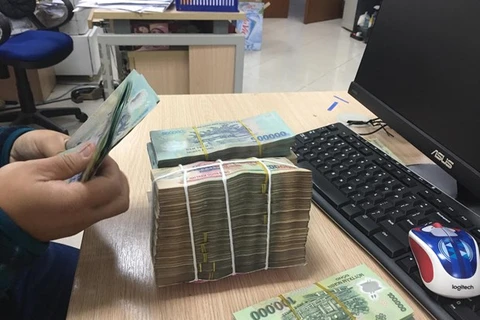
Corporate bond market cools for 2nd month ảnh 1Cash notes being counted. The corporate bond market continued cooling down in October with total bonds sold worth 409 million USD, down 12.8 percent monthly. (Photo laodong.vn)

Hanoi (VNS/VNA) - The value of corporate bonds issued in October was 9.5trillion VND (409 million USD), down 12.8 percent from September, according tothe Hanoi Stock Exchange (HNX).

Compared to August, the figure was down 84 percent.

Creditors remained the biggest issuers as the value of their sold bonds was 3.7trillion VND, accounting for nearly 39 percent of the total figure.

Real estate firms ranked second with 3.07 trillion VND worth of corporate bondssold to investors in September, which accounted for 32.3 percent of the total.

Services and construction companies issued 226 billion VND and 300 billion VNDworth of bonds in September, respectively.

Their figures accounted for 2.4 percent and 3.2 percent of the market’s total,respectively.

In October, 20 companies organised 90 bond auctions. The average term of thebonds was 5.47 years.

Bonds sold by lenders had the highest average annual yield rate of 6.08 percent,followed by construction companies (5.33 percent), property developers (4.61 percent),and services suppliers (2.69 percent).

The northern market regulator said that the market continued cooling down inOctober since Decree 81/2020/NĐ-CP took effect on September 1 to tighten thecorporate bond market in order to protect investors that are vulnerable torisks and make the market more transparent.

According to the HCM City Real Estate Association (HoREA), outstanding loansfor real estate companies in HCM City increased by 5.9 percent in 10 months to 293.8trillion VND in October.

The figure was equal to 12 percent of the total outstanding loans for allsectors in the southern hub city, which rose 5.5 percent in 10 months to 2.42quadrillion VND in October.

About 2.7 percent of outstanding loans for real estate projects were consideredbad debts, according to HoREA.

The Vietnamese economy continued progressing in the first nine months at a paceof 2.12 percent, inflation was controlled well and the consumer price index(CPI) rose only 3.71 percent.

Those factors mean the bad-debt ratio in the real estate sectorremains under control, HoREA said.

“But a large amount of loans made to real estate firms, including bondpurchases by both institutional and individual investors, may turn tonon-performing loans,” the association warned.

The regulators should pay attention to consumer lending, especially when somepeople borrow money to buy properties instead of building and repairing theirhouses as contracted, HoREA said.

Those loans may account for 1.7 percent of the total real estate loans and suchloans require stricter supervision from the authorities, the association added.

Property developers made big bond issuances in January-August but the sectorcooled down in September and October due to Decree 81/2020/NĐ-CP.

It should be noted that the number of individual investors accounts for 20percent of all investors while bond purchases by banking institutions occupy amajority of the total figure, HoREA said.

Those underline potential risks for investors, issuers and financial companieswhen the bonds come to maturity, the association said.

There needs to be an independent rating agency to evaluate the bond issuers,thus making the market more transparent and better protecting the investors,HoREA said./.
VNA

See more

Containers of fresh Vietnamese durian for export are subject to a full-chain traceability system. (Photo: VNA)

First “green lane” durian shipment exported to China

​Under the “green lane” process, quality control begins at the cultivation stage, including soil sampling and monitoring, and continues through harvesting and processing, with traceability labels attached to trees and applied to fruit at the time of picking. It also allows plant quarantine procedures and the issuance of certificates of origin (C/O) directly in the localities where the orchards are located.

Delegates at the Vietnam Expo 2026 (Photo: VNA)

Vietnam pushes for deeper auto supply chain ties with RoK

The RoK stood as Vietnam’s largest foreign investor with more than 95.2 billion USD in registered capital as of February 2026, or about 18% of all foreign cash flowing in, with thousands of active projects. In January-February alone, the RoK led the pack with nearly 2 billion USD in pledges, grabbing a whopping 32.7% of total registered capital and showing no signs of slowing down.

More than 600 tourism firms, 15 countries and territories, and 34 provinces and cities are promoting destinations and introducing tourism products at the fair (Photo: VNA)

Digital transformation key to elevating Vietnam’s tourism: official

Speaking at the opening of the Vietnam International Travel Mart (VITM) 2026 in Hanoi on April 10, Deputy Minister of Culture, Sports and Tourism Ho An Phong noted that despite challenges in 2025, Vietnam largely fulfilled its socio-economic development goals. Tourism remained a bright spot, recording 21.5 million foreign arrivals and 135.5 million domestic visitors, with total revenue exceeding 1 quadrillion VND (37.9 billion USD).

A drone sprays fertiliser over rice fields. (Photo: VNA)

Low-altitude economy emerges as new growth driver for Vietnam

The UAV technology is particularly effective in addressing challenges faced by ground infrastructure, especially in densely populated urban areas and remote regions. Smart aerial devices also enable real-time data collection, improving governance, decision-making and digital transformation across industries.

Passengers at Cat Bi Airport in Hai Phong city (Photo: VNA)

Aviation sector ensures fuel supply for April 30–May 1 peak

Aviation fuel suppliers are actively negotiating and diversifying supply sources both domestically and internationally, while strengthening coordination, storage and distribution capacity to meet immediate demand. These efforts aim to support airlines in optimising operations and maintaining stable flight schedules.

A session at the Vietnam–Australia Green Transition Forum 2026. (Photo: VNA)

Green transition offers opportunities for stronger Vietnam–Australia cooperation

Under the theme "Accelerating decarbonisation in agriculture and manufacturing – Unlocking trade and investment opportunities", the forum gathered nearly 200 researchers, experts and businesses involved in policy development, investment, research and innovation. Participants exchanged insights and explored ways to translate the cooperation potential between Vietnam and Australia into practical business opportunities.

Household businesses and individual entrepreneurs with annual revenue of 500 million VND or less are not subject to personal income tax and are only required to declare their actual revenue. (Photo: VNA)

Expanding personal income tax exemptions to drive knowledge economy

The Ministry of Finance has recently released the draft for public feedback, with the decree expected to take effect from July 1. The draft specifies 21 categories of tax-exempt income, adding five, aimed at encouraging individuals working in priority sectors aligned with national development strategies.​

A woman in Ninh Bình province is livestreaming to sell local products. (Photo: VNA)

Cross-border e-commerce potential remains largely untapped

Despite the domestic e-commerce market reaching an estimated 31 billion USD in 2025, placing Vietnam among the world’s top 10 and top three in ASEAN, total import-export turnover via e-commerce stood at just 4.45 billion USD.

A filling station of Petrolimex. Increasing energy prices have pushed up production and logistics expenses, spreading cost pressures across multiple goods and service categories (Photo: VNA)

Fuel price surge puts mounting pressure on CPI: NSO

An official stressed the need for close monitoring, proactive responses, ensuring stable fuel supply, as well as stronger market surveillance to prevent unjustified price hikes following fuel increases.