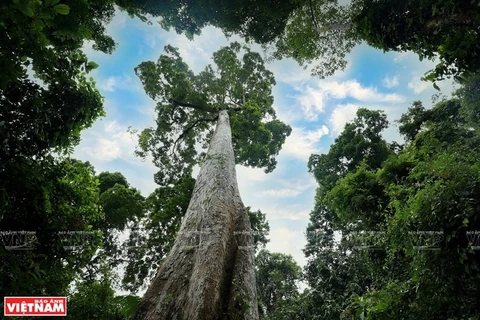
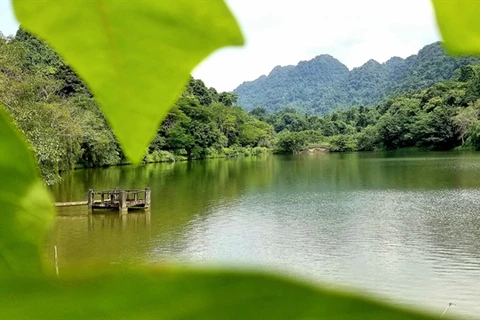
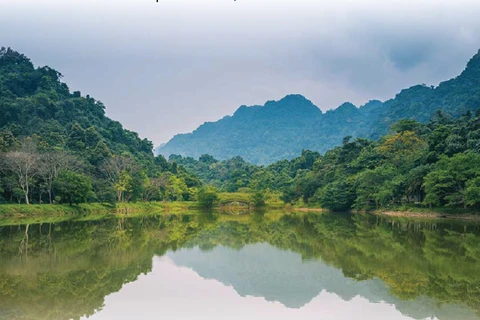
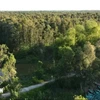
Cuc Phuong, Vietnam’s first national park, is situated in the Tam Diep Mountain Range, which spans over the territory of Ninh Binh, Hoa Binh, and Thanh Hoa provinces. (Photo: VNA)
 Covering 22,000 hectares stretching across Ninh Binh, Hoa Binh and Thanh Hoa provinces, Cuc Phuong is the first national park of Vietnam. For nearly 60 years since its establishment, Cuc Phuong’s preservation work has made great achievements and the national park itself is internationally recognised as the largest wildlife protection area in Southeast Asia.
With its limestone Karts topography, Cuc Phuong’s primary forest has value because of its archeology, paleontology and geology. Many archaeological sites have been discovered here, providing valuable insight into human history. The most notable of these are Con Moong cave and Ancient Man cave. In addition, many dry caves have been discovered and are now used for tourism hotspots. An initial survey also shows that Cuc Phuong mountains and forests still have many caves waiting to be explored by scientists and explorers.
The Cuc Phuong National Park is a tropical forest characterized by the ecological transitional between limestone mountains and common mountains. The forest area is mainly composed of layers of an evergreen tropical forest in the lowlands (under 500m) and low mountains (under 500m) that came from rocks and limestone. These types of flora and fauna exhibit the characteristics of karst topography and biodiversity.
It has long served as a research center for many conservation organizations, both national and international. According to surveys, Cuc Phuong has 2,234 floral species of 931 genera and 231 families. Included in these are 430 species of medicinal plants and 229 species of edible plants. 57 species are listed in the Vietnam Red Book of endangered species and also in the IUCN Red Book.
The fauna in Cuc Phuong is also very rich and diverse. Regarding vertebrates, there are 669 species from 120 families and 35 orders. These include 138 species of mammals, 337 species of birds, 80 species of reptiles, 48 species of amphibians, and 66 species of fish.
Cuc Phuong rivers and streams are home for some nowhere-seen-before species namely Niet Cuc Phuong fish (Pterocrypis cucphuongensis) and Cuc Phuong ear lizards (Tropidophorus cucphuongensis). Invertebrates in Cuc Phuong have 1,899 species from 169 families, 33 orders, 6 classes and 3 phyla. The insect class accounts for a large proportion such as 454 species of beetles, 378 species of lepidoptera and 314 species of membranous wings.
According to the national park’s director Nguyen Van Chinh, most of the community living around Cuc Phuong forest are Muong, an ethnic group with long-standing culture contributing greatly to the cultural identity of Vietnam. They have a strong connection to the forest spiritually and that connection drives them to protect the forest along with the management board of the National Park. Anyone who comes to Cuc Phuong can feel the pristine beauty of the primary forest.
Many domestic and international tourists going to Vietnam's first national park are astonished by Cuc Phuong’s vastness and mysterious atmosphere they call a “labyrinth of wonder”. As explained by Nguyen Van Chinh, “A million-year-old primary forest like Cuc Phuong certainly carries hidden and interesting things that await exploration. The limestone is barren, but growing on them is an ecosystem with thousands of different species of animals and plants. Obviously, it's a mystery and a wonder!”
Also, according to Chinh, who is determined to protect the diverse and rich ecosystem of Cuc Phuong, the national park management board has worked synchronously on three pillars. These are, combining forest protection with biodiversity conservation, fostering scientific research and international cooperation on conservation and promoting ecotourism in line with environmental education.
Floral conservation has been carried out in the Cuc Phuong National Park since 1985, with the establishment of a botanical garden of 167 hectares. The facility so far has gathered 811 species. Cuc Phuong Botanical Garden is considered the first methodically built botanical garden in Vietnam.
Currently, the Cuc Phuong National Park has three conservation programmes. These include endangered and rare primate rescue, carnivore and pangolin conservation and conservation of freshwater turtles and some other wildlife (deer, pheasants and monkeys). Currently the national park is protecting 64 species with 2,700 individuals.
Cuc Phuong has various wildlife rescue centers and programs. These rescue centers and programs are mostly located around the garden gate so visitors can easily visit them and learn more about Cuc Phuong’s conservation work. Such promotion is currently strongly pushed, especially in cooperation with local schools to improve environmental education for students.
Meanwhile, ecotourism is considered the main development direction of Cuc Phuong National Park. It is also the development strategy that Ninh Binh province has chosen for Cuc Phuong towards 2030.
Community-based tourism - the model that has developed strongly in Vietnam in recent years - has been in operation in Cuc Phuong since 2009, 2010. This is especially true in Muong villages located in the buffer zone such as Trac village (Lac Thinh, Yen Thuy, Hoa Binh communes) and Khanh village (An Nghia commune, Lac Son, Hoa Binh). Tourists will have a chance to discover the unique culture of the Muong, participate in cultural exchanges and learn about indigenous customs.
As Vietnam is focusing on recovering tourism damaged by the COVID-19 pandemic, the Cuc Phuong National Park has designed, introduced and operated various new ecotourism products to attract more visitors./.
VNA