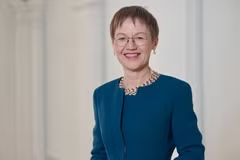
Danish Ambassador to Vietnam Nicolai Prytz (Photo: VNA)
Hanoi (VNA) – Duringan interview granted to the Vietnam News Agency on the occasion of New Year2024, Danish Ambassador to Vietnam Nicolai Prytz stressed Denmark is ready tosupport Vietnam in green transition.
Healso expressed his belief that the Green Strategic Partnership (GSP) will opena series of new opportunities and take Denmark-Vietnam bilateral relations to anew level.
Followingis the full text of the interview:
Reporter: What do you think aboutVietnam's economic development in 2023? In your opinion, what should Vietnam doto maintain economic growth in the coming years when it is predicted that theglobal economy will continue facing risks and challenges?
Ambassador Nicolai Prytz: In many ways,2023 was a difficult year for the global economy and being a largelyexport-driven economy, Vietnam obviously has not been immune from that – forexample, exports to the European Union and the USA was down by almost 10%.
Thishas primarily had an impact on the manufacturing sector, but has alsoinfluenced private consumption in Vietnam. Even though some improvements didoccur in the last part of the year, it seems reasonable to assume that some ofthese challenges will persist 2024 – but possibly to a lesser extent.
However,with an estimated economic growth of about 5% in 2023, it is safe to say thatVietnam – in spite of the abovementioned headwinds – have done quite wellcomparing to other countries. In fact, it is among the best performingeconomies in the region and the world.
Moreover,I am sure that many of these challenges are of a cyclical nature and thatVietnamese economy soon will be back on a plus 6% growth trajectory, asexternal demand recovers and gains further steam. The increasing inflow of FDIpoints to the same direction, as it reflects foreign investor’s high confidencein future economic growth in Vietnam.
Allthis being said, there are still things Vietnam could benefit from doing, inorder to address some of the structural challenges and make it even moreattractive for foreign investments. This includes improving of the businessenvironment and increasing productivity, upskilling of the labour force,digitalisation, etc.
Inorder to fuel continued economic growth, Vietnam also needs to develop it’s –already – constraint energy sector. Energy security and affordability arelegitimate concerns of the Vietnamese Government, but this needs to go hand inhand with the green transition.
Tothat end, Vietnam needs to make reforms and adopt firm policy measures in orderto create an enabling environment for foreign investments that can finance thegreen transition. If not, it could have a negative impact on attraction offuture FDI, as access to renewable energy increasingly is becoming pivotal forforeign investment decisions.
Reporter: Vietnam and Denmark haveannounced the establishment of the Green Strategic Partnership which opens anew chapter in the two countries' more than 50-year cooperation relations. Howwould you assess the prospect of bilateral cooperation relations after theGreen Strategic Partnership is established?
Ambassador Nicolai Prytz: Denmark andVietnam already have a very fruitful and mutually beneficial partnership cooperation,but I believe that the Green Strategic Partnership (GSP) will open a series ofnew opportunities and take our bilateral relations to a new level.
Onthe political level, we expect to see an increased number of high-level visitsbetween Denmark and Vietnam, which should intensify our policy dialogue onimportant topics, like climate change.
Onthe government-to-government technical cooperation, we already have a strongfoundation through our years of fruitful cooperation within our five strategicsectors: energy, food and agriculture, health, education and statistics. Thiswill obviously continue and be further enhanced by the GSP.
Finally,on the business-to-business level, the Embassy will continue serving as abridge to and encourage potential Danish companies to invest in Vietnam,particularly in the green transition.
Vietnamis only the fifth country that Denmark enters into GSP with – the others beingIndia, Indonesia, the Republic of Korea and South Africa – why it reflects thevery high priority we give to our bilateral relations with Vietnam.
Onecan argue, that we might have different starting points when it comes to thegreen transition and we are on different stages in our development, but it doesnot change the fact that we both aim for a common goal: A green, just andsustainable globe.
Thisalso means that Denmark within the framework of the GSP will continue tosupport Vietnam in achieving both its goals of becoming a high-income countryby 2045 and net zero carbon emissions by 2050. As the Danish experience hasshown, these two goals can indeed go hand in hand.
Reporter: Green transition is a currentglobal trend, and Vietnam has set the target of achieving net zero emissions by2050. How do you assess Vietnam's efforts towards that target? How can Denmarkfurther support Vietnam in this field?
Ambassador Nicolai Prytz: At COP 26, PrimeMinister Pham Minh Chinh of Vietnam committed to achieving net-zero emissionsby 2050, which sent a clear and positive signal to the world regarding Vietnam'sdirection and determination towards low-carbon and sustainable development.Since then, the Government of Vietnam has taken important measures.
InDecember 2022, Vietnam entered into the Just Energy Transition Partnership(JETP) with the International Partnership Group that consists of the G7countries, the European Union, Denmark, and Norway.
Subsequently,at COP28, Vietnam launched a Resource Mobilization Plan (RMP), which is animportant first step in the implementation of the JETP as it includes anassessment of priority investments. It also recognises the need to create anenabling environment that can attract the vast amount of private investmentthat is needed for the green transition.
Finally,it should be mentioned that the Vietnamese Government in the middle of lastyear, finally approved the Power Development Plan 8 (PDP8), which clearlyprioritises renewable energy as the source of energy to power Vietnam's futuregrowth.
Thechallenge now is to convert all these commitments into something much moretangible and real - like implementation plans, legal frameworks, etc. Vietnamis undoubtedly well positioned to lift this task, but it will require a firmcommitment from all relevant ministries.
Tothis end, in all modesty, I do believe that the ongoing Danish-VietnameseEnergy Partnership Program is very useful, as our cooperation focus on relevantaspects of the energy transition – e.g. long-term planning of the energysystem, efficient integration of wind and solar energy into the nationalelectricity system as well as improving energy efficiency in the industrialsector.
Asmentioned before, our two countries might be on different stages when it comesto the green transition and Vietnam, admittedly, is a much more complex countrythan Denmark (in terms of size, population, geography, etc.). The Danishsolutions and ideas might therefore not always be directly applicable inVietnam – but I do believe they can serve as useful guidance and inspiration.
Reporter: Not only the two Governments butthe business communities of both countries are also strongly engaging in thegreen transition. What does Vietnam need to do to attract more foreigninvestors, like Danish, in this transition?
Ambassador Nicolai Prytz: The privatesector plays a vital role in any country's green transition. It is privateinvestment - not public funding - that will be the main (financial) driver forthis transition.
However,in order for this to happen, the Vietnamese Government needs to approve clearambitious policies and legal frameworks that will create an enablingenvironment for potential investors in Vietnam’s green transition.
Toexemplify this, Danish investors are ready to invest huge amounts in offshorewind projects in Vietnam that potentially can power millions of localhouseholds, improve energy security while avoiding hundreds of million tons ofCO2 emissions – but investors need certainty.
Withthe clear policies and a proper legal framework in place, I have no doubt thatVietnam could become a regional hub for both offshore wind energy generation,but also play a crucial role in the regional supply chain for this kind ofprojects as it would bring along massive private sector investments in bothlocal production and re- and upskilling of labor.
Evenif we look beyond investors in the energy transition, there should be a strongincentive. As earlier mentioned, without access to renewable energy it will bedifficult for manufacturers to achieve a carbon neutral footprint, whichincreasingly seems to be an absolute prerequisite for offsetting products –e.g. textiles, footwear and electronics – in important markets like theEuropean Union and the USA.
Reporter: The Lunar New Year (or Tet)festival is a very important occasion for Vietnamese people. How do you feelabout the Tet atmosphere in Vietnam?
Ambassador Nicolai Prytz: I only assumedas Danish ambassador to Vietnam in September 2022, so I have only spent oneLunar New Year (Tet) here. Nevertheless, even with this modest experience, itstill left me with a very positive and profound impression.
Evenas a foreigner, it is hard not to feel happiness when you see how families meetand spend time together, while praying for their ancestors, good health andprosperity. Tet last year also added a culinary dimension to my experience inVietnam, as I had plenty of traditional food – even ’chưng’ cake.
Reporter: Thank you for the interview!