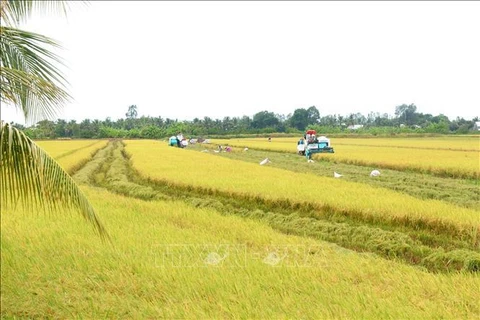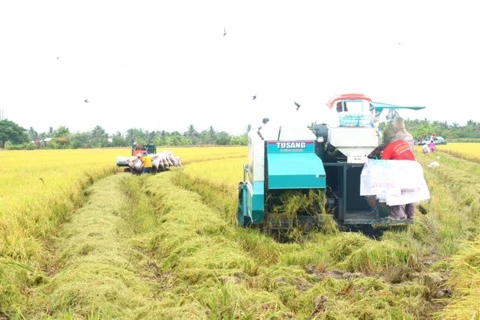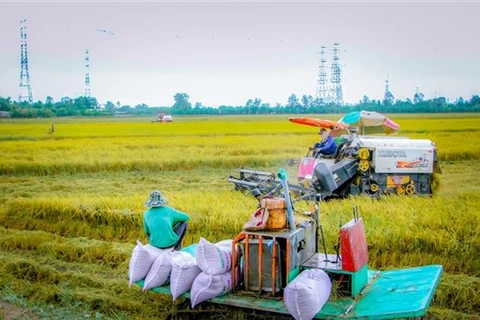
Hanoi (VNA) – Deputy Prime Minister Tran Luu Quang on July 17 requested the acceleration of the implementation of a project to develop 1 million hectares of specialised rice cultivation with high quality and low emissions associated with green growth in the Mekong Delta region from now to 2030.
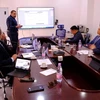
Speaking at a Hanoi meeting on the project implementation progress, Quang emphasised that it creates a new production method suitable for the world's production and consumption trends; and generates a breakthrough in agriculture thinking in the Mekong Delta, which is facing the effects of rapid and unpredictable climate change, thus contributing to improving the income and living conditions of farmers and businesses, and helping Vietnam realise its goal of achieving net zero emissions by 2050.
Agreeing with the opinions on the need to have the engagement of authorities in the central level, localities, farmers, and businesses in implementing the project, the Deputy PM required the Ministry of Agriculture and Rural Development (MARD) to keep the coordinating role, proactively handle the work under its authority, and report to the Prime Minister on issues beyond that.
Regarding borrowing loans from the World Bank (WB), the ministry must clarify investment items and work contents to ensure consistency, no duplication, and no overlap with other projects underway in the region, Quang added.
MARD Deputy Minister Tran Thanh Nam told the meeting that to carry out the project, his ministry has established a steering committee to oversee the project implementation. This committee includes representatives from the Ministry of Planning and Investment, the Ministry of Finance, the Ministry of Natural Resources and Environment, the State Bank of Vietnam, the World Bank, and 12 Mekong Delta localities.
The ministry has developed a technical process for producing high-quality, low-emission rice in the region and a plan to enhance capabilities for partners and agricultural cooperatives in developing value chain linkages under the project. It has also collaborated with localities to review the current status of production areas, infrastructure, production organisation and farming practices, and assess the situation of cooperatives in the Vietnam - Sustainable Agriculture Transformation Project in the 2015-2022 period.
Currently, the MARD is working with the WB and the 12 localities to finalise a loan project on infrastructure and technical support for high-quality, low-emission rice in the Mekong Delta region, Nam said.
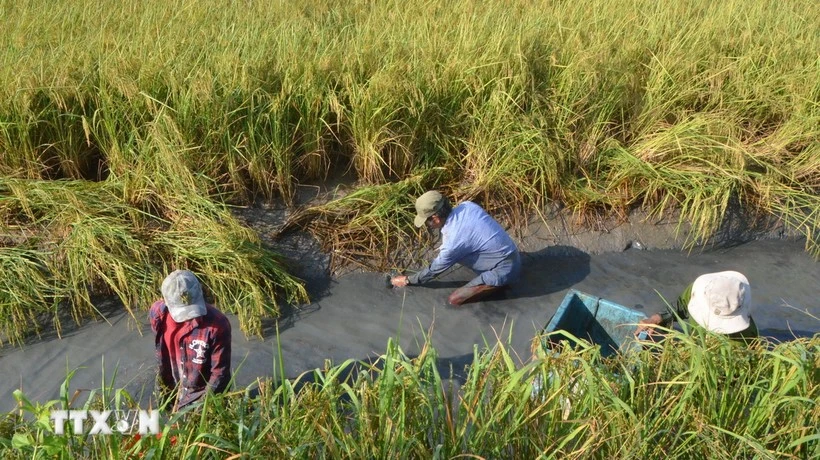
According to the official, the ministry has implemented seven pilot models in Can Tho city, and Dong Thap, Kien Giang, Tra Vinh, and Soc Trang provinces.
Initial assessments show that the rice farming model under the project during the 2024 Summer-Autumn crop in Can Tho has yielded positive results. Input costs have decreased by 10-15%, including those in seed, fertilisers, and irrigation water. The yield of the pilot model ranged from 6.13-6.51 tonnes/ha compared to 5.89 tonnes/ha in the normal one, while its profits reached 21-25.8 million VND (830-1,020 USD)/ha, surpassing the normal model by 1.3-6.2 million VND/ha.
Moreover, the pilot model contributed to reducing CO2 emissions by 2 tonnes/ha compared to the model that removes rice straw from the fields and by 12 tonnes/ha compared to that practicing rice straw burial after harvesting. Importantly, many businesses have committed to purchasing all rice produced under these pilot models.
As Vietnam is the first country in the world to have a large-scale project on rice production towards sustainable growth and emissions reduction, it is facing a lot of difficulties, Nam said, proposing the Government submit to the National Assembly a resolution to pilot certain specific policies regarding the use of official development assistance (ODA) and concessional loans from foreign donors during the legislature’s plenary session in October.
Additionally, the ministry recommended that the Government allow the ministry to collaborate with the Asian Development Bank (ADB) to prepare a project for a 270-million-USD loan and to support the implementation of the project./.