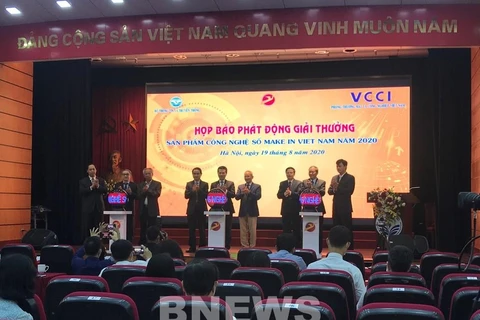
The Vietnam Smart City Awards 2020 honoured localities and firms for contributions to smart city development. (Photo courtesy of VINASA)
 Hanoi (VNA) - Digital technology had crept into all areas of smart cities and directly contributed to improving management efficiency and urban development.
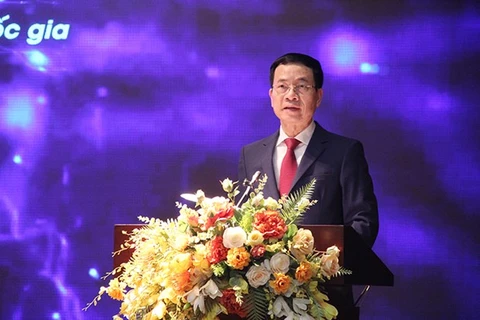
Nguyen Huy Dung, deputy minister of information and communications, made the statement at the 4th Smart City Summit 2020 held in Hanoi early this week.
Organised by the Vietnam Association for Software and IT Services (VINASA), the event attracted some 1,000 attendants through virtual forms in 27 provinces and cities nationwide.
Dung said the project to develop smart and sustainable cities in Vietnam from 2018-25 period with a vision to 2030 was approved by the Prime Minister in August 2018. The project clarifies principles for building smart cities in the country as well as key tasks for each period.
In addition, the national digital transformation programme by 2025 with a vision to 2030 approved in June 2020 sets a target of developing a digital Government, the economy and society while establishing local digital firms in the world market.
He said the development of a smart city included the implementation of a digital government, digital economy and digital society.
Going "smart" was a development trend for all cities around the world and the Vietnamese Government had always emphasised that the development of smart cities was a breakthrough necessary for improving national competitiveness.
He added that from a policy perspective, smart cities would be a place for the pilot implementation of new services, models and policies through the use of new digital technologies.
In recent years, the ministry had proactively co-ordinated with relevant ministries, localities and several international agencies from Singapore and the Republic of Korea to enhance smart city development, he added.
The 2020 Smart City Summit was a great opportunity for management agencies, experts, speakers and enterprises from home and abroad to share and contribute their valuable experience in the building and development of smart cities, he said.
The MIC had promulgated an ICT reference framework for smart city development which was the basis for localities to build ICT architecture and deploy digital infrastructure for local smart city development.
Smart cities had been out front in applying the achievements of the Fourth Industrial Revolution, he said.
There were many important factors in developing a smart city. However, infrastructure, an ICT platform and digital technology were considered key.
The deputy minister committed to accompany localities and the digital business community in developing smart cities in Vietnam, thus contributing to nationwide digital transformation.
Truong Gia Binh, VINASA’s chairman, said smart cities were a vital trend and an optimal solution to resolve the issues of rapid urbanisation. It would help urban areas maximise resources towards sustainable development, while better protecting the environment.
“The building of smart cities needs the participation of the Government, authorities, businesses and people,” Binh said.
Experts said Vietnam had proactively joined smart city networks in the region and around the world.
Vietnam has three cities that have joined the ASEAN smart city network since 2018 and nearly 40 localities implementing smart city models.
However, experts also pointed out that the actual implementation showed there were still many difficulties and challenges for city leaders, management agencies and businesses.
Nguyen Nhat Quang, VINASA’s vice chairman and chairman of Hai Hoa Software Technology Company, said in the context of Industry 4.0, building smart cities meant integrating digital technology to build a livable city. Technical solutions must be combined with construction and management solutions to maximise efficiency.
“The building of smart cities should ensure smart planning and follow technical standards,” Quang added.
Tran Quoc Thai, director of the Department for Urban Development under the Ministry of Construction, said they would focus on building a legal foundation and establishing and operating a database on digital urban spaces, while applying sustainable smart city planning./.
VNA