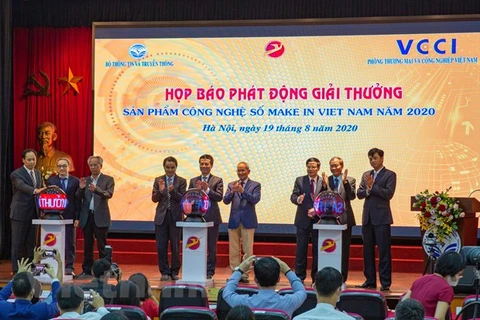
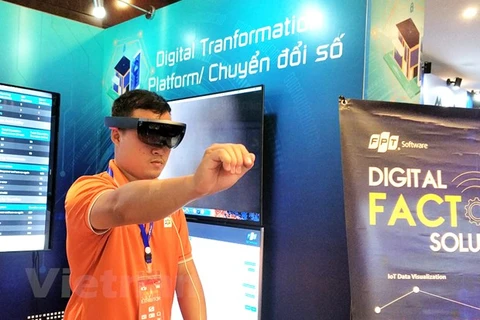
Many banks are competing in the race of digital banking (Photo: Contributor/ VietnamPlus)
Hanoi (VNA) – Right in the first week after the app electronic know your customer/client (e-KYC), the Tien Phong Commercial Joint Stock Bank (TPBank) has seen nearly 5,000 customers registering to open their accounts through the bank’s mobile app.
Heat from digital transformation
Just in one month, the banking market of Vietnam witnessed two big events – Vietcombank introduced the digital banking service VCB Digibank, and BIDV launched the digital transformation campaign.
In the history of the Vietnam commercial bank system, major members such as Vietcombank and BIDV have operated for more than a half of a century, with their total assets many times higher than private ones. Therefore, the digital transformation that has been kicked start by these big banks is expected to heat up the market.
However, with larger view to the market, the digital transformation from these “giants” seems to be slower than private joint stock banks with smaller scales but higher dynamism in technological application.
TPBank is one of the examples. The bank has become one of the first banks in Vietnam to successfully launch the e-KYC on its mobile app. This is a milestone marking the outstanding performance of the bank in digitalising its customer services compared with others.
The eKYC solution allows TPBank to overcome all geographical and time barriers to identify 100 percent of online customers based on biometrics without face-to-face meetings as per the current process.
Customers can register for an account and make transactions only with a smartphone.
The bank has completed the whole e-KYC process on mobile app to the step of highest identification thanks to video call technology, ensuring the same level of accuracy of verification of information compared with face-to-face meeting. In Vietnam, only TPBank has reached this step and become ready to put it into use right after a relevant legal corridor is completed.
While many banks have only started to strengthen their digital transformation campaign, TPBank’s digitalisation has reached a new level. Its e-KYC technology allows customers to use banking services in a fastest and most simple way at anytime and anywhere.
Right in the first week after e-KYC was launched, nearly 5,000 customers have opened their accounts through the TPBank app easily. The figure showed that e-KYC has met the demand of customers, especially young customers who are familiar with technology and love convenience and simplicity.
 TPBank has become a pioneer in digitalisation (Photo: Contributor/VietnamPlus)
Advantages of pioneers
Explaining why e-KYC of TPBank draws that a large number of customers, Pham Tien Dung, Director of the Payment Department under the State Bank of Vietnam (SBV), said that the SBV describes e-KYC as the “ticket” for banks to digitalisation, which has been owned by TPBank for four years before the technology is applied in its 24/7 LiveBank, becoming the first bank in Vietnam to make it. TPBank customers have been able to open their bank accounts at any time without having to come to the bank during working hours.
Thanks to its experience in implementing and operating e-KYC from LiveBank, TPBank General Director Nguyen Hung said that it does not take the bank much time to promote it on mobile platform, while the bank can predict and minimise risks arising on the app.
This is also a result of the decision to chose digital transformation strategy and the vision that the bank made in 2015, said Hung, adding that each year, TPBank set aside 25-30 percent of its budget for technology. But more importantly, the approaching to source technology has been implemented at an early time and in a continuous manner, along with the personnel strategy and the setting up of procedures and the enriching of experience, he said.
As a result, the ratio of transactions through the digital banking service at TPBank rose to 83 percent at the end of June 2020 from 72 percent in late 2018. The ratio of transactions made at the same time has also been up from 66 percent to 72 percent, he said.
From the case of TPBank, it can be seen that the early selection of digital transformation strategy and the fast development of digital banking will help shorten the process. Those who come first will have more opportunities to win the market share. In the first six months of this year, TPBank saw a considerable rise in the number of new customers as well as current and saving accounts (CASA).
In the future, Hung said that the bank will apply new and more updated technologies with the increase use of artificial intelligence (AI), machine learning as well as blockchain and Big data and the use of robot to increase labour productivity and operational efficiency./.