Customers buy dragon fruits at a Big C supermarket in Hanoi. The fruit is being sold at 15,500 VND per kilo, two to three times lower than on normal days. (Photo: VNA)
 Hanoi (VNS/VNA) - Local authorities and businesses are making efforts to promote domestic consumption of agricultural products, which are piling up due to the impact of novel coronavirus outbreaks in China.
Export turnover is forecast to decrease in the first quarter of this year due to the epidemic and subsequent impact on trade.
According to Nguyen Bich Lam, General Director of the General Statistics Office (GSO), exports are estimated to fall 21 percent to 46.5 billion USD in the first quarter. Items including agricultural products, seafood, wood products and garment and textile products are likely to be the worst hit.
Exports to China are predicted to reach 5.6 billion USD, declining by 25 percent year-on-year, with agricultural and wood products affected.
Insiders said that the agricultural sector is estimated to be most damaged by the epidemic from China, including dragon fruit, watermelon, seafood, wood and rice. However, it’s also an opportunity to change production and business methods to adapt to new challenges and difficulties, including those caused by the spreading of new strain of coronavirus (nCoV-2019).
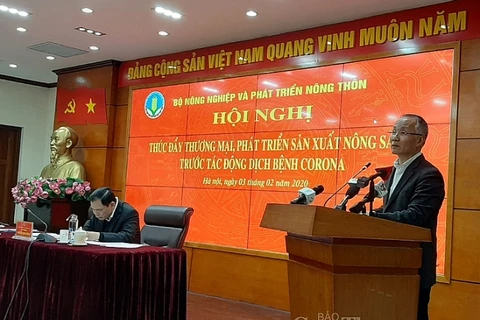
Minister of Agriculture and Rural Development Nguyen Xuan Cuong said it’s necessary to develop both short- and long-term scenarios.
“In order to take advantage of opportunities, it’s necessary to develop large-scale production and co-operation chains to find other directions for agricultural outputs,” Cuong said.
Cuong added: "If there was no coronavirus, there would be other problems. Therefore, we need to be alert, not afraid of the disease. This situation poses challenges for us, requiring strong solutions to cope with it.”
Nguyen Ton Quyen, former vice president and general secretary of the Vietnam Association of Wood and Forest Products, said shipments of woodchips to China have dropped due to the virus. “However, I see that it’s a chance for local businesses to develop production of artificial boards and medium-density fiberboard made of woodchips.”
“In the last two weeks, four Vietnamese woodchip manufacturers have bought machines to produce artificial boards,” Quyen said.
Quyen also proposed the State to consider supporting such businesses with interest rates and helping them complete production lines to take advantage of the opportunity.
Deputy Chairman of the Vietnam Fruit and Vegetables Association Dinh Cao Khue said as the epidemic broke, the operation of businesses exporting goods to China stopped completely.
“Some businesses lost deposits of 100-200 million USD because they could not sell goods, while others bought goods from farmers and kept them in stock because they wanted to keep their prestige,” Khue said.
Khue said the association is promoting exports to other countries. However, the governments of some countries have warned citizens to avoid crowds, meaning fewer people were going to the market and shopping.
Khue said coconuts could be preserved for 75 days, while red dragon fruits and white dragon fruits can keep for 15 days and 45 days, respectively.
“With such times, I expected the Ministry of Agriculture and Rural Development to supply updated information about the customs clearance of goods in the border area between Vietnam and China,” Khue said.
“We also need prediction on the purchasing power of the Chinese when trade is re-opened,” he added.
As for seafood, Deputy General Secretary of the Vietnam Association of Seafood Exporters and Producers Nguyen Hoai Nam said the industry has not seen any cancellation of orders due to coronavirus, but there were several delays or order adjustments.
“Our difficulty now is that some cruises have temporarily stopped receiving containers of goods to China,” Nam said.
“Enterprises exporting to China are currently stockpiling, suffering high costs for warehouses. In China, there are many firms directly selling Vietnamese seafood to restaurants, however when the restaurant system stops buying or reduces the volume of seafood purchases, these firms are forced to stop importing seafood from Vietnam because they do not want to pay the cost of storing goods,” Nam said.
“I see a number of opportunities here. Firstly, the demand for frozen and canned products will increase because many people do not want to eat fresh products during the outbreak. Secondly, China is one the biggest five sellers of tuna in the world. Many countries will cut or reduce the import of Chinese tuna, so it’s time for Vietnamese firms to expand the export of tuna, increasing market share,” he added.
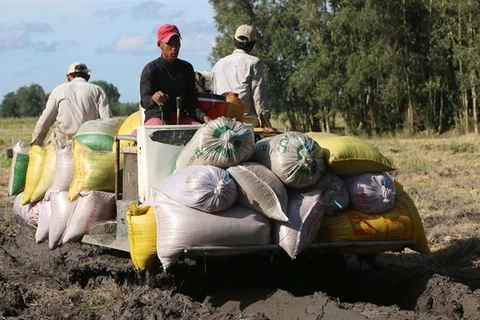
In terms of the rice industry, Bui Thi Thanh Tam, General Director of the Northern Food Corporation, said five or six years ago the Chinese market was Vietnam’s biggest but it’s now different. Vietnam has expanded to many different markets, so the import value of China is no longer dominant in Vietnam’s rice industry.
“The coronavirus epidemic does not impact our rice industry much,” Tam said.
Deputy General Director of Central Group Nguyen Thi Phuong said the group is focusing on buying agricultural products from farmers in provinces of Binh Thuan, Gia Lai, Khanh Hoa, Long An and Tien Giang.
“This supporting programme has been carried out at all 37 Big C supermarkets and GO! nationwide, lasting until the situation is controlled. We expect to consume about 80 tonnes of dragon fruit and watermelon per day, helping farmers stabilise their production while customers can enjoy fresh fruits,” Phuong said.
At Big C and GO! supermarkets in the northern region, watermelon is sold at 6,200 VND per kilo while dragon fruit at 15,500 VND per kilo. In the southern region, the fruits are priced at 4,900 VND and 10,900 VND per kilo, respectively. These prices are two to three times lower than those on normal days.
“The demand for agricultural products is very high in our supermarket chain. At this time, we are committed to providing as maximum support as we can.”
“We proposed the Ministry of Agriculture and Rural Development inform us of agricultural products which are in stock, to set up proper marketing programmes,” Phuong said./.
VNA